Original Series / Visual Study
Marrakech, Morocco | Original Series Gallery Canvas
Regional Dossier

MARRAKECH, MOROCCO | "المدينة الحمراء, The Red City"

Marrakech is the most sensory-intense city in North Africa, a medieval imperial capital of one million people at the foot of the High Atlas Mountains where the 12th century Koutoubia minaret, the souks of the medina, the tanneries of the Chouara, and the extraordinary evening theater of the Djemaa el-Fna square create an urban experience of such concentrated cultural vitality that the square itself has been inscribed by UNESCO as an Intangible Cultural Heritage of Humanity. The city was founded in 1062 CE by the Almoravid dynasty and served as the capital of an empire stretching from Morocco to Spain, accumulating the mosques, madrasas, and palaces of the Almoravid, Almohad, Saadian, and Alaouite dynasties over nine centuries of successive imperial ambition. The medina walls, built of pisé (rammed earth) and painted the specific terracotta-rose that gives the city its name, enclose a 1,000-year urban landscape of such complexity that the traditional Berber, Arab, Jewish, and sub-Saharan African communities that built it are still legible in the layout of the neighborhoods.

The colors are the specific palette of a Saharan-edge imperial city: the deep terracotta-rose of the pisé medina walls that gives Marrakech its name, the brilliant blue of the Majorelle Garden against the amber light of the High Atlas, the deep gold of the Saadian Tombs marble catching the afternoon light through the latticed windows, and the extraordinary amber-to-violet of the Djemaa el-Fna at dusk when the food stalls ignite their gas lanterns and the square transforms from a market into the most theatrically lit public space in the world.

Select Size
Museum-Grade Canvas
Ready to Hang
Made to Order · Ships in 3–5 Days (U.S.)
Add to the collection for /

$65.00

Finding the Stillness

It's hard to put the "vibe" of a place into words, so we put together a few images that we think show the quiet side of Marrakech, Morocco. These are the textures and small moments we've archived to capture the stillness of this corner of the world.

Marrakech, Morocco visual study 01
Marrakech, Morocco / No. 01 via Paul Macallan
The iconic Koutoubia Mosque stands tall against a breathtaking backdrop of the snow-capped Atlas Mountains, capturing the timeless soul of Marrakech. Bathed in warm sunlight, the city's signature terracotta rooftops and lush palm trees create a perfect harmony between vibrant urban history and serene natural grandeur. It’s a peaceful reminder of the beautiful contrasts our world holds, inspiring a quiet sense of wonder and wanderlust.
Marrakech, Morocco visual study 02
Marrakech, Morocco / No. 02 via Frida Aguilar Estrada
Vibrant teal and rich textiles breathe life into the warm, sun-baked clay of this traditional market courtyard. Surrounded by ancient earthen architecture and meticulously crafted local wares, the scene captures a quiet moment of cultural beauty and artistic heritage. It is a peaceful invitation to explore the deep stories, craftsmanship, and timeless charm woven into the heart of the desert.
Marrakech, Morocco visual study 03
Marrakech, Morocco / No. 03 via Abdou Faiz
The breathtaking symmetry of intricate stucco carvings and vibrant zellij tilework frames a peaceful courtyard, showcasing the pinnacle of Moroccan craftsmanship. As sunlight dances across the central reflection pool, the majestic archways invite a quiet moment of awe and contemplation. It is an inspiring tribute to the timeless devotion, artistry, and architectural beauty that bridges the past with the present.

Where to wander

Archival Note: A curated field study of Marrakech, Morocco, prioritizing cultural relevance and archival merit. These locations have been meticulously researched and vetted to ensure they represent the most authentic atmosphere for your own expedition.

Local Cuisine Spotlight
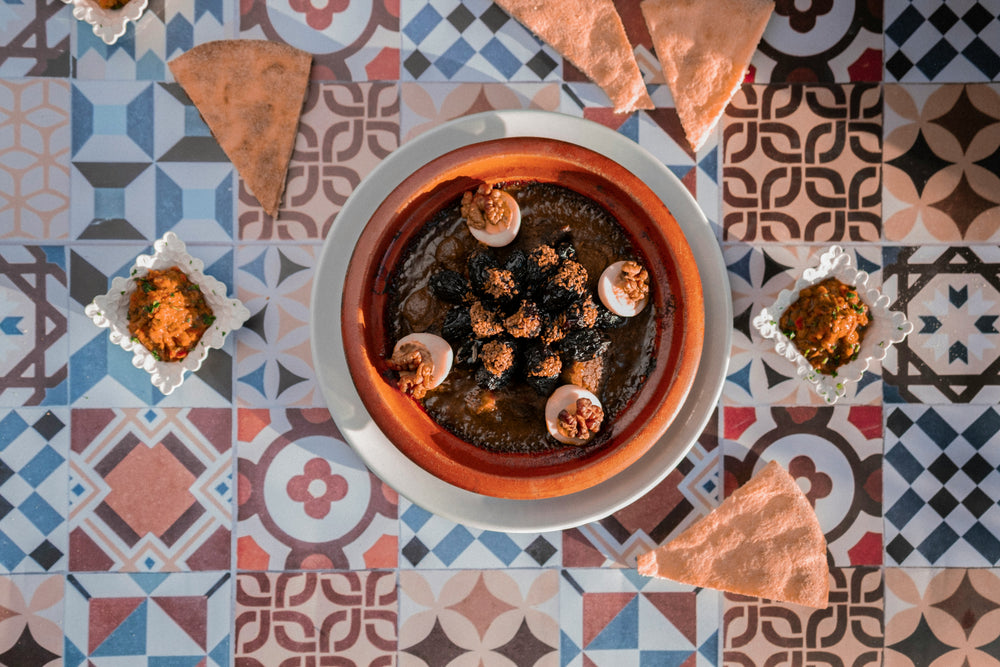
A beautifully slow-cooked tagine takes center stage, adorned with rich prunes, toasted walnuts, and boiled eggs in a celebration of traditional Moroccan flavors. Set against a vibrant backdrop of intricately patterned mosaic tiles and accompanied by fresh flatbread, this overhead view captures the warm, welcoming spirit of shared meals. It is an inspiring reminder of how culinary traditions bring people together, offering a peaceful taste of rich heritage and heartwarming hospitality.
Credits: HAMZA NOUASRIA
Local cuisine study in Marrakech, Morocco

☕︎ Local Flavor

Authentic Moroccan Food Walking Tour & Dinner

Rating: 5★ | Price: $$ | Coordinates: 31.6258° N, 7.9892° W

Navigate the food geography of the medina with a local guide who knows the specific stall for kaab ghzal (gazelle horn pastries filled with orange-blossom almond paste), the harira vendor whose broth has been simmering since morning, and the msemmen maker in the alley behind the spice souk. Ten stops across the old quarter culminate in a rooftop dinner of tagine and Rāʼib yogurt above the rooftops. This is the fastest way to acquire a working map of what and where to eat for the rest of your stay.

View Entry Details

Moroccan Cooking Class with Souk Market Visit

Rating: 4.9★ | Price: $$$ | Coordinates: 31.6290° N, 7.9874° W

A morning in the spice souk to source ras el hanout, preserved lemon, and saffron, followed by a private kitchen session decoding the layered logic of a slow-cooked tagine and a vegetable couscous. The curriculum covers the difference between a Marrakchi and a Fasi table, the technique of steaming couscous three times over the broth, and the reason Moroccan cuisine uses cinnamon in savory cooking. The meal at the end — which you made — is one of the best lunches the city offers.

View Entry Details

Nomad Restaurant

Rating: 4.8★ | Price: $$$ | Coordinates: 31.6313° N, 7.9866° W

A rooftop kitchen above the Souk des Babouches that has become the clearest expression of what modern Moroccan cooking looks like when it takes its own tradition seriously. The menu documents the country’s culinary geography — m’hanncha pastry reinterpreted with dark chocolate, a camel burger that is better than it has any right to be, the beef and preserved lemon tagine that is the standard against which every other tagine in the medina must be judged. The terrace looks out over a roofscape of television aerials and zellige domes. Order the virgin mojito made with fresh Moroccan mint.

View Entry Details

Le Jardin

Rating: 4.7★ | Price: $$$ | Coordinates: 31.6328° N, 7.9893° W

A 16th-century riad in the Mouassine district whose ground-floor garden — mango trees, olive trees, a central fountain — operates as an open-air dining room in the middle of the densest part of the medina. The menu is light Moroccan and Mediterranean: fresh salads, grilled fish, and cold-pressed vegetable dishes that provide a necessary counterpoint to the richness of the souk food outside. Coming here at midday, when the alley outside is at peak noise and the garden is cool and shaded and entirely quiet, is one of the finest transitions the city offers.

View Entry Details

🛌︎ Boutique Stays

La Mamounia

Rating: 4.9★ | Price: $$$$ | Coordinates: 31.6225° N, 7.9934° W

Set within thirty acres of walled gardens adjacent to the Koutoubia Mosque, this palace hotel has defined the gold standard of Moroccan luxury since 1923. Its restored interiors — a commission by Jacques García — blend Art Deco geometry with intricate zellige tilework and cedarwood ceilings in a synthesis that no other property in the city has replicated. Churchill painted here. The pool terrace at dusk, when the city’s ochre walls catch the last light and the call to prayer rises from the mosque, is the most atmospheric single moment Marrakech offers.

View Entry Details

Royal Mansour Marrakech

Rating: 4.9★ | Price: $$$$ | Coordinates: 31.6278° N, 7.9904° W

Commissioned by King Mohammed VI and built by the royal craftsmen of the Médérsa tradition, this private-riad compound holds fifty-three individual riads connected by underground corridors so that guests never cross paths unless they choose to. The craftsmanship is genuinely incomparable — tadelakt walls, hand-carved stucco ceilings, and mosaic fountains executed to standards that no commercial contractor could achieve. It is not a hotel so much as a living demonstration of what Moroccan artisanry looks like when money is no object.

View Entry Details

IZZA Marrakech

Rating: 4.8★ | Price: $$$ | Coordinates: 31.6315° N, 7.9853° W

Seven adjoining 16th-century medina riads reimagined as a fourteen-room literary sanctuary in the heart of the souk district. Each room is named for a friend of Marrakech — Jack (Kerouac), Yves (Saint Laurent), Winston (Churchill) — with vintage editions carefully placed on writing desks and zellige-tiled wet rooms that feel genuinely architectural rather than decorative. The courtyard is one of the most beautiful in the medina, and the rooftop is a quiet platform above the chaos of the souks below.

View Entry Details

Riad L’Atelier

Rating: 4.8★ | Price: $$$ | Coordinates: 31.6323° N, 7.9841° W

A boutique riad in the northern medina built around three tranquil courtyards and an onsite art gallery whose rotating exhibitions draw from the city’s community of resident painters and photographers. The natural and airy design — whitewashed walls, woven textiles, hand-thrown ceramics — provides a quiet counterweight to the sensory intensity of the souks outside. Arrivals are met at the medina gate and guided in on foot, which is still the only way to reach it.

View Entry Details

📍︎ Field Study

Djemaa el-Fna

Rating: 5★ | Price: $ | Coordinates: 31.6258° N, 7.9892° W

The greatest public square in the world, and the one that most rewards doing nothing. By day it is chaotic and human — acrobats, henna artists, men with monkeys, orange juice vendors. By dusk it transforms into the largest open-air restaurant on earth: two hundred smoke-filled food stalls materializing from nothing, the air thick with cumin and charcoal and the sound of a hundred competing musicians. UNESCO designated it a Masterpiece of Intangible Cultural Heritage not because of any building but because of the daily performance that has never stopped happening here for a thousand years.

View Entry Details

Jardin Majorelle & Musée Yves Saint Laurent

Rating: 5★ | Price: $$ | Coordinates: 31.6418° N, 7.9999° W

Jacques Majorelle spent forty years building this two-and-a-half-acre botanical garden, and the cobalt blue that covers its walls — Majorelle Blue, a pigment he patented in 1937 — is one of the most precise pieces of color theory in garden design. Yves Saint Laurent bought it in 1980 to save it from developers, and the garden now contains his ashes. The adjacent YSL museum documents one of fashion’s great archives in a building that is itself a serious work of architecture. Go at 8:30 AM when it opens.

View Entry Details

Marrakech Medina & Souk Walking Tour

Rating: 5★ | Price: $$ | Coordinates: 31.6305° N, 7.9872° W

The medina of Marrakech is a UNESCO World Heritage Site and one of the best-preserved medieval urban environments on earth — but it is also genuinely disorienting in a way that is part of its design logic, not a flaw. Walking its fourteen kilometers of alleyways with a guide who knows the geography of craft — which derb leads to the dyers, which turn takes you to the brass souk — transforms the labyrinth from overwhelming to navigable. The Bahia Palace, the Saadian Tombs, and the Ben Youssef Médérsa are each worth pausing for.

View Entry Details

Atlas Mountains Day Trip & Berber Villages

Rating: 4.9★ | Price: $$$ | Coordinates: 31.2197° N, 7.9398° W

The High Atlas begins one hour south of Marrakech and reaches 4,167 meters at Jebel Toubkal, the highest peak in North Africa. A day trip into the Ourika Valley or the Ait Benhaddou corridor puts you inside a landscape of pise fortresses, walnut orchards, and Amazigh (Berber) villages that operate on a completely different calendar from the city. The descent back into Marrakech at dusk, when the pink mountains dissolve behind the city’s silhouette, is the best possible way to end a day in Morocco.

View Entry Details

Typography

Archival Note: A formal technical study of Marrakech, Morocco, archiving the coordinates, elevation, and environmental data that define the region. This data serves as a vital record for our ongoing global field study, providing the technical foundation behind every atmospheric detail captured in our visual work.

Botanical and pigment specimen study for Marrakech, Morocco Colors of Marrakech, Morocco
Coordinates
31.6295° N, 7.9811° W — Southern Morocco, High Atlas foothills, Haouz Plain
Historical Epoch
Almoravid Dynasty, founded 1062 CE by Yusuf ibn Tashfin
Elevation
454 m / 1,490 ft, oasis city on the Haouz Plain at the foot of the High Atlas
Atmosphere
Semi-Arid (BSk), hot dry summers, mild Atlas winters
Observation Hour
06:00 AM, First call to prayer from the Koutoubia over the still medina
Primary Pigment
Medina Terracotta (#C0614A) and Majorelle Blue (#6050DC)
Best Time to Visit
March through May, September through November, the Atlas-cooled air keeps the medina comfortable, the souks are navigable, and the mountain day trips are at their most beautiful
Avoid Visiting
June through August, the medina reaches 38°C+ with intense humidity trapped in the narrow lanes, and the Djemaa el-Fna becomes oppressive at midday

Behind The Scenes

Nathan

Note from the Founder

Hey, did you know this fun fact about Marrakech, Morocco? The medina of Marrakech was declared a UNESCO World Heritage Site in 1985 and contains one of the best-preserved medieval Islamic urban environments on earth.
Thank you for exploring the Marrakech, Morocco series with us. We hope these notes have inspired you to add this incredible destination to your own passport—we are so glad you're here. — Nathan

Some of our Favorites