The Pokhara Collection

Phewa Lake Colorful Boats, Pokhara canvas
No. 1

Phewa Lake Colorful Boats

Bring Himalayan Calm Home

Prints from$29· Canvas from $65

Phewa Lake Pagoda Pokhara, Pokhara canvas
No. 2

Phewa Lake Pagoda Pokhara

Bring Himalayan Calm Home Daily

Prints from$29· Canvas from $65

World Peace Pagoda Pokhara, Pokhara canvas
No. 3

World Peace Pagoda Pokhara

Daily Himalayan Peace at Home

Prints from$29· Canvas from $65

Annapurna Range Sunrise Pokhara, Pokhara canvas
No. 4

Annapurna Range Sunrise Pokhara

Daily Himalayan Calm at Home

Prints from$29· Canvas from $65

Phewa Lake Annapurna Panorama, Pokhara canvas
No. 5

Phewa Lake Annapurna Panorama

Wake to Himalayan Calm Daily

Prints from$29· Canvas from $65

Annapurna Range Prayer Flags, Pokhara canvas
No. 6

Annapurna Range Prayer Flags

Daily Calm of the Himalayas

Prints from$29· Canvas from $65

The Complete Pokhara Set

Hang all six together, the way they were made to be seen

Click any canvas to see that pieceTap any canvas to see that piece

Always adding new places

Missing your favorite spot in Pokhara, Nepal?

This collection grows every week. Tell me the place, the view, or the corner you'd want on your wall, and I'll add it to the list.

I read every one, and I'll only email you about your request.

In Real Homes

On real walls

Every canvas is printed to order and hung by people like you. Here’s how they look at home.

Keep Exploring

Your Next Stop in Nepal

The Spirit of the Land

Archival Note: A curated field study of Pokhara, Nepal, prioritizing the specific atmospheric stillness of the region. These artifacts have been meticulously sourced from our global archival partners to represent the area's unique cultural frequency and environmental character. This selection serves as a formal observation for our ongoing global archive, vetted for its visual accuracy and archival merit.

Pokhara, Nepal study No. 01
Pokhara, Nepal / 01 VIA / Anish Acharya
The island sits peacefully in the center of the lake, its cluster of trees and structures reflected in the glassy water below. The evening light casts the distant mountains in layers of blue, while warm clouds drift across the sky, creating that serene moment just before twilight when the world feels still and contemplative. The water's gentle ripples catch the fading daylight, making the entire scene feel both timeless and intimately present.
Pokhara, Nepal study No. 02
Pokhara, Nepal / 02 VIA / Aui Vimuktanon
The diffused light filters through the canopy of this centuries-old banyan tree, casting dappled shadows across the peaceful street below. Standing here would feel serene and timeless, enveloped by the cool shade and the weight of history radiating from the enormous gnarled trunk. The quiet street and sparse activity create an intimate moment frozen between the tree's ancient presence and the modern world just beyond its reach.
Pokhara, Nepal study No. 03
Pokhara, Nepal / 03 VIA / Nishess Shakya
This landscape captures Pokhara's dramatic contrast between the golden rice fields in harvest season and the snow-dusted Himalayan range beyond. The image reveals the intricate layering of the valley, cultivated flatlands transitioning to dense green forests that blanket the intermediate hills. Often overlooked is the subtle texture of the harvested crops creating a woven pattern across the foreground, which grounds the composition and emphasizes the scale of the mountains.
The Story Behind the Art

The Real Pokhara

More than a shop, each page is an immersive guide to the real Pokhara: local tips and tricks, the language you'll hear, where to eat, stay, and explore, the lay of the land, and a fun fact to carry home — every canvas mapped to the very spot it was captured.

Pokhara, Nepal | Where the Himalayas Meet Still Water

Pokhara sits at the edge of Phewa Lake like a long exhale, the Annapurna range rising so suddenly behind the city that first-time visitors often stop mid-sentence just to stare. It is a town that has long welcomed those arriving on foot from the mountains, and that spirit of open-armed rest runs through every teahouse and lakeside path. The old Newari trading culture left its fingerprints on the architecture, while generations of trekkers and monks passing through gave the place a wonderfully layered, unhurried character. Light here is theatrical, bouncing off the lake in the morning and draping the peaks in amber and rose as the sun drops behind the ridgeline each evening.

The watercolor palette of Pokhara draws from two worlds meeting in one frame: the deep glacial blue-green of Phewa Lake blending into mist-softened grey-violet for the distant Himalayan snowfields, while the foreground fills with the warm ochres and terracotta reds of lakeside rooftops and monastery walls. Himalayan pine green threads through the hills and the wet season deepens every tone to something almost luminous, turning the valley into a painter's dream of saturated, layered color.

We hope you love getting lost in Pokhara through the art above — and that one of these canvases finds a home on your wall. Happy travels, from all of us at The Painted Passport.
Where to wander

Archival Note: A curated field study of Pokhara, Nepal, prioritizing cultural relevance and archival merit. These locations have been meticulously researched and vetted to ensure they represent the most authentic atmosphere for your own expedition.

Local Cuisine Spotlight
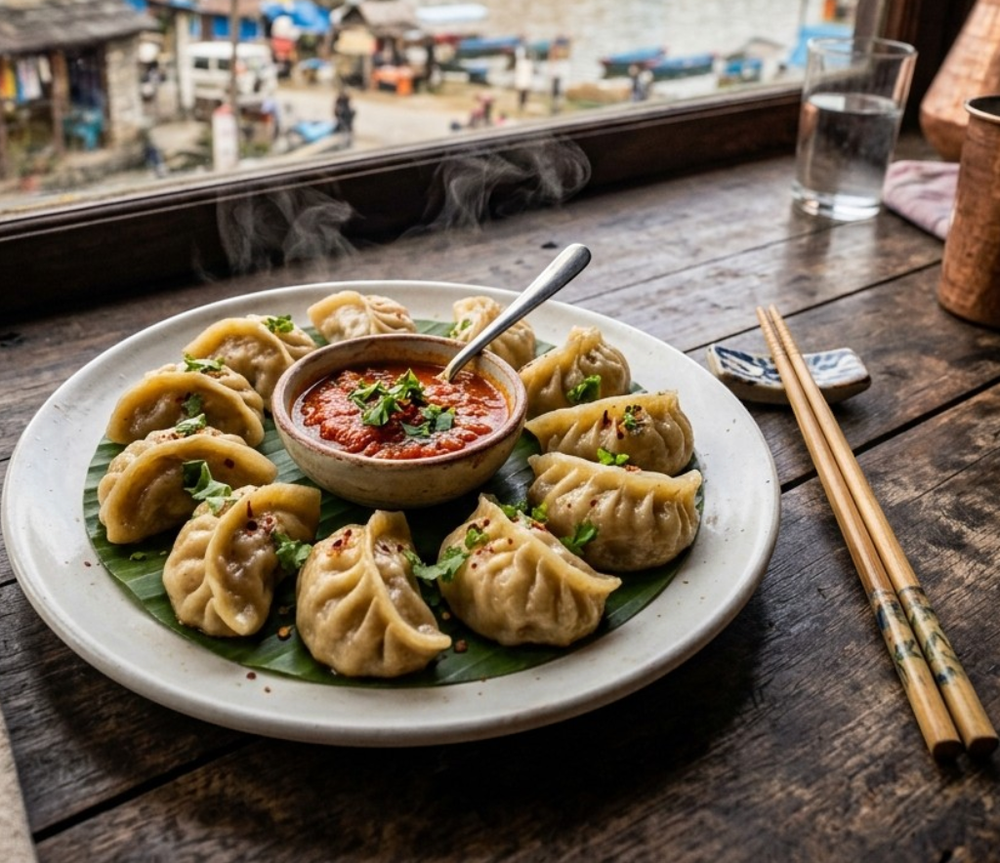
These beautifully steamed momos showcase the delicate craft of Nepali dumpling-making, their pleated edges perfectly folded and pale golden from the steam. Arranged in an inviting circle with a fragrant red chili sauce at the center, they promise the tender, savory filling within. This beloved Himalayan comfort food offers a warm, satisfying taste of Pokhara's culinary heritage.
Credits: THE PAINTED PASSPORT
Local cuisine study in Pokhara, Nepal

☕︎ Local Flavor

Moondance Restaurant

Rating: 4* | Price: $$ | Coordinates: 28.2105° N, 83.9560° E

Moondance is a beloved Lakeside institution serving creative fusion dishes that blend Nepali flavors with international techniques in a warm, fairy-lit setting. The wood-fired pizza and homemade pasta draw as many fans as the hearty dal bhat served with love. Live acoustic music on weekend evenings makes dinner here feel like a genuine celebration of life.

View Entry Details

Lhasa Tibetan Restaurant

Rating: 4* | Price: $ | Coordinates: 28.2090° N, 83.9545° E

A cozy hideaway run by a warm Tibetan family, this restaurant serves soul-warming momos, thukpa noodle soup, and butter tea that feel like a hug on a cool mountain evening. The hand-stamped menus and colorful prayer flags strung across the ceiling create an intimate, authentic atmosphere unlike anywhere else. Every bite here tells a story of Tibetan tradition lovingly preserved far from home.

View Entry Details

Caffe Concerto

Rating: 4* | Price: $$ | Coordinates: 28.2115° N, 83.9565° E

Perched with a gorgeous lake view, Caffe Concerto is the perfect spot to sip freshly brewed Nepali coffee while watching morning mist lift off Phewa Lake. The breakfast menu featuring homemade granola, fresh fruit, and thick wholegrain toast is a true treat after days of trekking. The relaxed, bookshelf-lined interior makes it impossible to leave after just one cup.

View Entry Details

OR2K Pokhara

Rating: 4* | Price: $$ | Coordinates: 28.2100° N, 83.9558° E

With low cushioned seating, colorful lanterns, and an entirely vegetarian menu inspired by Middle Eastern and Mediterranean cuisines, OR2K creates a wonderfully bohemian dining experience. The fresh falafel wraps, creamy hummus, and warm pita bread are prepared with genuine care and locally sourced ingredients wherever possible. It is a vibrant gathering spot where trekkers, yogis, and travelers swap stories over delicious, wholesome food.

View Entry Details

🛌︎ Boutique Stays

Temple Tree Resort & Spa

Rating: 5* | Price: $$$ | Coordinates: 28.2096° N, 83.9556° E

Nestled among lush gardens beside Phewa Lake, Temple Tree Resort offers elegant rooms with stunning Annapurna mountain views. The spa treatments using local herbs are absolutely rejuvenating after a long trek. Warm Nepali hospitality and beautifully designed cottages make every morning feel like a peaceful retreat.

View Entry Details

Kantipur Temple House

Rating: 4* | Price: $$ | Coordinates: 28.2080° N, 83.9540° E

Inspired by traditional Newari architecture, this charming boutique hotel features hand-carved wooden windows and cozy courtyard spaces. Each room is thoughtfully decorated with local textiles and crafts that tell a story of Nepal's rich culture. The rooftop terrace offers spectacular sunrise views over the Himalayas that will leave you breathless.

View Entry Details

Fish Tail Lodge

Rating: 5* | Price: $$$$ | Coordinates: 28.2150° N, 83.9500° E

Accessible only by a hand-pulled raft, Fish Tail Lodge sits on a private peninsula surrounded by the shimmering waters of Phewa Lake. The iconic thatched-roof cottages and lush gardens create an atmosphere of magical seclusion right in the heart of Pokhara. Waking up to Machhapuchchhre reflected in the still lake is an experience that stays with you forever.

View Entry Details

Lakeside Retreat Guesthouse

Rating: 3* | Price: $ | Coordinates: 28.2110° N, 83.9570° E

This friendly family-run guesthouse along the Lakeside strip offers clean, comfortable rooms just steps from the water and local restaurants. The owners greet you like family and happily share tips on hidden local spots most tourists never discover. It is an ideal budget-friendly base for trekkers and backpackers who want authenticity without sacrificing comfort.

View Entry Details

📍︎ Field Study

Phewa Lake Boat Ride

Rating: 5* | Price: $ | Coordinates: 28.2130° N, 83.9510° E

Drifting across the glassy waters of Phewa Lake in a traditional wooden rowboat is one of the purest joys Pokhara offers. The reflection of the Annapurna range shimmering beneath you feels almost surreal, especially in the golden light of early morning. Row out to the small island temple of Tal Barahi and receive a quiet blessing before the rest of the world wakes up.

View Entry Details

World Peace Pagoda

Rating: 5* | Price: Free | Coordinates: 28.1950° N, 83.9430° E

Perched high on a hillside south of Phewa Lake, this gleaming white Japanese Buddhist stupa offers a 360-degree panorama of Pokhara, the lake, and the entire Annapurna Himalayan range. The hike up through the forest is meditative and filled with birdsong that makes the journey as rewarding as the destination. Arriving at sunset when the peaks glow pink and orange is an experience of breathtaking, almost spiritual beauty.

View Entry Details

Davis Falls & Gupteshwor Cave

Rating: 4* | Price: $ | Coordinates: 28.1960° N, 83.9640° E

Davis Falls is a fascinating waterfall that dramatically disappears into a deep underground channel carved through solid rock over thousands of years. Just across the road, the sacred Gupteshwor Mahadev Cave winds beneath the earth to a natural Shiva shrine visited by devoted pilgrims year-round. The combination of natural wonder and living religious tradition makes this a deeply memorable and thought-provoking stop in Pokhara.

View Entry Details

International Mountain Museum

Rating: 4* | Price: $ | Coordinates: 28.2010° N, 83.9700° E

This remarkable museum celebrates the history, culture, and heroic stories of Himalayan mountaineering with exhibits that span ancient Sherpa traditions to modern summit expeditions. Life-size dioramas, vintage climbing gear, and stunning photography bring the world's highest peaks compellingly close. It is an inspiring and humbling place that deepens your appreciation for every mountain you can see from Pokhara's shores.

View Entry Details

The Dossier

Archival Note: A formal technical study of Pokhara, Nepal, archiving the coordinates, elevation, and environmental data that define the region. This data serves as a vital record for our ongoing global field study, providing the technical foundation behind every atmospheric detail captured in our visual work.

Botanical and pigment specimen study for Pokhara, Nepal Colors of Pokhara, Nepal
Coordinates
28.2096° N, 83.9556° E — Lakeside District, Pokhara, Gandaki Province, Nepal
Historical Epoch
Pokhara was a Newari trading crossroads on the ancient salt route between the Terai plains and Tibet. It remained relatively isolated until a road connection in 1968 opened it to the outside world almost overnight.
Elevation
742-822 m / 2,434-2,697 ft - Pokhara Valley sits at mid-elevation, warm enough for lush subtropical vegetation while the Annapurna peaks above it exceed 8,000 m
Atmosphere
Cwa - Humid Subtropical with dry winter. Warm and green with dramatic monsoon seasons. October through November delivers crisp blue skies and the clearest mountain views of the year.
Observation Hour
06:15 - Dawn light on the Annapurna range reflected in Phewa Lake lasts only minutes before haze builds. The mirror-still water and rose-gold peaks together are the defining visual of Pokhara.
Primary Pigment
Phewa Glacial Teal (#5B8FA8) and Annapurna Dusk Rose (#C4826A)
Best Time to Visit
October through November - Post-monsoon skies are crystal clear, mountain views are at their best, and the valley is lush green from seasonal rain.
Avoid Visiting
June through August - Peak monsoon brings heavy daily rainfall, persistent cloud cover that hides the peaks, and occasionally disrupted roads and trails.

The Local Tongue


Language is the invisible architecture of Pokhara, Nepal. These entries document the regional vocabulary—capturing the "texture" of local speech that standard translations often miss. Hand-curated expressions reflecting the specific spirit and daily rhythm of the region.
Archival study of Nepali cultural texture

via / Shishir Pandey

Primary Language Nepali
Regional Dialect Gandaki Nepali, with notable Gurung and Tibetan linguistic influence in lakeside and market areas

आरामदायी (Aaramdayi)

Aaramdayi translates loosely as restful or comfortably at ease, but carries a warmth that the English word misses entirely. In Pokhara it is used to describe the particular feeling of sitting on a lakeside terrace after days on a mountain trail, boots finally off, dal bhat on the table and Machhapuchhre glowing in the late afternoon light.

Bhat-Bhat

Bhat-Bhat is a colloquial phrase meaning roughly rice and more rice, used affectionately to describe the Nepali relationship with dal bhat as the anchor of every day. In Pokhara guesthouses a host asking if a traveler has eaten will often simply gesture toward the kitchen pot and say it with a smile, no further words needed.

Khojne

Khojne means to seek or to search, but in the mountain context it carries a philosophical undertone of purposeful wandering rather than simply looking for something lost. Porters and guides in the Annapurna foothills use it when describing why people come to the region at all, as though the act of walking toward a peak is itself the point, not the arrival.

Wait! before you go...

Before you head over to Pokhara, Nepal, we’ve audited the essential data points for this corner of the world. These notes cover the logistics—from currency ratios to transit hubs—to help you navigate the landscape with clarity.
🚲 Getting Around Within Pokhara, taxis and electric three-wheelers are the most practical options. Fares should be agreed before boarding as meters are rarely used, and the main Lakeside strip is compact enough to cover comfortably on foot or by hired bicycle.
⚖️ Cash or Card Cash remains essential in Pokhara, especially for smaller guesthouses, local restaurants, and any activity booking done directly with guides. Cards are accepted at larger hotels and some Lakeside restaurants, but carrying Nepali rupees avoids the frequent connectivity issues that affect card terminals.
☁️ Good to Know Removing shoes before entering homes, guesthouses, and temple interiors is expected and important to observe. Pointing feet toward a person or a religious object is considered disrespectful, so sitting cross-legged or with feet tucked away when on the ground near a stupa or shrine is a small gesture that locals notice and appreciate.
🏧 ATMs ATMs are plentiful along the Lakeside strip and near the bus park, with most accepting Visa and Mastercard reliably. Withdrawal limits per transaction are often set low, around 10,000 NPR, so withdrawing in multiple transactions or finding a bank ATM rather than a standalone machine is advisable for larger cash needs.
💳 Currency The Nepali Rupee (NPR) is the only legal tender and Indian Rupees of 100 denominations and below are also accepted in some border-adjacent contexts, though not commonly in Pokhara. USD and EUR can be exchanged at licensed money changers along Lakeside at competitive rates, and it is worth carrying small denomination rupee notes for tipping and local stalls.
🔌 Plugs Nepal uses Type C, D, and M sockets at 230V 50Hz. A universal travel adapter with surge protection is strongly recommended given occasional voltage fluctuations.
🛡️ Safety Pokhara is considered one of the safer cities in Nepal for travelers, with a relaxed lakeside atmosphere and a well-established tourism infrastructure. Solo travelers including solo women generally report feeling comfortable, though the usual awareness around bag security in busy market areas and on boats applies as standard precaution.
✈️ Airports Pokhara Regional International Airport (PKR) serves the city with domestic flights from Kathmandu on multiple airlines, taking roughly 25 to 30 minutes. The new Pokhara International Airport opened in 2023 and is expected to expand international connectivity, though Kathmandu's Tribhuvan International Airport (KTM) remains the primary international entry point for most visitors.

Behind The Scenes

Nathan

Note from the Founder

Hey, did you know this fun fact about Pokhara, Nepal? Pokhara sits closer to the Annapurna peaks than almost any other city on earth. The straight-line distance from Lakeside to the summit of Machhapuchhre is under 30 km, making the scale of the view from the valley genuinely extraordinary.
Thank you for exploring the Pokhara, Nepal series with us. We hope these notes have inspired you to add this incredible destination to your own passport—we are so glad you're here. Nathan's signature