Old Quebec City, Quebec

This Canvas features original artwork from our time in Old Quebec City, Quebec.
Canvas / Visual Study
Regional Dossier

OLD QUEBEC CITY, QUEBEC | "La Vieille Capitale — The Only Walled City in North America"

Old Quebec City is the most historically complete city in North America — a UNESCO World Heritage Site on the Cap-Diamant promontory above the St. Lawrence River, where the French colonial ramparts, the Château Frontenac above the cliff, the cobblestone Basse-Ville streets, and the Place Royale where Champlain established the first permanent French settlement in 1608 constitute the most intact surviving urban ensemble of New France architecture anywhere in the world. The city is the only walled city north of Mexico still surrounded by its original fortifications — a 4.6-kilometre circuit of stone ramparts and gates containing four centuries of French, British, and Canadian architectural ambition layered on the most strategically important river in the history of North America.

The colors are the palette of the Quebec winter: the warm amber of gas lamp light on snow-covered cobblestones along the Rue du Petit-Champlain, the deep copper-green of the Château Frontenac's roofline against a pale winter sky, the cream and grey limestone of the Basse-Ville catching the flat December light, and the specific blue of the half-frozen St. Lawrence when ice floes drift past the Terrasse Dufferin in January.

Select Size
Add to the collection for /

$65.00

Finding the Stillness

It's hard to put the "vibe" of a place into words, so we put together a few images that we think show the quiet side of Old Quebec City, Quebec. These are the textures and small moments we've archived to capture the stillness of this corner of the world.

Old Quebec City, Quebec visual study 01
Old Quebec City, Quebec / No. 01 via Timothee Geenens
The imposing Château Frontenac rises magnificently above the snow-dusted streets of Old Quebec, its copper-green turrets and brick façade glowing softly in the winter light. Below, the charming lower town buildings cluster together in shades of peach, cream, and rust, their European character unmistakable even beneath the season's first snow. There's a profound stillness here in the cold air—the kind of moment where history feels present and the city invites you to slow down, breathe deeply, and simply take it all in.
Old Quebec City, Quebec visual study 02
Old Quebec City, Quebec / No. 02 via Veronique Trudel
The stone buildings glow softly under winter light, their butter-yellow shutters and dormers creating a gentle warmth against the season's chill. Fresh snow dusts the rooftops and cobblestones while evergreen wreaths tied with crimson bows frame each window, suggesting the quiet comfort of centuries-old traditions continuing in this European-style quarter. There's something restorative about places like this—where time moves differently, where you can almost hear the crunch of snow underfoot and imagine the stories these walls have held.
Old Quebec City, Quebec visual study 03
Old Quebec City, Quebec / No. 03 via Lianhao Qu
The cobblestone streets glow softly under the warm light of street lamps, while evergreens draped in tiny white lights line the pathway like sentinels of winter joy. A grand Christmas tree stands illuminated against the deep blue evening sky, its star reaching upward as shop windows cast their gentle amber light onto the stone buildings. There's a stillness here that invites you to slow down and breathe in the cold air, to feel the weight of centuries beneath your feet while the present moment sparkles all around you.

Where to wander

Archival Note: A curated field study of Old Quebec City, Quebec, prioritizing cultural relevance and archival merit. While we haven't touched down here yet, we've meticulously vetted these locations through our global network of contributors to ensure they represent the most authentic atmosphere for your own expedition.

Local Cuisine Spotlight
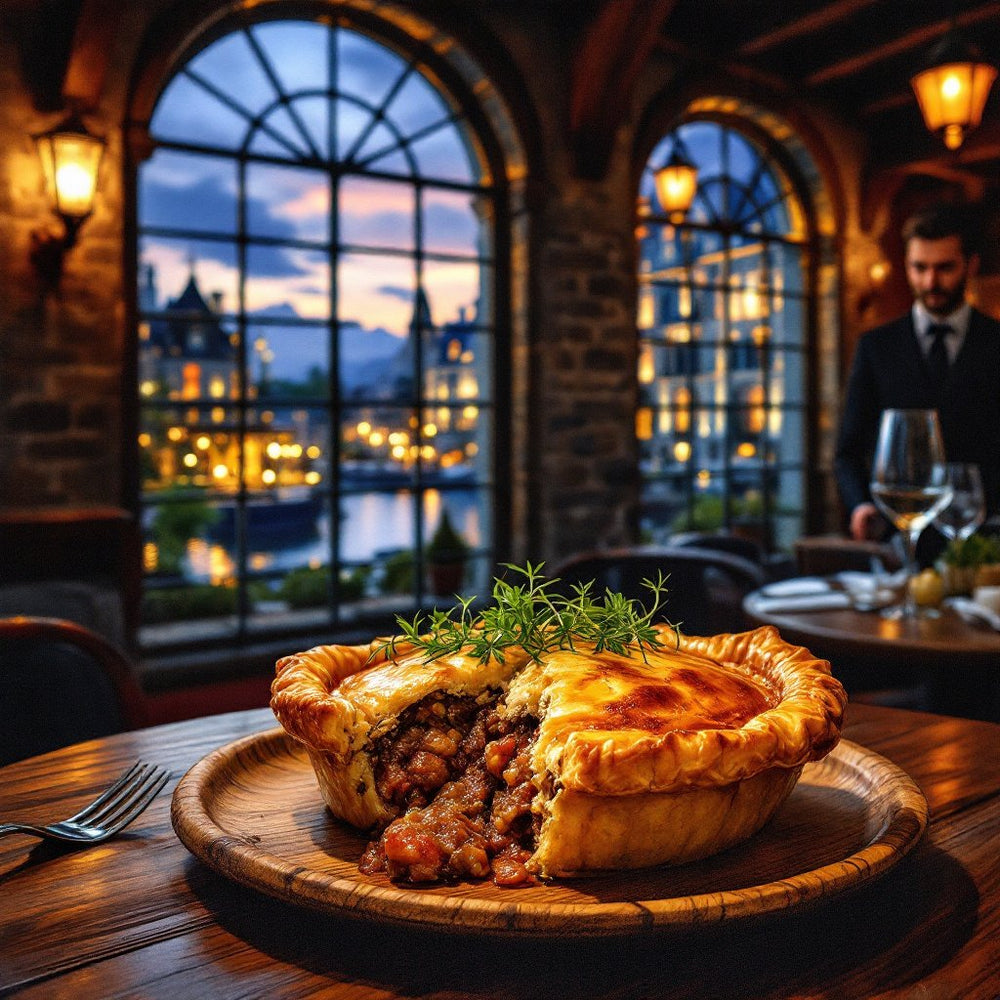
This flaky-crusted tourtière embodies centuries of French-Canadian tradition, filled with seasoned ground pork, veal, and warming spices like cloves and cinnamon. Served steaming in Old Quebec's stone-walled restaurants, each bite delivers the comforting richness that sustained generations through harsh winters, while its golden pastry shatters delicately beneath the fork.
Credits: Nathan S
Local cuisine study in Old Quebec City, Quebec

☕︎ Local Flavor

Le Saint-Amour

Rating: 4.9★ | Price: $$$$ | Coordinates: 46.8131° N, 71.2087° W

Le Saint-Amour is the most accomplished fine dining address in Quebec City — a greenhouse-roofed dining room in a 19th-century townhouse on the Rue Sainte-Ursule in the Upper Town, where chef Jean-Luc Boulay has been building a menu around the specific agricultural and marine geography of the St. Lawrence valley for over three decades. The foie gras preparations, the Quebec lamb with wild herbs from the Charlevoix uplands, the fresh-water fish from the St. Lawrence and the Laurentian lakes, and the cheese program built around the extraordinary artisanal fromageries of the Eastern Townships and Charlevoix constitute the most complete culinary map of Quebec's gastronomic territory available in a single menu. The wine cellar, focused on Burgundy and Bordeaux with a serious Quebec ice wine selection, and the glass-roofed garden atrium make it the most romantically atmospheric serious restaurant in the walled city.

View Entry Details

Panache at Auberge Saint-Antoine

Rating: 4.9★ | Price: $$$$ | Coordinates: 46.8118° N, 71.2009° W

Panache is the most architecturally dramatic restaurant in Quebec City — a soaring two-story stone dining room in the auberge's original 1822 warehouse building, where the exposed timber trusses, the stone walls three feet thick, and the fireplace that occupies an entire end wall create a room that operates simultaneously as a piece of living architectural history and as the setting for one of the city's most technically serious kitchens. The menu is built around the auberge's own Île d'Orléans market garden, the heritage breed farms of Charlevoix, and the fish and shellfish from the tidal flats of the St. Lawrence estuary, and the kitchen applies a contemporary Quebec culinary intelligence that treats the regional larder as both its primary creative brief and its most urgent cultural argument. Dining at Panache is the most complete single experience of what Quebec's culinary identity has become when it is operating at the highest level.

View Entry Details

Le Lapin Sauté

Rating: 4.7★ | Price: $$ | Coordinates: 46.8117° N, 71.2010° W

Le Lapin Sauté is the most charming restaurant in the Basse-Ville — a small, yellow-painted bistro on the Rue du Petit-Champlain, the oldest commercial street in North America, where the kitchen has built a menu entirely around rabbit in all its preparations: braised, roasted, confited, in terrine and in rillettes and in a ragù with fresh pasta that is the most specific expression of the Québécois farmhouse cooking tradition available in the tourist corridor without any of the tourist-kitchen compromises that define most of its neighbors. The rabbit is sourced from the farms of the Île d'Orléans and the Beauce region, and the preparations rotate seasonally between the braised autumn versions and the lighter roasted preparations of summer. The small stone dining room, the outdoor terrace on the cobblestone pedestrian street, and the glass of Québécois cider served with the rillettes make Le Lapin Sauté the most specifically delightful lunch in old Quebec.

View Entry Details

Aux Anciens Canadiens

Rating: 4.6★ | Price: $$$ | Coordinates: 46.8130° N, 71.2059° W

Aux Anciens Canadiens is the most historically significant restaurant in Quebec City — operating since 1966 in the Maison Jacquet, one of the oldest surviving houses in Canada, built in 1675 on the Rue Saint-Louis in the Upper Town. The menu is an authoritative and unapologetic presentation of the classic Québécois cuisine de terroir: the tourtière and the cipaille, the maple-glazed duck, the caribou ragoût with wild blueberry reduction, the sugar pie, and the maple syrup in four preparations that constitute the most comprehensive archival menu of the pre-industrial Quebec farmhouse kitchen available in the old city. The three dining rooms inside the 350-year-old stone house — the low ceilings, the wide plank floors, the fireplace — are the correct physical context for a meal whose entire argument is about the continuity between the land and the table that defines Québécois food culture at its most deeply rooted.

View Entry Details

🛌︎ Boutique Stays

Fairmont Le Château Frontenac

Rating: 4.7★ | Price: $$$$ | Coordinates: 46.8120° N, 71.2047° W

The Château Frontenac is the most photographed hotel in the world and the single most iconic building in Canada — a turreted French château built by the Canadian Pacific Railway in 1893 on the Cap-Diamant promontory above the St. Lawrence River, where its copper rooflines, its stone towers, and its position at the center of the Old Upper Town create the architectural anchor around which the entire visual identity of Quebec City is organized. The hotel is not merely a backdrop to the city but its primary compositional element — visible from every approach to the old walled city, from the Dufferin Terrace below, from the ferries crossing to Lévis, and from the Île d'Orléans twenty kilometers upstream. To stay in the château is to occupy the physical center of a UNESCO World Heritage city as it was conceived and built — a deliberate monument to the specific ambition of the late Victorian Canadian institutional imagination at its most unrestrained.

View Entry Details

Hôtel Manoir Victoria

Rating: 4.8★ | Price: $$$ | Coordinates: 46.8133° N, 71.2092° W

Hôtel Manoir Victoria occupies a heritage building on the Côte du Palais at the intersection of the Upper and Lower Towns — one of the most precisely positioned addresses in Old Quebec, where the hotel's location between the steep lane of the Côte de la Canoterie and the commercial life of the Saint-Jean axis gives it access to both the historic core of the Upper Town and the working Basse-Ville neighborhoods below the escarpment. The interior maintains the proportions and the stone construction of the original 1830s building while delivering contemporary amenities with a discretion that does not compete with the architectural context. The indoor pool, the Ristorante Il Teatro, and the proximity to the Palais de l'Intendant archaeological site make this the most intelligently positioned full-service hotel in the old city for guests who want the Upper Town's historical density without the Château's premium.

View Entry Details

Auberge Saint-Antoine

Rating: 4.9★ | Price: $$$$ | Coordinates: 46.8118° N, 71.2009° W

Auberge Saint-Antoine is the finest hotel in Quebec City and one of the great small luxury hotels in North America — a 95-room boutique property in the Basse-Ville built directly over and around an active archaeological site, where over 700 artifacts recovered during the excavation of the original 1700s trading post are displayed throughout the public spaces and guest rooms in cases that are embedded in the original stone walls. The hotel occupies the buildings of the former maritime trading post at the foot of the Côte de la Montagne, where the archaeological excavations revealed intact 17th-century harbor infrastructure, and the rooms on the archaeological level provide direct visual access to the excavation trenches through glass floors. Panache restaurant on the ground floor is one of the most serious kitchens in the city, using the auberge's own market garden on the Île d'Orléans to supply the seasonal menu.

View Entry Details

Hôtel Priori

Rating: 4.7★ | Price: $$$ | Coordinates: 46.8121° N, 71.2014° W

Hôtel Le Priori occupies a heritage stone building on the Rue Sault-au-Matelot in the Basse-Ville's most atmospheric block — a narrow lane of 17th and 18th-century buildings between the Auberge Saint-Antoine and the Place Royale that constitutes the most intact surviving streetscape of the original colonial lower town. The 28 rooms and suites are individually designed with a spare Scandinavian-influenced aesthetic that uses the stone walls, the low timber ceilings, and the original wide-plank floors as the primary decorative elements rather than competing with them. The hotel's intimate scale and its location between the working harbor district and the Place Royale archaeological heart of New France make it the most historically immersive small accommodation in old Quebec — where the 17th century is not a museum display but the actual physical substance of the room around you.

View Entry Details

📍︎ Field Study

The Fortifications & Plains of Abraham

Rating: 4.9★ | Price: $ | Coordinates: 46.8072° N, 71.2226° W

The fortifications of Quebec City are the only remaining walled city walls in North America north of Mexico — a 4.6-kilometer circuit of stone ramparts, bastions, and gates built and rebuilt by the French, the British, and the Canadian government between 1690 and 1871, enclosing the entire Upper Town in a military engineering sequence that documents three different national building traditions in a single continuous structure. The Plains of Abraham beyond the Saint-Louis Gate is where the 1759 Battle of Quebec — the fifteen-minute engagement between Wolfe and Montcalm that determined whether North America would become primarily English or French — was decided in a single morning on a flat plateau above the St. Lawrence. The National Battlefields Park that now covers the plains preserves the topography of the engagement with the specific restraint of a landscape that knows the weight of what happened on it, and the view of the St. Lawrence from the cliff edge above the Citadelle is the most precisely atmospheric historical viewpoint in Canada.

View Entry Details

Place Royale & the Basse-Ville

Rating: 4.9★ | Price: $ | Coordinates: 46.8116° N, 71.2024° W

Place Royale is the birthplace of French civilization in North America — the small cobblestone square in the Basse-Ville where Samuel de Champlain established his trading post in 1608, where the church of Notre-Dame-des-Victoires has stood since 1688, and where the surrounding blocks of 17th and 18th-century stone buildings constitute the most complete surviving urban ensemble of New France architecture anywhere in the world. The square was the commercial heart of the colony for 150 years, and the archaeological excavations beneath and around it have revealed the continuous layers of occupation from the Algonquin summer camp to the French trading post to the British commercial district. Walking from the Place Royale along the Rue du Petit-Champlain, up the Escalier Casse-Cou to the Upper Town, and back down the Côte de la Montagne is the most compressed available experience of the 400 years of continuous occupation that makes Quebec City the most historically legible cityscape in North America.

View Entry Details

Terrasse Dufferin & the Promenade des Gouverneurs

Rating: 4.9★ | Price: $ | Coordinates: 46.8118° N, 71.2050° W

The Terrasse Dufferin is the most theatrically perfect public promenade in North America — a 671-metre elevated boardwalk cantilevered over the cliff face between the Château Frontenac and the Citadelle, where the view of the St. Lawrence River, the Île d'Orléans, and the Laurentian Mountains on the far bank provides the single most comprehensive single-viewpoint study of the Quebec geography. The promenade extends south from the terrace to the Promenade des Gouverneurs, which climbs along the cliff face to the Plains of Abraham via a series of staircases and observation platforms that provide the aerial perspective on the relationship between the Cap-Diamant escarpment and the river that defined the entire strategic and commercial history of New France. In winter, the tobogganing slide built over the original 17th-century slide route from the Château to the Lower Town operates on the same alignment it has occupied for nearly 350 years, and the view of the Château above the winter river from the terrace at dusk is the most specifically beautiful image available in the city.

View Entry Details

Carnaval de Québec

Rating: 4.9★ | Price: $$ | Coordinates: 46.8075° N, 71.2188° W

The Carnaval de Québec is the largest winter carnival in the world — a seventeen-day festival held each February in the old walled city where the ice palace on the Plains of Abraham, the international ice sculpture competition, the snow sculptures along the Grande-Allée, the night parades through the fortification gates, and the canoe race across the ice floes of the St. Lawrence combine into the most complete possible experience of what Quebec's French-Canadian culture has built from the specific challenge of surviving — and then celebrating — the most severe urban winter in North America. Bonhomme Carnaval, the seven-foot snowman who has served as the festival's ambassador since 1955, and the traditional cariole and dog-sled races outside the city walls are not tourist performances but the legitimate continuation of the winter survival culture that the habitants of New France developed as the only available response to a winter that arrived in October and did not leave until April. The Carnaval is the most concentrated single expression of Québécois cultural identity available at any time of year.

View Entry Details

Typography

Archival Note: A formal technical study of Old Quebec City, Quebec—archiving the coordinates, elevation, and environmental data that define the region. This data serves as a vital record for our ongoing global field study, allowing us to reconstruct the regional atmosphere with archival precision before our physical arrival.

Botanical and pigment specimen study for Old Quebec City, Quebec Colors of Old Quebec City, Quebec
Coordinates
46.8120° N, 71.2097° W — Capitale-Nationale region, Quebec, St. Lawrence River valley
Historical Epoch
French Colony 1608 / British Conquest 1759 / UNESCO World Heritage 1985
Elevation
0–98 m / 0–321 ft — Basse-Ville at St. Lawrence river level, rising steeply to the Cap-Diamant Upper Town
Atmosphere
Humid Continental (Dfb). Severe winters with heavy snowfall November through March, spectacular October foliage, warm and brilliantly clear summers, and the extraordinary quality of the long golden light the St. Lawrence valley produces at solstice.
Observation Hour
16:30. The specific winter afternoon window when the low January sun enters the Rue du Petit-Champlain from the south and the gas lamp light begins to warm the snow on the cobblestones before the full dark — the moment when the Basse-Ville becomes the painting.
Primary Pigment
Château Copper (#7A9E7E) and Cobblestone Cream (#D4C5A9)
Best Time to Visit
February for the Carnaval, June through September for the long golden summer evenings on the Terrasse Dufferin, and October for the fall foliage visible from the Upper Town above the St. Lawrence.
Avoid Visiting
November through January outside Carnaval season — the cold is severe, daylight is minimal, and the outdoor terrasse culture defining the city's summer social life is entirely absent.

Behind The Scenes

Nathan

Note from the Founder

Hey, did you know this fun fact about Old Quebec City, Quebec? Old Quebec is the only remaining walled city north of Mexico in North America, and its fortifications are the only ones on the continent that were continuously maintained and upgraded rather than demolished in the 19th century. The walls were actually rebuilt and extended by the British after the 1759 conquest, making them a rare example of the conquering power investing more in the defensive infrastructure of the city than the original builders did.
Thank you for exploring the Old Quebec City, Quebec series with us. We hope these notes have inspired you to add this incredible destination to your own passport—we are so glad you're here. — Nathan

The Magnets

The Coasters

The Canvas

Some of our Favorites