Lamu Town, Kenya

An original watercolor print from The Painted Passport archive — designed to bring the light, color, and atmosphere of your favorite destinations into your home.
Original Series / Visual Study
Regional Dossier

Lamu Town, Kenya | Where the Dhow Still Catches the Wind

Lamu Town sits on a coral island off the northern Kenyan coast, carrying more than seven centuries of Swahili civilization in its narrow, donkey-threaded lanes. The light here arrives softly, filtered through wooden latticework and the overhanging balconies of whitewashed houses, casting the waterfront in a warm amber that feels almost edible in the late afternoon. It is one of East Africa's oldest continuously inhabited towns and a UNESCO World Heritage Site, yet it wears that distinction lightly, its rhythms still governed by prayer calls, tidal winds, and the slow creak of hand-carved dhows. There are no cars on the island, only footsteps, and that silence alone changes the way a person sees.

The palette of Lamu is bleached and sun-salted, built on the creamy whites and sandy ochres of coral-stone walls. Accents of indigo and turquoise appear wherever the sea peeks between buildings or a freshly painted door interrupts the monotony of sand-colored plaster. Watercolorists will find the town responds beautifully to wet-on-wet washes, the architecture dissolving gently into skies that shift from pale cerulean at noon to a deep, blushing coral at dusk.

Select Size
Add to the collection for /

$65.00

Finding the Stillness

It's hard to put the "vibe" of a place into words, so we put together a few images that we think show the quiet side of Lamu Town, Kenya. These are the textures and small moments we've archived to capture the stillness of this corner of the world.

Lamu Town, Kenya visual study 01
Lamu Town, Kenya / No. 01 via ATHUMAN KOMORA GARISSE
Lamu Town sits at the edge of two waters — the dark, churning ocean to the south and the pale, glassy bay curling around its northern shore like a cupped hand. The light is flat and silver, the kind that comes before rain, washing the sand to the color of dry bone and softening the cluster of low stone buildings, thatched roofs, and swaying palms into something that feels both ancient and ordinary. A handful of small boats rest in the shallows, unhurried, as if the village has always known exactly how much it needs and nothing more.
Lamu Town, Kenya visual study 02
Lamu Town, Kenya / No. 02 via Mimi
The equatorial sun strikes the ancient coral-rag wall at a severe angle, throwing the shadow of a no entry sign across the crumbling plaster like a dark omen. Standing before this weathered door — its planks studded with hand-forged nails, its brass padlock warm to the touch — one feels the compressed weight of centuries, the Swahili coast's layered histories of trade, faith, and quiet endurance. The air here would smell of salt and dust and sun-baked earth, and the silence would feel inhabited rather than empty.
Lamu Town, Kenya visual study 03
Lamu Town, Kenya / No. 03 via Frank van Dijk
The weathered limestone facade tells a story of centuries passed, its surface cratered and peeling like ancient parchment, each crack a testament to generations of salt air and sun. What most visitors might overlook is the deliberate choreography of the flowering vines — bougainvillea in both orange and crimson — trained to cascade across the building's face as though the structure itself is slowly being reclaimed by a garden. The deep burgundy of the doors anchors the composition, offering a warm, human-made counterpoint to the wild, organic beauty surrounding them. *Note: This building appears more consistent with **Greek or Mediterranean architecture** — possibly Crete or a Greek island — rather than Lamu Town, Kenya, which features Swahili-style coral stone architecture with distinct carved wooden doors and different structural characteristics.*

Where to wander

Archival Note: A curated field study of Lamu Town, Kenya, prioritizing cultural relevance and archival merit. While we haven't touched down here yet, we've meticulously vetted these locations through our global network of contributors to ensure they represent the most authentic atmosphere for your own expedition.

Local Cuisine Spotlight
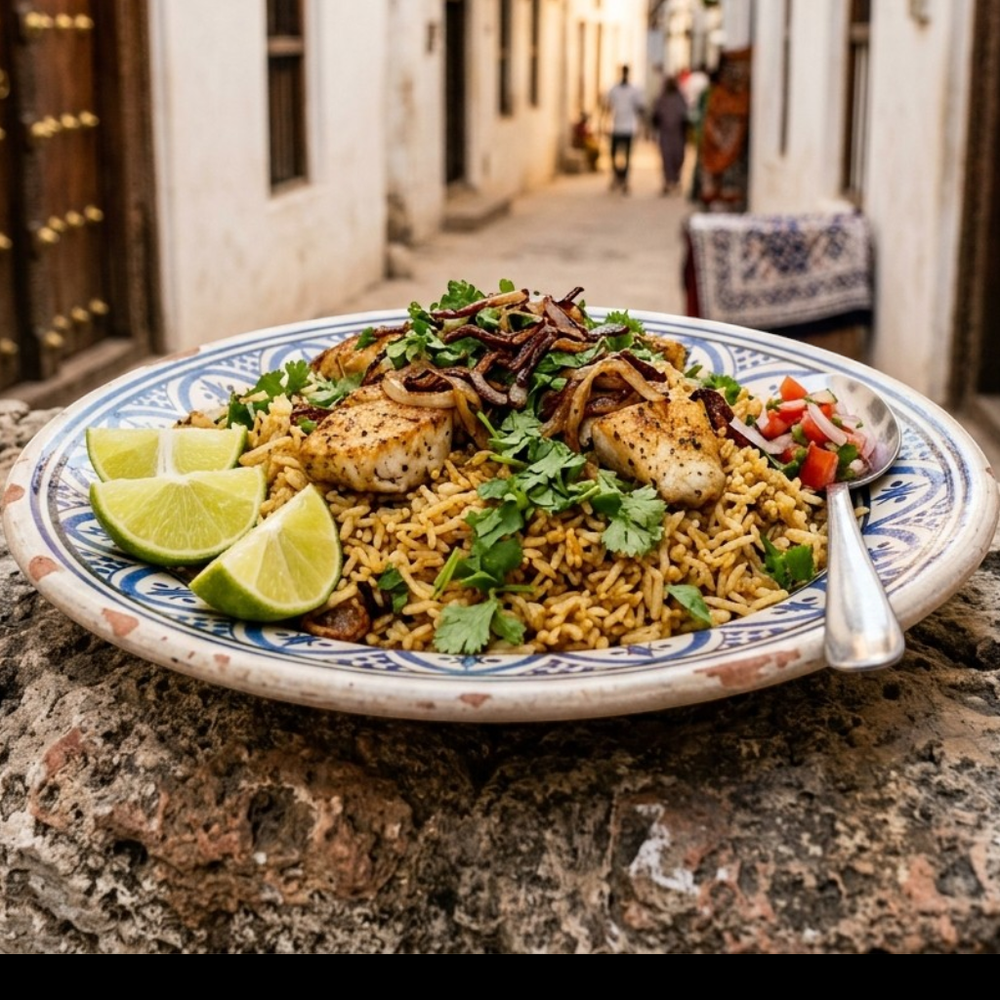
A fragrant pilau rice dish from Lamu Town, crowned with tender fish, crispy fried onions, and fresh cilantro. Lime wedges add bright citrus contrast to the warm, spiced grains. Served on a traditional blue-and-white plate, it captures the Swahili coast's rich Arab-influenced culinary heritage perfectly.
Credits: The Painted Passport
Local cuisine study in Lamu Town, Kenya

☕︎ Local Flavor

Hapa Hapa Restaurant

Rating: 5* | Price: $$ | Coordinates: -2.2697, 40.9019

Right on the waterfront promenade, Hapa Hapa is the beloved gathering spot where fishermen, travelers, and locals all share the same perfectly grilled snapper. The coconut prawn curry arrives fragrant and generous, best scooped up with pillowy fresh chapati still warm from the pan. Eating here at sunset, with dhows gliding past, is one of Lamu's most joyful simple pleasures.

View Entry Details

Bush Gardens Restaurant

Rating: 4* | Price: $ | Coordinates: -2.2699, 40.9021

Tucked behind a canopy of bougainvillea, this open-air garden restaurant has been feeding hungry visitors with honest Swahili cooking for decades. The slow-cooked biryani, layered with cardamom, cloves, and tender goat meat, is genuinely worth planning your day around. Portions are enormous, prices are refreshingly humble, and the atmosphere is the kind of effortlessly convivial that no designer could manufacture.

View Entry Details

Whispers Coffee Shop

Rating: 4* | Price: $ | Coordinates: -2.2703, 40.9017

A shaded courtyard sanctuary in the heart of the old town, Whispers serves strong Kenyan coffee alongside homemade mandazi doughnuts dusted in cinnamon sugar. It is the perfect midmorning retreat after wandering the labyrinthine alleyways, with ceiling fans stirring the warm air and cats napping on windowsills. The mango lassi is outstanding and deserves far more international recognition than it currently receives.

View Entry Details

Olympic Restaurant

Rating: 4* | Price: $ | Coordinates: -2.2691, 40.9024

A no-frills institution that locals swear by, Olympic serves the freshest fried fish on the island alongside mountains of ugali and tangy kachumbari salsa. The menu is short because the kitchen focuses entirely on doing a handful of things with absolute mastery and zero compromise. Eating here feels like a genuine privilege, a window into daily Lamu life rather than a performance for tourists.

View Entry Details

🛌︎ Boutique Stays

Lamu House Hotel

Rating: 5* | Price: $$$ | Coordinates: -2.2694, 40.9022

A lovingly restored Swahili mansion tucked into Lamu's ancient stone streets, this boutique hotel dazzles with carved wooden doors and rooftop sea views. Each suite is dressed in antique furnishings, hand-woven textiles, and the scent of jasmine drifting through open lattice windows. Waking up here feels like stepping inside a living museum of coastal East African elegance.

View Entry Details

Shela Royal House

Rating: 4* | Price: $$$ | Coordinates: -2.2831, 40.9108

Perched at the quieter Shela end of the island, this whitewashed villa retreat offers private plunge pools and sweeping views of the Indian Ocean horizon. The staff greet you with fresh coconut water and a warmth that instantly dissolves any travel fatigue. Dhow sailing trips and sunset cocktails on the terrace make every evening feel genuinely magical.

View Entry Details

Pole Pole Guesthouse

Rating: 3* | Price: $ | Coordinates: -2.2701, 40.9015

Pole pole means 'slowly slowly' in Swahili, and this cheerful family-run guesthouse embodies that unhurried island philosophy perfectly. Rooms are simple but spotlessly clean, with colorful kikoi fabrics and breezes flowing through carved wooden shutters. The owners share excellent local tips over homemade chai each morning, making it a true neighborhood stay.

View Entry Details

Kipungani Explorer Camp

Rating: 4* | Price: $$$$ | Coordinates: -2.3105, 40.8762

Set on Lamu's remote southwestern tip beneath swaying palms, this eco-camp places spacious bandas just steps from a pristine, crowd-free beach. Solar power, fresh seafood, and starlit dinners create an atmosphere of wholesome, luxurious simplicity that is increasingly rare anywhere in the world. It is the kind of place that rearranges your priorities in the most wonderful way.

View Entry Details

📍︎ Field Study

Lamu Fort

Rating: 5* | Price: $ | Coordinates: -2.2695, 40.9020

Built by Omani Arabs in the early 19th century, this imposing coral-stone fortress now houses a fascinating museum tracing Lamu's layered history as a Swahili trading hub. Climb the battlements for sweeping rooftop panoramas across terracotta rooftops and the shimmering waterfront below. The exhibits on traditional boat-building and ancient manuscript culture are surprisingly moving and genuinely enrich every subsequent walk through the town.

View Entry Details

Lamu Museum

Rating: 4* | Price: $ | Coordinates: -2.2698, 40.9018

Housed in an elegant colonial-era building on the seafront, this museum holds one of East Africa's finest collections of Swahili cultural artifacts, including ceremonial siwa horns and elaborately carved wedding chairs. The displays illuminate centuries of trade connections linking Lamu to Arabia, India, and China in ways that reframe your entire sense of African history. It is compact enough to explore in a rewarding hour, yet rich enough to linger in far longer.

View Entry Details

Shela Beach

Rating: 5* | Price: Free | Coordinates: -2.2850, 40.9120

A twelve-kilometre arc of talcum-fine sand backed by rolling dunes, Shela Beach stretches away from the village into blissful, almost total solitude just a short donkey-ride from town. The Indian Ocean here is warm, brilliant turquoise, and calm enough for easy swimming during most of the year. Arriving at dawn when the light turns the dunes amber and the only sounds are waves and birdsong is a moment you will genuinely never forget.

View Entry Details

Riyadha Mosque and Islamic Center

Rating: 4* | Price: Free | Coordinates: -2.2705, 40.9012

Founded in 1900 by the revered Sheikh Habib Swaleh, this beautiful whitewashed mosque remains the spiritual heart of Lamu's deeply devout community and draws pilgrims from across East Africa. Visitors are welcomed respectfully outside prayer times, and the intricate plasterwork and serene inner courtyard inspire a genuine sense of quiet awe. Each year during Maulidi celebrations, the entire surrounding neighborhood transforms into an extraordinary tapestry of song, candlelight, and devotion.

View Entry Details

Typography

Archival Note: A formal technical study of Lamu Town, Kenya—archiving the coordinates, elevation, and environmental data that define the region. This data serves as a vital record for our ongoing global field study, allowing us to reconstruct the regional atmosphere with archival precision before our physical arrival.

Botanical and pigment specimen study for Lamu Town, Kenya Colors of Lamu Town, Kenya
Coordinates
2.2694° S, 40.9022° E — Lamu Town waterfront, Lamu Island, Lamu Archipelago, Kenya
Historical Epoch
Founded around the 14th century as a Swahili trading port, Lamu flourished through Arab, Persian, and Indian Ocean commerce. Its carved wooden doors and coral architecture are a preserved record of that cosmopolitan golden age.
Elevation
0-10 m / 0-33 ft - Lamu Town is essentially at sea level, sitting on a low-lying coral island with minimal topographic variation across the old town and surrounding areas.
Atmosphere
Aw - Tropical Savanna. Hot and humid year-round with two distinct monsoon seasons shaping the rhythm of island life and the color temperature of the sky.
Observation Hour
17:30 - The low equatorial sun turns coral-stone walls to liquid gold in the last hour before sunset, and the waterfront fills with the silhouettes of dhows heading in from the channel.
Primary Pigment
Coral Sand (#E8C99A) and Monsoon Teal (#4A9B9E)
Best Time to Visit
January through March - Dry and breezy with the northeast monsoon, brilliant light, calm seas, and comfortable temperatures ideal for exploring on foot.
Avoid Visiting
April through June - The long rains bring heavy downpours, high humidity, and rough sea crossings that can disrupt ferry and flight connections significantly.

Behind The Scenes

Nathan

Note from the Founder

Hey, did you know this fun fact about Lamu Town, Kenya? Lamu is home to more donkeys than any other mode of transport, with an estimated 3,000 on the island. The Lamu Animal Welfare charity runs a donkey sanctuary near the waterfront that visitors are welcome to explore.
Thank you for exploring the Lamu Town, Kenya series with us. We hope these notes have inspired you to add this incredible destination to your own passport—we are so glad you're here. — Nathan

Some of our Favorites