Himeji, Japan

This Home Decor features original artwork from our time in Himeji, Japan.
Home Decor / Visual Study
Regional Dossier

Himeji, Japan | 'The white heron at the heart of the plains'

Himeji spreads across the Harima Plain where castle walls still tower above rooftops and temple smoke curls into the morning sky. The city grew around its luminous white fortress, a structure so elegant it was nicknamed the White Heron, and that grace still shapes the rhythm of daily life here. Narrow lanes wind between traditional machiya townhouses, gardens unfold in deliberate compositions of water and stone, and the mountains to the west hold centuries-old pilgrimage trails that remain unchanged. This is a place where feudal Japan remains visible in the present, where you can trace the path of samurai processions through modern streets.

The watercolor palette of Himeji centers on the brilliant whites and grays of castle plaster, warmed by the honey tones of wooden gates and earthen walls. Cherry blossoms wash the spring canvases in pale pink, while the deep greens of shaped pines anchor every garden composition. Autumn brings persimmon orange and maple crimson, and the distant mountains layer in subtle blues and lavenders that shift with the weather rolling in from the Seto Inland Sea.

Add to the collection for /

$18.00

Finding the Stillness

It's hard to put the "vibe" of a place into words, so we put together a few images that we think show the quiet side of Himeji, Japan. These are just some of the textures and small moments that felt special to us while we were exploring.

Himeji, Japan visual study 01
Himeji, Japan / No. 01 via Vladimir Haltakov
The white walls of Himeji Castle rise against an overcast sky, its tiered roofs stacking upward in the distinctive style of feudal Japanese architecture. Stone fortifications anchor the structure to the hillside, their dark gray surfaces contrasting with the pale buildings above, while green trees soften the edges where rock meets wood. The muted afternoon light catches the curved eaves and small windows, revealing the intricate details of a castle that has stood for centuries.
Himeji, Japan visual study 02
Himeji, Japan / No. 02 via Josh C
Lush green maples frame a traditional teahouse tucked into a forested hillside, its weathered tile roofs settling into the landscape as if they've always belonged there. The soft, diffused light suggests an overcast spring or early summer day, when humidity hangs in the air and sounds seem to travel differently through dense foliage. A few visitors pause along the path, small and quiet against the scale of the surrounding trees, their presence barely disturbing the stillness of the place.
Himeji, Japan visual study 03
Himeji, Japan / No. 03 via Caspar Wai
The pale blossoms carry faint coral-pink centers that deepen where the stamens emerge, creating small bursts of warmth against the soft white petals. The shallow depth of field blurs the surrounding branches into a hazy cloud, making it nearly impossible to distinguish individual flowers from the collective bloom. Even the thin brown stems seem to disappear into the mass, barely visible except where they catch the light at sharp angles.

Where to wander

Archival Note: These recommendations were curated personally during our time in Himeji, Japan to capture the textures that defined the quiet frequencies of the trip. Every entry here is a place we genuinely love; we hope these notes inspire you to wander off the main path and discover the same stillness we found on the ground.

Local Cuisine Spotlight
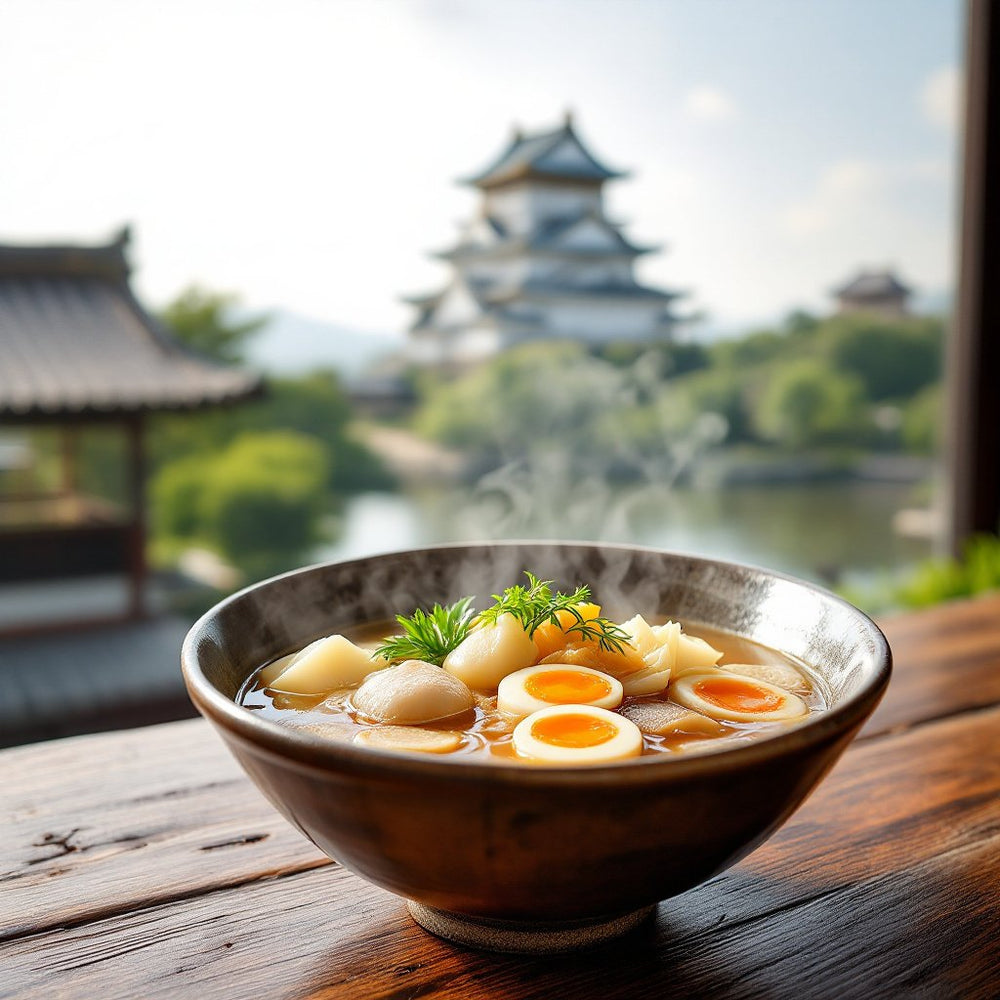
Steaming ramen broth cradles tender wontons and halved soft-boiled eggs with golden yolks, their richness deepening the umami of the dashi. Delicate dill fronds crown the bowl, an unexpected herb that brings brightness to this Himeji interpretation. The castle town's version honors traditional techniques while embracing subtle innovation.
Credits: The Painted Passport
Local cuisine study in Himeji, Japan

☕︎ Local Flavor

Menme

Rating: 5* | Price: $ | Coordinates: 34.8276 N, 134.6908 E

The master here has been pulling noodles by hand for thirty-five years, his movements so practiced they resemble calligraphy. The specialty ekisoba arrives in a delicate dashi made from Awaji Island konbu and bonito flakes shaved that morning. Locals fill every seat by noon, ordering kakiage tempura that shatters at the first bite, revealing threads of fresh burdock root and carrot.

View Entry Details

Kappo Hamasaku

Rating: 5* | Price: $$$ | Coordinates: 34.8314 N, 134.6883 E

Chef Hamasaku sources fish directly from morning auctions in Shirahama, preparing omakase courses that change with tide tables and seasons. The counter seats eight, allowing you to watch him transform just-caught amadai into delicate scales that bloom like chrysanthemums when touched with heat. His wife serves each course with commentary about provenance and preparation, pouring sake from Tatsuno breweries nearby.

View Entry Details

Takenoko

Rating: 4* | Price: $$ | Coordinates: 34.8289 N, 134.6912 E

Bamboo shoots star here during spring, harvested before dawn from the family's grove and served within hours as sashimi, tempura, and rice. Even in winter, the menu celebrates Harima region vegetables prepared with subtle technique that honors their essential flavors. The machiya setting preserves original earthen walls and a small courtyard where camellias drop red petals onto moss-covered stones.

View Entry Details

Nishimuraya Coffee

Rating: 4* | Price: $ | Coordinates: 34.8321 N, 134.6897 E

This kissaten has occupied the same corner since 1948, serving hand-drip coffee from beans roasted weekly in a vintage Fuji Royal machine. The owner's father established the shop after returning from Osaka, bringing with him recipes for thick-cut toast and tamago sandwiches on impossibly soft shokupan. Regulars claim the same seats daily, reading newspapers beneath ceiling fans that have turned for seventy-five years.

View Entry Details

🛌︎ Boutique Stays

Hotel Claire Higasa

Rating: 5* | Price: $$ | Coordinates: 34.8343 N, 134.6939 E

This boutique property sits within walking distance of the castle, housed in a renovated merchant's residence where wooden beams still carry the scent of hinoki cypress. The owners serve breakfast with locally-milled rice and tamago-yaki that arrives still steaming, prepared by the grandmother who has cooked here for forty years. Each room features shoji screens that filter morning light into soft geometric patterns across tatami floors.

View Entry Details

Tokiwaso Ryokan

Rating: 5* | Price: $$$ | Coordinates: 34.8312 N, 134.6895 E

The kaiseki dinner alone justifies a stay at this family-run ryokan, where seasonal ingredients arrive daily from the Seto Inland Sea and mountain foragers. Private onsen baths overlook a moss garden designed in the Edo period, where stone lanterns emerge from carefully pruned azaleas. The current proprietor is the sixth generation, maintaining traditions while offering the rare luxury of complete quietude in the castle town.

View Entry Details

Himeji Guesthouse Sora

Rating: 4* | Price: $ | Coordinates: 34.8298 N, 134.6921 E

Run by a ceramicist and his carpenter wife, this guesthouse occupies a renovated kura storehouse with walls nearly two feet thick that keep summer heat at bay. Communal dinners happen around a reclaimed temple table, where travelers and locals share homemade umeshu and stories. The couple offers morning coffee in handthrown cups, each one slightly different, fired in their kiln out back.

View Entry Details

Nikko Himeji

Rating: 4* | Price: $$ | Coordinates: 34.8356 N, 134.6944 E

Contemporary design meets traditional hospitality in this efficiently elegant hotel steps from Himeji Station. Floor-to-ceiling windows frame the castle floating above the cityscape, particularly stunning during the blue hour before dawn. The public bath on the top floor uses water enriched with local mineral salts, and the lobby library stocks rare books on Japanese castle architecture.

View Entry Details

📍︎ Field Study

Himeji Castle

Rating: 5* | Price: $$ | Coordinates: 34.8394 N, 134.6939 E

The white plastered walls earned this fortress its nickname White Heron Castle, rising in perfect symmetry across six interconnected stories that somehow survived wars and earthquakes since 1609. Recent restoration revealed original construction techniques, including secret corridors and defensive labyrinths designed to confuse invaders. Visit at dawn when mist collects in the moats and you'll understand why castle architects considered this the pinnacle of their art.

View Entry Details

Koko-en Garden

Rating: 5* | Price: $ | Coordinates: 34.8381 N, 134.6927 E

Nine separate walled gardens occupy the former samurai quarter, each demonstrating a different Edo-period landscape philosophy. The tea ceremony garden centers on a reconstructed residence where matcha service happens hourly, served with seasonal wagashi that mirror colors visible through the windows. Koi in the main pond approach the bridges expecting food, their scales flashing copper and white against dark water.

View Entry Details

Shoshazan Engyoji Temple

Rating: 5* | Price: $$ | Coordinates: 34.8669 N, 134.6478 E

Cable cars ascend Mount Shosha to this thousand-year-old temple complex hidden in cryptomeria forests, where halls cascade down the mountainside in arrangements that feel inevitable and eternal. Hollywood filmed The Last Samurai here, drawn by wooden structures weathered silver and the absolute silence between prayer bells. Monks still practice ascetic training in the compound, their chants audible at dusk when fog obscures everything but the temple roofs.

View Entry Details

Himeji City Museum of Art

Rating: 4* | Price: $ | Coordinates: 34.8367 N, 134.6881 E

The permanent collection focuses on Belgian and French post-impressionists, an unexpected treasure curated with obvious passion and deep knowledge. Rotating exhibitions often feature contemporary Japanese artists working in traditional media, providing context for how watercolor and ink painting continue evolving. The building itself, designed by Kiyonori Kikutake, uses raw concrete and angular forms that somehow complement rather than compete with the castle visible from the sculpture garden.

View Entry Details

Typography

Archival Note: We have personally documented these geographic specs for Himeji, Japan to ensure every watercolor study is anchored in real-world data. By cataloging the precise elevation, light cycles, and historical epochs, we provide a technical foundation that justifies the atmospheric stillness captured in our visual artifacts.

Botanical and pigment specimen study for Himeji, Japan Colors of Himeji, Japan
Coordinates
34.8394° N, 134.6939° E — Harima Plain, Hyogo Prefecture
Historical Epoch
Himeji's story centers on 1609, when feudal lord Ikeda Terumasa completed the castle that still dominates the skyline. The Edo period brought prosperity as a castle town, while the 20th century saw the city survive World War II bombing remarkably intact, allowing UNESCO to recognize the fortress as Japan's finest surviving feudal architecture.
Elevation
3–371 m / 10–1,217 ft — Harima coastal plain to Mount Shosha summit
Atmosphere
Cfa - Humid Subtropical. The Seto Inland Sea moderates extremes, bringing mild winters and summers that hover between pleasant and intensely humid depending on the week.
Observation Hour
06:30. Dawn light turns the white walls of Himeji Castle into soft gold and fills Koko-en Garden with long shadows that define every stone and pine branch. The air holds a clarity that makes colors sing before the day warms.
Primary Pigment
Shirasagi White (#F5F5F0) and Maple Crimson (#D4372E)
Best Time to Visit
April or November - cherry blossoms frame the castle in spring pastels, while autumn maples set the gardens ablaze without the summer humidity or winter chill.
Avoid Visiting
August brings oppressive heat and humidity that makes climbing the castle's steep stairs exhausting, while afternoon thunderstorms arrive almost daily.

Behind The Scenes

Nathan

Note from the Founder

Hey, did you know this fun fact about Himeji, Japan? Himeji Castle has never fallen to enemy attack and survived the 1945 firebombing of the city when a single incendiary bomb landed in the main keep but failed to detonate. That unexploded bomb was discovered during post-war repairs and is now displayed in the castle museum.
Thank you for exploring the Himeji, Japan series with us. We hope these notes have inspired you to add this incredible destination to your own passport—we are so glad you're here. — Nathan

Some of our Favorites