Hallstatt, Austria

This Canvas features original artwork from our time in Hallstatt, Austria.
Canvas / Visual Study
Regional Dossier

HALLSTATT, AUSTRIA | "Das Juwel des Salzkammerguts"

Hallstatt is the most photographed village in the Alps — a tiny lakeside settlement of fewer than 800 people clinging to the narrow shelf between the Hallstätter See and the sheer limestone walls of the Dachstein massif in the Austrian Salzkammergut, where the pastel Baroque facades of the 16th and 17th-century townhouses stack above the waterfront in a composition so precise and so perfectly reflected in the still green water that it has become one of the most replicated images in the world. The village sits on a salt deposit mined continuously for over 7,000 years, making it one of the oldest inhabited settlements in Europe and giving its name to the Hallstatt culture — the first Iron Age civilization of Central Europe.

The palette is specific and composed: the pale sage and ochre of the waterfront facades, the deep grey-green of the Hallstätter See in early morning, the brilliant white of the Dachstein limestone catching midday light, and the dark copper of the church spire against an alpine sky. It is a palette of extraordinary restraint that rewards extended attention.

Select Size
Add to the collection for /

$65.00

Finding the Stillness

It's hard to put the "vibe" of a place into words, so we put together a few images that we think show the quiet side of Hallstatt, Austria. These are just some of the textures and small moments that felt special to us while we were exploring.

Hallstatt, Austria visual study 01
Hallstatt, Austria / No. 01 via Willian Justen
The morning light catches the wake of the Stefanie as it glides across impossibly clear water, passengers gathered on deck beneath mountains that rise like ancient sentinels. Snow still clings to the high peaks while spring has already dressed the valley in green, and the church spire stands as it has for centuries, a quiet marker of time and continuity. There's something about the stillness of the lake's reflection that makes you want to sit on those wooden docks and simply watch the light change across the water.
Hallstatt, Austria visual study 02
Hallstatt, Austria / No. 02 via Rashid Khreiss
Traditional wooden houses climb the mountainside in gentle layers, their weathered facades telling centuries of Alpine stories. Soft mist clings to the dramatic peaks above, while the still lake below mirrors the village in perfect calm. There's something profoundly restorative about this place—the way mountain, water, and human life exist in such graceful balance, as if time itself moves more slowly here.
Hallstatt, Austria visual study 03
Hallstatt, Austria / No. 03 via Datingscout
The still water mirrors the old boathouse and the white manor with its fairy-tale turrets, while the forested mountain rises protectively behind. Sunlight filters through the trees, casting a soft glow on the weathered wood and stone—everything feels suspended in time, inviting you to simply breathe and be present. Standing here, you can almost hear the gentle lap of water against the dock and feel the cool mountain air on your skin.

Where to wander

Archival Note: These recommendations were curated personally during our time in Hallstatt, Austria to capture the textures that defined the quiet frequencies of the trip. Every entry here is a place we genuinely love; we hope these notes inspire you to wander off the main path and discover the same stillness we found on the ground.

Local Cuisine Spotlight
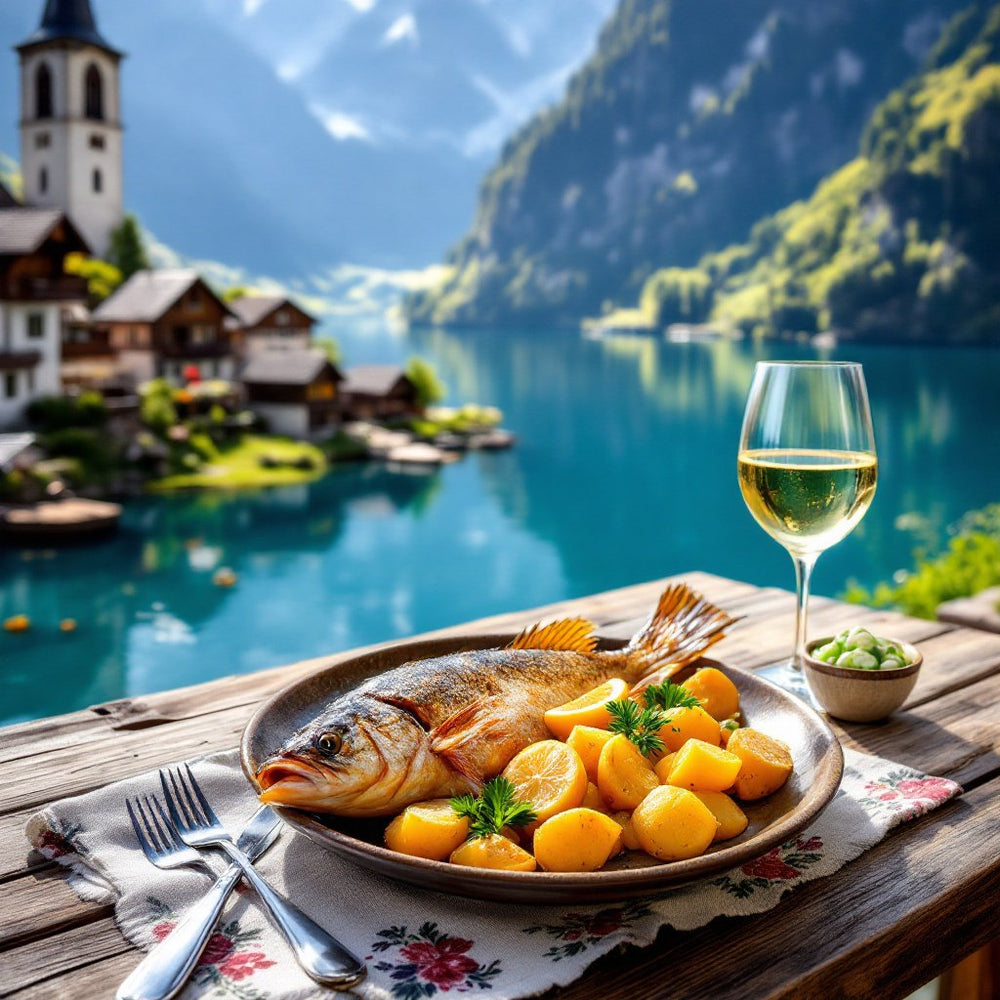
The crystal-clear alpine lakes surrounding Hallstatt yield delicate perch, traditionally pan-fried whole until the skin crisps golden. Served alongside buttery *Erdäpfel* (potatoes) and a glass of crisp Grüner Veltliner, this simple preparation honors centuries of fishing tradition in the Salzkammergut region, where the fish's sweet, flaky flesh needs little embellishment beyond a squeeze of lemon and fresh herbs.
Credits: The Painted Passport
Local cuisine study in Hallstatt, Austria

☕︎ Local Flavor

Restaurant Bräugasthof Hallstatt

Rating: 4★ | Price: $$ | Coordinates: 47.5621° N, 13.6490° E

The historic brewery-turned-restaurant that has occupied the same lakeshore position since the 18th century, serving Hallstätter See trout prepared in the traditional blue-poaching method alongside regional Styrian-Austrian dishes that have evolved little in two hundred years. The terrace extends directly over the water, and on calm evenings the reflection of the Dachstein in the lake is visible from the table.

View Entry Details

Café Konditorei Ruth

Rating: 4★ | Price: $ | Coordinates: 47.5623° N, 13.6492° E

The best Austrian pastry counter in the village — a family-run Konditorei that has been producing Linzer Torte, Apfelstrudel, and Salzburger Nockerl to the same specifications for three generations. The interior is small, genuinely local, and entirely free of the tourist packaging that afflicts most commercial premises in the historic core. The Melange is correct and the Strudel arrives warm.

View Entry Details

Restaurant Simony

Rating: 4★ | Price: $$$ | Coordinates: 47.5625° N, 13.6494° E

The most formal dining room in Hallstatt — a lakeside restaurant attached to the historic Seehotel Simony that serves elevated regional Austrian cuisine with an emphasis on local Salzkammergut ingredients: freshwater fish from the lake, wild mushrooms from the surrounding forests, and dairy from the mountain farms of the Dachstein plateau. The wine list focuses on Wachau Grüner Veltliner and Burgenland Blaufränkisch.

View Entry Details

Marktplatz Street Food & Bakeries

Rating: 4★ | Price: $ | Coordinates: 47.5623° N, 13.6493° E

The cluster of small bakeries, sausage stands, and food stalls around the market square that represent the most economical and most authentically local eating experience in Hallstatt. The Laugenbretzel from the bakery on the north side of the square, the Käsekrainer from the stand near the ferry dock, and the Obstler from the schnapps distillery on the upper lane together constitute the most complete sensory introduction to Salzkammergut food culture available within a 200-metre radius.

View Entry Details

🛌︎ Boutique Stays

Seehotel Hallstatt

Rating: 4★ | Price: $$$ | Coordinates: 47.5622° N, 13.6493° E

The most perfectly positioned property in the village — a lakeside hotel whose balconied rooms look directly across the Hallstätter See to the Dachstein massif, offering the exact composition that has defined Hallstatt's global image. The building occupies a narrow strip of land between the cliff face and the water's edge, placing guests inside the photograph rather than merely viewing it from across the lake.

View Entry Details

Heritage Hotel Hallstatt

Rating: 4★ | Price: $$$ | Coordinates: 47.5624° N, 13.6491° E

A restored 16th-century Salzkammergut townhouse set within the historic core of the village, whose thick stone walls and original timber ceilings carry the specific weight of a building that has observed seven centuries of salt trade, Habsburg administration, and Alpine social life. The breakfast room faces the market square and the Pfarrkirche, providing the most architecturally coherent morning view in the Salzkammergut.

View Entry Details

Gasthof Zur Mühle

Rating: 3★ | Price: $$ | Coordinates: 47.5617° N, 13.6488° E

The most unpretentious and genuinely local accommodation in Hallstatt — a traditional Austrian Gasthof whose rooms are simple, its prices fair, and its position on the northern edge of the village ideally suited to early morning walks before the day-tripper crowds arrive by ferry. The ground-floor restaurant serves proper Salzkammergut cooking: Forelle blau, Schnitzel, and Strudel without theatrical presentation.

View Entry Details

Pension Hallberg

Rating: 4★ | Price: $$ | Coordinates: 47.5620° N, 13.6495° E

A family-run guesthouse perched on the cliff terrace above the village centre, whose elevated position provides the clearest unobstructed view of the lake available from any accommodation in Hallstatt. The rooms are simply furnished in the traditional Austrian Alpine style — pine wood, wool blankets, tiled stove — and the owners maintain the property with the attentiveness that only a genuinely family-operated establishment can sustain over decades.

View Entry Details

📍︎ Field Study

Hallstatt Salt Mine (Salzwelten)

Rating: 5★ | Price: $$ | Coordinates: 47.5598° N, 13.6441° E

The oldest salt mine in the world, in continuous operation for over 7,000 years — a subterranean network of shafts and galleries carved into the Salzberg mountain above Hallstatt that gave the Hallstatt culture its name and its wealth. The tour descends through chambers used by Celtic miners in 800 BCE, past the preserved wooden infrastructure of the Bronze Age workings, and includes the original wooden miners' slide, which remains the most efficient way to descend between levels and has been in use for over two centuries.

View Entry Details

Dachstein Ice Caves

Rating: 5★ | Price: $$ | Coordinates: 47.5167° N, 13.6833° E

A system of glacial ice caves on the Dachstein plateau accessible by cable car from Obertraun, whose interior chambers contain ice formations up to 500 years old — vaulted galleries of blue and white ice shaped by meltwater flowing through the limestone karst over millennia. The Mammoth Cave adjacent to the ice cave preserves geological formations on a scale that makes the human body feel appropriately small. The cable car ascent from the valley floor provides the clearest overhead view of the Hallstätter See available from any fixed infrastructure.

View Entry Details

Pfarrkirche & Beinhaus (Parish Church & Charnel House)

Rating: 5★ | Price: Free | Coordinates: 47.5623° N, 13.6496° E

The Gothic parish church whose distinctive red-painted spire has anchored the Hallstatt skyline for six centuries, set on a narrow terrace above the market square with a charnel house containing over 1,200 decorated skulls — the Beinhaus — that represents one of the most extraordinary medieval funerary traditions in Alpine Europe. The practice of decorating the skulls of the deceased with floral motifs and the names of the departed arose from the practical impossibility of maintaining full graves on the cliff-enclosed land of the village, and it continues today.

View Entry Details

Museum Hallstatt

Rating: 4★ | Price: $ | Coordinates: 47.5624° N, 13.6495° E

The municipal museum that holds the most comprehensive collection of Hallstatt culture artefacts outside Vienna — Bronze Age and Iron Age objects excavated from the Salzberg cemetery since 1846, including the bronze and iron tools, ceramic vessels, amber beads, and ornamental fibulae that established the Hallstatt period as the founding designation of Central European Iron Age archaeology. The collection is presented chronologically and contextually, making it the essential intellectual framework for understanding what the village stands on.

View Entry Details

Typography

Archival Note: We have personally documented these geographic specs for Hallstatt, Austria to ensure every watercolor study is anchored in real-world data. By cataloging the precise elevation, light cycles, and historical epochs, we provide a technical foundation that justifies the atmospheric stillness captured in our visual artifacts.

Botanical and pigment specimen study for Hallstatt, Austria Colors of Hallstatt, Austria
Coordinates
47.5622° N, 13.6493° E — Upper Austria, Salzkammergut lake district
Historical Epoch
Hallstatt culture Iron Age 800–450 BCE. Habsburg salt monopoly 1311. UNESCO World Heritage inscription 1997. Population peak under salt trade 1500s. Continuous salt mining 5000 BCE to present day.
Elevation
511 m / 1,677 ft — valley floor at lake level; Salzberg plateau at 800 m / 2,625 ft
Atmosphere
Oceanic Highland (Cfb). Cool, wet summers averaging 20°C, cold winters with reliable snow and frozen lake periods. The valley geometry channels fog in autumn and creates specific inversion light events where the village sits above the cloud layer with clear blue sky above.
Observation Hour
07:15. The early morning light enters the valley from the east and strikes the pastel waterfront facades before the day-trip boats arrive, when the lake retains its mirror quality and the full elevation of the village — facade, cliff face, and Dachstein — reflects perfectly in the still green water.
Primary Pigment
Hallstatt Sage (#8A9E85) and Dachstein Limestone (#D4CFC8)
Best Time to Visit
May through June — the valley is at its most green, the Dachstein still carries snow for the visual contrast, crowds have not yet peaked, and the morning lake reflections are at their finest before the summer heat creates surface disturbance.
Avoid Visiting
July through August — maximum visitor density, the narrow village paths become genuinely difficult to navigate, and the morning calm is gone by 9 AM when the first day-trip boats arrive.

Behind The Scenes

Nathan

Note from the Founder

Hey, did you know this fun fact about Hallstatt, Austria? The village of Hallstatt was so perfectly replicated in China that a full-scale copy was built in Guangdong province in 2012 — complete with the church spire, the waterfront facades, and an artificial lake.
Thank you for exploring the Hallstatt, Austria series with us. We hope these notes have inspired you to add this incredible destination to your own passport—we are so glad you're here. — Nathan

The Magnets

The Coasters

The Canvas

Some of our Favorites