Edinburgh, Scotland

An original watercolor print from The Painted Passport archive — designed to bring the light, color, and atmosphere of your favorite destinations into your home.
Original Series / Visual Study
Regional Dossier

EDINBURGH, SCOTLAND | "Auld Reekie"

Edinburgh is one of the most dramatically situated capitals in Europe, a medieval city built across volcanic hills above the Firth of Forth, where the Old Town climbs the ridge from Holyrood Palace to Edinburgh Castle along the Royal Mile and the Georgian New Town stretches in rational sandstone grids below. Dean Village, tucked into the gorge of the Water of Leith ten minutes from the city centre, preserves a cluster of 19th-century sandstone mill buildings, the clock tower, conical turret, and warm amber stone catching the low Scottish light in a way that feels entirely removed from the capital a few minutes above. The city produced the Scottish Enlightenment, the first modern encyclopaedia, the foundations of modern economics, and the novels of Walter Scott, all within two generations of the same compact urban fabric of closes, wynds, and eight-storey tenements that solved urban density five centuries before modernism proposed its alternatives and whose solutions still work.

The colors are warm and specific: deep amber sandstone tenements at golden hour, the particular blue-grey sky above Arthur's Seat, the dark basalt of the castle rock rising above the Old Town, and the cool silver of the Water of Leith in the late afternoon light. A palette built from volcanic geology, Scottish light, and four centuries of sandstone accumulation that makes the city feel like it grew from the rock it sits on.

Add to the collection for /

$18.00

Finding the Stillness

It's hard to put the "vibe" of a place into words, so we put together a few images that we think show the quiet side of Edinburgh, Scotland. These are just some of the textures and small moments that felt special to us while we were exploring.

Edinburgh, Scotland visual study 01
Edinburgh, Scotland / No. 01 via Kate Bielinski
Golden evening light washes over Edinburgh's layered skyline, catching the weathered stone of the Dugald Stewart Monument and illuminating centuries of architecture stretching toward the distant hills. The path curves gently downward, inviting you to pause and take in the spires, castle, and tree-lined streets below, while soft clouds drift across an ever-changing Scottish sky. There's a profound stillness here, standing above the old town, where history feels both monumental and intimate all at once.
Edinburgh, Scotland visual study 02
Edinburgh, Scotland / No. 02 via Bayo Adegunloye
The golden hour bathes Edinburgh's historic skyline in amber light, with the Balmoral Hotel's clock tower standing proud against clouds painted in shades of honey and rose. Below, the gentle curve of Princes Street leads the eye toward distant spires and the castle's ancient silhouette, while the day's last sunbeams seem to gather the city in a soft, unhurried embrace. There's something about this light, the way it softens stone and stills time, that makes you want to simply pause and breathe it all in.
Edinburgh, Scotland visual study 03
Edinburgh, Scotland / No. 03 via Rayan De
The still water of Leith becomes a perfect mirror at dusk, doubling the stone buildings and soft pink sky in a moment of complete calm. Edinburgh's old architecture stands solid and timeless along the waterway, their warm lights just beginning to glow as evening settles in. There's something deeply restorative about this kind of urban quietness, the city pausing to breathe, inviting you to do the same.

Where to wander

Archival Note: A curated field study of Edinburgh, Scotland, prioritizing cultural relevance and archival merit. These locations have been meticulously researched and vetted to ensure they represent the most authentic atmosphere for your own expedition.

Local Cuisine Spotlight
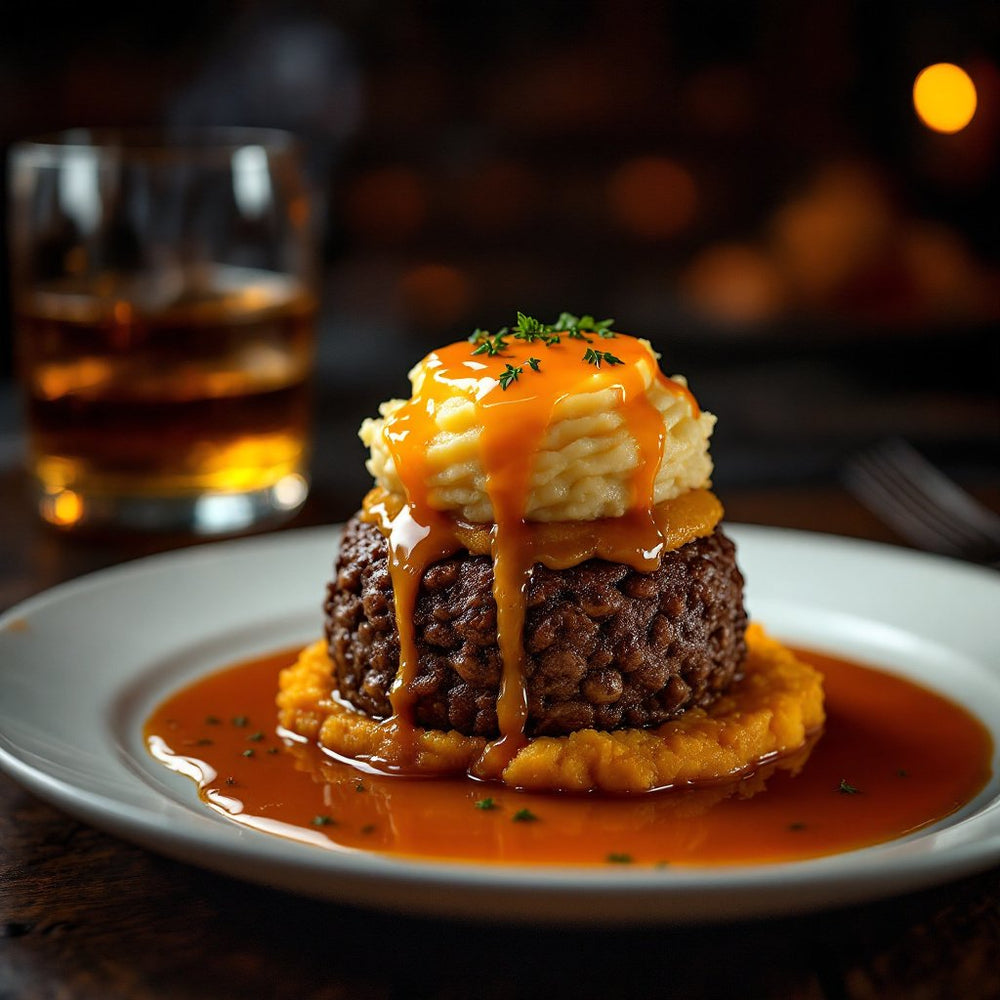
Scotland's national dish arrives as a savoury trinity: spiced haggis, lamb offal and oatmeal in a natural casing, alongside neeps and tatties, each element carrying its own texture and warmth. A whisky cream sauce ties the plate together in the specific amber colour of a Speyside malt held up to the light.
Credits: THE PAINTED PASSPORT
Local cuisine study in Edinburgh, Scotland

☕︎ Local Flavor

The Witchery by the Castle

Rating: 4.7★ | Price: $$$$ | Coordinates: 55.9494° N, 3.1979° W

Ascend to the most theatrically atmospheric restaurant in Scotland — a 16th-century building at the gates of Edinburgh Castle where the dining rooms are furnished with dark oak panelling, embossed leather walls, and antique tapestries that have accumulated over decades into an interior of extraordinary density. The menu is built around the Scottish larder at its most ambitious: dry-aged Aberdeen Angus beef, hand-dived scallops from the west coast, grouse and venison from the Highland estates, and a wine list of over 1,000 bins that documents three decades of serious collecting. The Witchery is a physical manuscript of Edinburgh's capacity for theatrical self-invention — a restaurant that has been preserving the visual language of the Scottish Renaissance interior since 1979 while maintaining a kitchen that takes the Scottish larder as seriously as any in the country.

View Entry Details

The Scran and Scallie

Rating: 4.6★ | Price: $$$ | Coordinates: 55.9544° N, 3.2271° W

Discover the gastropub that Tom Kitchin opened in Stockbridge to bring his Michelin-starred approach to Scottish ingredients into a format accessible for daily life — a neighbourhood pub of dark wood, stone floors, and open fires where the Cullen skink arrives in a properly made version and the haggis, neeps, and tatties is treated as the serious dish it always was rather than the tourist novelty it became. The building dates to the 19th century and sits in the specific residential quarter of the New Town where the Edinburgh intelligentsia has always congregated, two streets from the Water of Leith. The Scran and Scallie preserves the lineage of the Scottish pub as a culinary institution — a place that documents the argument that national cuisine is best served in the kind of room where the local community actually comes to eat.

View Entry Details

Kitchin Restaurant

Rating: 4.8★ | Price: $$$$ | Coordinates: 55.9756° N, 3.1742° W

Navigate to Leith's regenerated waterfront and the one-Michelin-star restaurant where Tom Kitchin has spent nearly twenty years building a kitchen philosophy entirely around Scottish seasonal ingredients and the French classical techniques he learned under Pierre Koffmann and Guy Savoy in London and Paris. The menu changes with what arrives from the farms and boats each morning — razor clams from Skye, wild garlic from the Pentlands, native breed pork from Borders farms — and the resulting tasting sequences document the Scottish larder at its most precise and ambitious. Kitchin is the most important restaurant in Scotland and a physical manuscript of the argument that Scottish food culture had always been defined by exceptional raw material, and that the decades of institutional mediocrity were a failure of confidence rather than a failure of the land.

View Entry Details

Edinburgh Farmers Market

Rating: 4.6★ | Price: $ | Coordinates: 55.9468° N, 3.2070° W

Walk the Saturday market in the shadow of Edinburgh Castle where over 60 Scottish producers gather in the castle esplanade to sell directly to the city — Orkney cheese, Perthshire venison, cold-smoked salmon from the Highlands, handmade oatcakes, and heather honey from the Borders alongside the bakers and preservers and brewers who make up the most concentrated sampling of Scottish food culture available in a single hour on a Saturday morning. The market has been operating in this specific location since 1996 and has become the primary mechanism by which Scottish farmers and small producers maintain a direct relationship with their urban consumers. This market is an anchor for the argument that Scotland has one of the finest food cultures in Europe — documenting the continuity between the Highland and Island producers and the Edinburgh table that supermarket distribution was designed to sever.

View Entry Details

🛌︎ Boutique Stays

The Balmoral Hotel Edinburgh

Rating: 4.8★ | Price: $$$$ | Coordinates: 55.9523° N, 3.1887° W

Inhabit the most iconic building on Princes Street — the Caledonian Railway's 1902 North British Station Hotel, now operating as The Balmoral, whose clock tower has kept Edinburgh time for over a century with one specific exception: the clock runs three minutes fast to help passengers catch their trains, a tradition maintained to this day as an act of functional civic generosity. The interior combines the Edwardian grandeur of the original building with contemporary Scottish craftsmanship in the bedrooms — Harris Tweed headboards, Arran cashmere throws, and artwork commissioned from Scottish artists across all 168 rooms. The Balmoral is the most architecturally significant hotel in Scotland and a physical manuscript of the civic ambition of the Caledonian Railway — a building that has been documenting the arrivals and departures of Edinburgh life from the same corner since 1902.

View Entry Details

Prestonfield House Hotel

Rating: 4.8★ | Price: $$$$ | Coordinates: 55.9380° N, 3.1666° W

Rest in a 1687 house at the foot of Arthur's Seat — the most extraordinary country house hotel in Scotland, where every room is furnished with an accumulation of damask, velvet, taxidermy, antique portraiture, and Jacobean oak that makes the interior feel less like a hotel and more like being inside the private collection of someone who has been acquiring beautiful things for three hundred years without ever running out of space. The restaurant occupies the original dining room and serves Scottish produce to a standard that matches the interior ambition. Prestonfield preserves the lineage of the Scottish country house as a specific architectural and social institution — a place that documents the tradition of Scottish hospitality at its most confident and idiosyncratic, within walking distance of the city centre.

View Entry Details

Hotel du Vin Edinburgh

Rating: 4.6★ | Price: $$$ | Coordinates: 55.9456° N, 3.1942° W

Unearth a converted Georgian townhouse in the Old Town, two minutes from the Royal Mile, where the Hotel du Vin group has preserved the original Georgian bones — high ceilings, deep sash windows, original stone staircase — while adding the wine-focused identity that defines the brand in a city whose drinking culture has always been more whisky than Bordeaux. The whisky snug is one of the finest whisky bars in Edinburgh with over 200 expressions arranged by region and distillery, and the bistro serves properly made Scottish classics alongside a wine list built for serious drinking rather than margin. Hotel du Vin Edinburgh documents the Georgian New Town townhouse as a living residential institution — a building that has maintained its domestic scale and urban character across two centuries of the city's transformation.

View Entry Details

The Witchery Suites

Rating: 4.9★ | Price: $$$$ | Coordinates: 55.9494° N, 3.1979° W

Sleep in nine suites carved from 16th and 17th-century buildings at the gates of Edinburgh Castle — each one furnished with an extraordinary density of antique textiles, carved oak, painted ceilings, freestanding baths, and four-poster beds that constitute the most theatrical accommodation in Scotland and possibly in Britain. James Thomson has been collecting and installing the contents of these rooms since 1979 and the result is a sequence of interiors that function simultaneously as private apartments and as curated archives of Scottish decorative arts from the Renaissance period. The Witchery Suites are a physical manuscript of Edinburgh's deep architectural and decorative history — rooms that preserve the visual language of the Scottish Renaissance as a lived, inhabited experience rather than a museum reconstruction.

View Entry Details

📍︎ Field Study

Edinburgh Castle Guided Tour

Rating: 4.7★ | Price: $$ | Coordinates: 55.9486° N, 3.2008° W

Ascend the volcanic rock that has been fortified since the Iron Age and that has served as the seat of Scottish royal power, the repository of the Scottish Crown Jewels, and the defining topographical feature of the city for over a thousand years — the castle rock rises 130 metres above sea level on three sheer sides, making it one of the most naturally defensive sites in Europe and the reason Edinburgh exists where it does. The Honours of Scotland — the Crown, Sceptre, and Sword of State dating from the 15th and 16th centuries — are the oldest surviving Crown Jewels in the British Isles, on permanent display in the Crown Room alongside the Stone of Destiny, the ancient coronation seat of Scottish kings. Edinburgh Castle is the most concentrated physical archive of Scottish statehood ever assembled — a complex that has been documenting the continuity of Scottish political and military ambition from the Iron Age to the present in the fabric of its successive building phases.

View Entry Details

Royal Mile and Old Town Walking Tour

Rating: 4.8★ | Price: $ | Coordinates: 55.9492° N, 3.1883° W

Navigate the medieval spine of Edinburgh with a specialist guide who can read the specific architectural layers of the Royal Mile — the closes and wynds that run off the main street, the tenement buildings that reach eight and nine stories because the ridge was too narrow to expand sideways, and the specific compression of Scottish urban life that produced the social mixing and intellectual energy of the Scottish Enlightenment in streets where philosophers and fishwives occupied the same staircase. The closes preserve the pre-Georgian street pattern of the medieval city in extraordinary detail — Mary King's Close alone documents four centuries of continuous urban occupation beneath the later buildings. This walk is a guided reading of a city that solved the problem of urban density five hundred years before modernism proposed its alternatives, and whose solutions still work.

View Entry Details

Loch Lomond and the Highlands Day Trip

Rating: 4.8★ | Price: $$ | Coordinates: 56.0900° N, 4.5800° W

Journey north from Edinburgh through the Forth Valley into the Scottish Highlands — passing Stirling Castle, the Wallace Monument above the River Forth, and the Highland Boundary Fault that marks the geological divide between the Scottish Lowlands and the Highland massif, before descending to Loch Lomond, the largest freshwater lake in Great Britain by surface area at 71 square kilometres. The light on the loch changes every thirty minutes as the cloud cover shifts above the Munros to the north and west, and the specific quality of Highland light — blue-grey, vast, and without reference — is something that no photograph quite renders. This day trip documents the transition between two entirely different Scotlands in a single journey — the agricultural lowland that produced the Enlightenment and the Highland wilderness that produced the mythology.

View Entry Details

Scotch Whisky Experience Tour

Rating: 4.7★ | Price: $$ | Coordinates: 55.9490° N, 3.1987° W

Discover the most comprehensive whisky education experience in Scotland at the purpose-built attraction beside Edinburgh Castle, where the production process, the five whisky regions, and the specific sensory vocabulary of Scotch are taught through guided tasting sequences developed in collaboration with the Scotch Whisky Association. The Silver Tour includes tastings from all five regions — Campbeltown, Highland, Islay, Lowland, and Speyside — chosen to demonstrate the specific relationship between the geography, water source, and peat level of each region and the character of its spirit. The Scotch Whisky Experience is a physical manuscript of the Scottish relationship with distillation — an institution that has been documenting the specific technical and cultural tradition of Scotch production since 1988, at the point where the Royal Mile meets the castle rock that the tradition has always been made in the shadow of.

View Entry Details

Typography

Archival Note: A formal technical study of Edinburgh, Scotland, archiving the coordinates, elevation, and environmental data that define the region. This data serves as a vital record for our ongoing global field study, providing the technical foundation behind every atmospheric detail captured in our visual work.

Botanical and pigment specimen study for Edinburgh, Scotland Colors of Edinburgh, Scotland
Coordinates
55.9533° N, 3.1883° W — Lothian, Firth of Forth, south-east Scotland
Historical Epoch
Celtic hillfort 600 BCE. Edinburgh Castle established 7th century CE. Medieval burgh from 1130. Acts of Union 1707. Scottish Enlightenment 1740-1800. Georgian New Town 1765-1850. Devolution and Scottish Parliament 1999.
Elevation
0–251 m / 0–823 ft, city built across volcanic hills with Arthur's Seat as the highest point
Atmosphere
Oceanic (Cfb). Cool, wet, and changeable year-round, mild summers and cold winters. The haar rolls in from the Firth of Forth unpredictably. Best light is autumn, clear, amber, and low-angled across the sandstone.
Observation Hour
19:30. Golden hour on the Dean Village sandstone as the summer sun drops toward the Pentland Hills, the amber stone warming to deep gold and the Water of Leith catching the last light below the mill buildings.
Primary Pigment
Dean Village Amber (#C4874A) and Castle Basalt (#4A4A52)
Best Time to Visit
April through June, the Scottish spring light is extraordinary, the city is not yet at Festival capacity, and the long evenings let you walk the Water of Leith in the last of the light.
Avoid Visiting
August, the Edinburgh Festival triples the city's population, doubles hotel prices, and turns the Royal Mile into something requiring patience.

Behind The Scenes

Nathan

Note from the Founder

Hey, did you know this fun fact about Edinburgh, Scotland? Edinburgh has more listed buildings per square kilometre than any other city in the UK, and the Old and New Towns form a single UNESCO World Heritage Site.
Thank you for exploring the Edinburgh, Scotland series with us. We hope these notes have inspired you to add this incredible destination to your own passport—we are so glad you're here. — Nathan

Some of our Favorites