Paris, France

Golden hour drapes the grand boulevard in amber, spilling across white-clothed tables as lamplight blooms against Haussmann stone. This watercolor study of the Champs-Elysees cafe terraces in Paris glows with warm ochre and soft dusk blue, tender and luminous.
Original Series / Visual Study
Regional Dossier

PARIS, FRANCE | "La Ville-Lumière"

Paris is the most painted city in the world, a 2,000-year-old capital on the Seine where the specific quality of the light, the geometry of the Haussmann boulevards, and the limestone of the 19th-century facades have produced a visual language so particular that it has defined Western ideas of beauty, elegance, and urban order for three centuries. The city's transformation under Baron Haussmann between 1853 and 1870 replaced the medieval street network with 137 km of uniform cream-stone boulevards, creating the perspectival city of aligned facades and vanishing-point views toward monuments that painters and photographers have documented ever since. In spring, the chestnut trees along the grands boulevards bloom in white and pink against the pale zinc of the Mansard rooflines, and the combination of botanical color, dressed stone, and diffused northern light produces the specific atmospheric signature of Paris in April that has drawn artists to the city for five centuries.

The colors are cool and specific: the blue-grey zinc of the Haussmann rooftops under an overcast sky, the warm amber of the limestone facades at golden hour, the deep green of the iron metro entrances and park benches, and the particular pale gold of the sandstone at Versailles in the afternoon light. It is a palette of controlled elegance, a city that has always known exactly what it looks like.

Select Size
Museum-Grade Canvas
Ready to Hang
Made to Order · Ships in 3–5 Days (U.S.)
Add to the collection for /

$65.00

Finding the Stillness

It's hard to put the "vibe" of a place into words, so we put together a few images that we think show the quiet side of Paris, France. These are just some of the textures and small moments that felt special to us while we were exploring.

Paris, France visual study 01
Paris, France / No. 01 via Léonard Cotte
As day transitions into night, Paris glows with a quiet, timeless elegance under a soft lavender sky. The warm, golden streetlamps of the Pont Alexandre III cast beautiful reflections across the gentle ripples of the Seine, inviting a sense of peace and wonder. It’s a breathtaking reminder of how beautifully history and romance intertwine in the Heart of Light.
Paris, France visual study 02
Paris, France / No. 02 via Joe deSousa
A vibrant golden sunset washes over the Seine, casting a warm, comforting glow across the historic heart of Paris. People gather along the stone banks to relax and share stories, while a river boat glides gracefully through the water, capturing the city's lively yet deeply peaceful spirit. It is a beautiful reminder of the simple joy found in pausing to watch the day gently fade away.
Paris, France visual study 03
Paris, France / No. 03 via 3
Bathed in the bright, clear light of a beautiful afternoon, the iconic glass pyramid of the Louvre stands as a striking symbol of modern creativity meeting historic grandeur. Visitors from around the world gather in the expansive courtyard, finding a moment of shared inspiration amidst the dancing fountains and timeless architecture. It captures the vibrant, uplifting energy of a city that seamlessly bridges its rich heritage with the promise of the future.

Where to wander

Archival Note: A curated field study of Paris, France, prioritizing cultural relevance and archival merit. These locations have been meticulously researched and vetted to ensure they represent the most authentic atmosphere for your own expedition.

Local Cuisine Spotlight
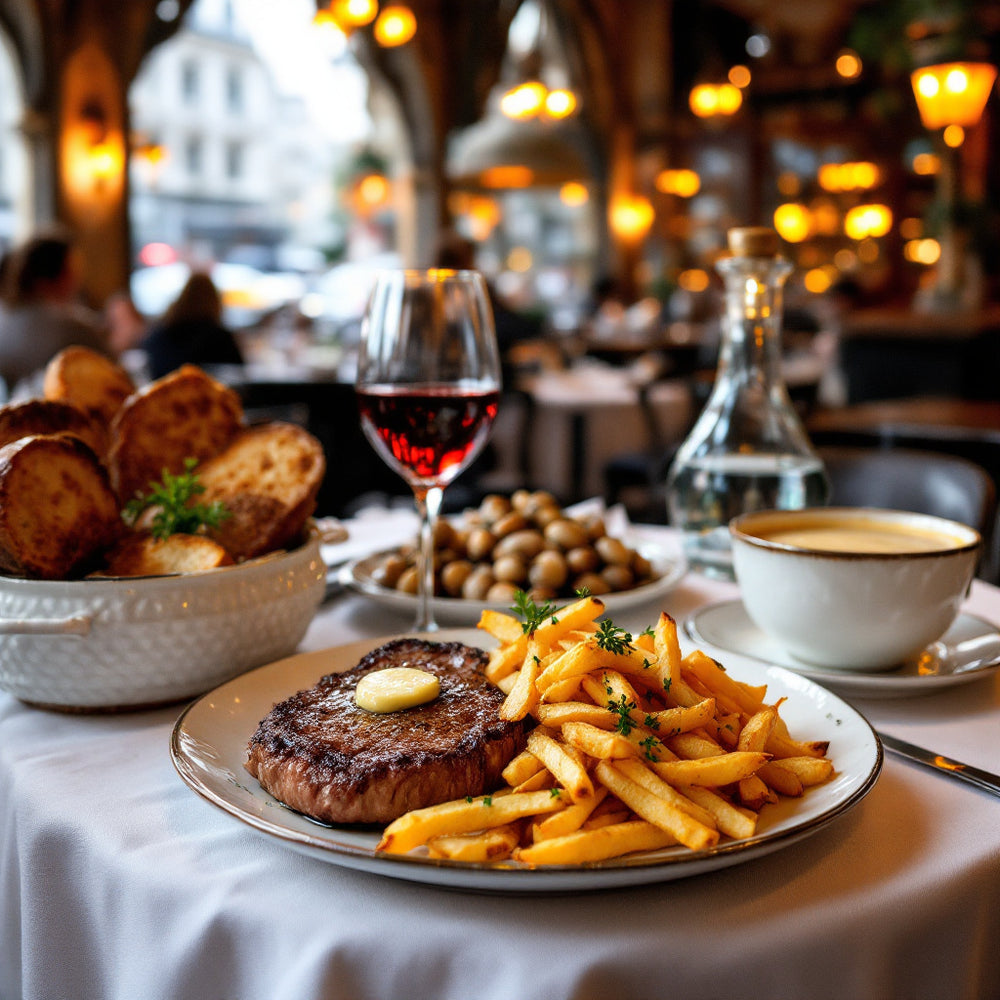
The warm, inviting ambiance of a Parisian bistro comes alive over a classic meal of steak frites paired with a rich glass of red wine. Nestled beneath softly glowing lights and arches, this cozy table setting captures the effortless romance and comforting joy of European dining. It is an inspiring reminder to slow down, savor the moment, and enjoy life's delicious simplicity.
Credits: 5
Local cuisine study in Paris, France

☕︎ Local Flavor

Le Jules Verne

Rating: 4.8★ | Price: $$$$ | Coordinates: 48.8584° N, 2.2945° E

Ascend 125 meters above the city on a private elevator to one of the most architecturally charged dining rooms on earth. Chef Frédéric Anton works with aged meats, black truffles, and hand-harvested sea vegetables in a two-Michelin-star kitchen suspended inside Gustave Eiffel's 1889 iron lattice. This table is a physical manuscript of French culinary ambition — a place where the city's relationship with beauty, elevation, and the art of the meal is documented in every course.

View Entry Details

Septime

Rating: 4.7★ | Price: $$$ | Coordinates: 48.8531° N, 2.3799° E

Navigate the reservation system — open daily at 10am, books out within minutes — and you will earn a seat at what many consider the most honest table in Paris. Chef Bertrand Grébaut works with whatever arrived from the Loire Valley and Brittany that morning, plating it in a stripped-back dining room of raw concrete and oak that feels more like a Scandinavian workshop than a French restaurant. Septime documents the transition from ceremony to substance in Parisian dining — a lineage of local, seasonal cooking that has quietly shifted the city's culinary identity.

View Entry Details

Marché des Enfants Rouges

Rating: 4.6★ | Price: $$ | Coordinates: 48.8625° N, 2.3589° E

Discover the oldest covered market in Paris — operating continuously since 1628 — tucked into a courtyard in the heart of Le Marais behind green iron gates on Rue de Bretagne. The stalls sell Moroccan couscous, Japanese bento, Lebanese mezze, French cheese, and fresh oysters from the same vendors who have occupied this footprint for generations, eaten standing at communal wooden tables under a glass roof. This market is an anchor for the city's multicultural identity and a rare surviving example of how Paris has historically processed the world into its daily life.

View Entry Details

Le Comptoir du Relais

Rating: 4.6★ | Price: $$$ | Coordinates: 48.8525° N, 2.3397° E

Settle into one of the zinc-topped tables at this Saint-Germain-des-Prés institution and let chef Yves Camdeborde's brasserie menu — built around aged Basque pork, slow-braised lamb, and daily market vegetables — remind you what French bistro cooking was always supposed to feel like. The building dates to the early 1800s and the single-page handwritten menu changes with the seasons and whatever the chef found at Rungis market at dawn. Le Comptoir preserves the lineage of the neighborhood brasserie as a living social institution — a place where the ritual of lunch still structures the Parisian day.

View Entry Details

🛌︎ Boutique Stays

Ritz Paris

Rating: 4.9★ | Price: $$$$ | Coordinates: 48.8688° N, 2.3292° E

Step into the architectural ambition of César Ritz, who built his vision of the perfect hotel in 1898 on the Place Vendôme — a palace of gilded boiseries, hand-knotted Aubusson carpets, and a bar where Hemingway famously claimed he helped "liberate" Paris in 1944. The hotel spans two 18th-century mansions connected by a garden gallery, each room furnished with period Louis XVI and Directoire pieces sourced by Ritz himself. This address is a physical manuscript of the idea of Paris as a global standard for luxury — the place that defined what the world expected a great hotel to be.

View Entry Details

Hotel Grand Mazarin

Rating: 4.7★ | Price: $$$ | Coordinates: 48.8556° N, 2.3524° E

Rest within a converted 17th-century Marais townhouse that has been reconfigured into a 29-room boutique hotel of natural stone, hand-painted silk walls, and exposed oak beams that tell the story of the building's original life as a merchant's residence. The location places you between the Place des Vosges and the Pompidou Centre — the historical and contemporary poles of the arrondissement — within walking distance of every gallery, market, and courtyard that makes this neighborhood the most architecturally dense in the city. Grand Mazarin documents the transition of Le Marais from aristocratic quarter to living cultural archive, preserved in the fabric of its walls.

View Entry Details

Hotel Montalembert

Rating: 4.7★ | Price: $$$ | Coordinates: 48.8561° N, 2.3222° E

Inhabit a quietly elegant Left Bank address on Rue de Montalembert in the 7th arrondissement, four blocks from the Seine and within walking distance of the Musée d'Orsay, the Rodin museum, and the bookshops of Saint-Germain-des-Prés. The hotel was originally constructed in 1926 and renovated with warm walnut paneling, cream limestone, and a library sitting room that reflects the intellectual character of the neighborhood it occupies. Montalembert is an anchor for the Left Bank's identity as Paris's thinking quarter — a place where writers, publishers, and artists have historically done their best work.

View Entry Details

Hotel des Grands Boulevards

Rating: 4.6★ | Price: $$$ | Coordinates: 48.8711° N, 2.3479° E

Unearth one of the most talked-about hotel openings of the last decade — a 50-room property carved from a 19th-century Haussmann building on the Boulevard des Italiens, with an interior designed by Dorothée Meilichzon that layers terracotta tiles, velvet booths, rattan, and antique mirrors into something that feels deeply Parisian without being nostalgic. The rooftop bar, framed by zinc and overlooking the second arrondissement's roofline, has become one of the city's most sought-after evening addresses. This hotel preserves the lineage of the Grand Boulevards as Paris's entertainment spine — the same strip where Offenbach premiered his operettas and where the city still goes to be seen.

View Entry Details

📍︎ Field Study

Palace of Versailles Skip-the-Line Guided Tour

Rating: 4.8★ | Price: $$ | Coordinates: 48.8049° N, 2.1204° E

Navigate directly past the queues that can stretch for two hours in peak season and enter the Hall of Mirrors — 73 meters of painted barrel vault, 357 gilded mirrors, and 20,000 candles — with a guide who can place you in the specific political moment that produced it. Louis XIV commissioned Jules Hardouin-Mansart to construct this wing between 1678 and 1684 as a deliberate demonstration of French supremacy over the Dutch Republic, each mirror panel a reflection of windows placed opposite to suggest that Versailles had more light than any palace in Europe. The palace is a physical manuscript of absolute monarchy — a document of how architecture can be weaponized as a statement of geopolitical power.

View Entry Details

Louvre Museum Highlights Small-Group Tour

Rating: 4.8★ | Price: $$ | Coordinates: 48.8606° N, 2.3376° E

Navigate the largest museum on earth — 72,735 square meters of galleries across three wings of a former royal palace — with a specialist guide who has mapped the most meaningful path through 35,000 works. The Denon Wing holds the Italian Renaissance collection, the Richelieu Wing the Flemish masters, and the Sully Wing the ancient Near East and Egypt collections, all arranged within a palace that has served as fortress, royal residence, revolutionary archive, and museum over 800 years. The Louvre is the most ambitious cultural archive ever constructed — an institution that has been actively documenting humanity's visual history since 1793.

View Entry Details

Montmartre Artist Quarter Walking Tour

Rating: 4.9★ | Price: $ | Coordinates: 48.8867° N, 2.3431° E

Climb through the steep limestone streets of Montmartre with a guide who can trace the specific addresses where Van Gogh lived at 54 Rue Lepic, where Picasso developed Cubism at the Bateau-Lavoir on Place Émile-Goudeau, and where the Sacré-Coeur Basilica rose in Romanesque-Byzantine white travertine stone between 1875 and 1914. The hill's geology — it sits on a gypsum quarry that gave Paris its limestone building material for centuries — produced the specific village character that has always made it feel separate from the city below. Montmartre is an archive of the moment when Paris became the center of the modern art world — a hillside that still holds the physical memory of the most concentrated creative energy in the history of Western culture.

View Entry Details

Seine River Evening Cruise with Aperitif

Rating: 4.7★ | Price: $$ | Coordinates: 48.8566° N, 2.3522° E

Board a glass-topped boat near the Pont Neuf as the evening light drops below the roofline and the city transitions from amber to gold — passing Notre-Dame de Paris, the Musée d'Orsay, the Eiffel Tower, and the Pont Alexandre III in sequence from the water level that Haussmann's urban redesign was specifically calibrated to be seen from. The Seine has been the operational spine of Paris since the city's founding as a Gaulish fishing village on the Île de la Cité in the 3rd century BCE, and the river's UNESCO-listed banks constitute the single most photographed stretch of urban architecture in the world. This cruise documents the city as it was designed to be experienced — from the water, at dusk, with a glass of something cold.

View Entry Details

Typography

Archival Note: A formal technical study of Paris, France, archiving the coordinates, elevation, and environmental data that define the region. This data serves as a vital record for our ongoing global field study, providing the technical foundation behind every atmospheric detail captured in our visual work.

Botanical and pigment specimen study for Paris, France Colors of Paris, France
Coordinates
48.8566° N, 2.3522° E — Île-de-France, Seine River basin, northern France
Historical Epoch
Celtic Parisii settlement from 3rd century BCE. Roman Lutetia from 52 BCE. Medieval capital of the Frankish kingdom. Haussmann's urban transformation 1853–1870. Capital of the Third Republic and center of the Belle Époque from 1871.
Elevation
28–130 m / 92–427 ft, broadly flat basin city with Montmartre hill as the highest point
Atmosphere
Oceanic (Cfb). Mild and overcast much of the year, with warm summers and cool wet winters. The diffused northern light that makes the city so paintable is a direct product of this climate, grey skies that flatten shadows and soften everything.
Observation Hour
19:45. Golden hour on the Haussmann limestone facades as the summer sun drops toward the western horizon, the cream stone turning to deep amber and the zinc rooftops catching the last light in long blue-grey planes above the boulevard perspective lines.
Primary Pigment
Haussmann Limestone (#E8DCC8) and Seine Zinc (#8A9BA8)
Best Time to Visit
April through June, the chestnut trees are in bloom, the light is extraordinary, and the city has not yet reached the tourist pressure of high summer.
Avoid Visiting
July through August, peak heat, maximum crowds at every major site, and hotel prices at their highest. The city empties of Parisians and fills with visitors.

Behind The Scenes

Nathan

Note from the Founder

Hey, did you know this fun fact about Paris, France? The Eiffel Tower was originally meant to be dismantled after the 1889 World's Fair. The only reason it survived was its usefulness as a radio transmission tower. Paris's most iconic structure was saved by antenna cable.
Thank you for exploring the Paris, France series with us. We hope these notes have inspired you to add this incredible destination to your own passport—we are so glad you're here. — Nathan

Some of our Favorites