Bruges, Belgium

This Canvas features original artwork from our time in Bruges, Belgium.
Canvas / Visual Study
Regional Dossier

BRUGES, BELGIUM | "Het Venice van het Noorden"

Bruges is a medieval Flemish city of extraordinary completeness — a compact historic centre of Gothic brick architecture, stepped-gable merchant houses, and a network of still green canals that have preserved the specific urban character of a prosperous 14th-century trading port in a state that few cities in northern Europe can match. The city reached the height of its commercial power between 1200 and 1400, when the Zwin estuary connected it directly to the North Sea and made it the primary trading hub of northern Europe — the place where English wool, Baltic grain, Italian silk, and Iberian spice met and were exchanged by Flemish merchants whose wealth funded the greatest painting tradition outside of Italy. When the Zwin silted in the 1490s and trade shifted to Antwerp, Bruges entered a 400-year economic sleep so complete that the Industrial Revolution passed it by entirely, and the medieval fabric survived intact while every comparable city in northern Europe was rebuilt.

The palette is cool and composed: the warm terracotta of the Flemish brick against the grey North Sea sky, the deep slate of the Gothic spires, the still green-grey of the Groenerei canal in morning light, and the stepped white stone of the gable copings catching whatever sun the Flemish climate allows. It is a palette of considerable restraint that the Flemish Primitives — van Eyck, Memling, van der Goes — understood and exploited with unequalled precision.

Select Size
Add to the collection for /

$65.00

Finding the Stillness

It's hard to put the "vibe" of a place into words, so we put together a few images that we think show the quiet side of Bruges, Belgium. These are the textures and small moments we've archived to capture the stillness of this corner of the world.

Bruges, Belgium visual study 01
Bruges, Belgium / No. 01 via Despina Galani
The afternoon light catches the worn brick facades and terracotta rooftops along the canal, their reflections softening in the still water below. Medieval buildings lean gently toward one another as they've done for centuries, while the belltower stands watch over this timeless scene. There's something deeply calming about places like this—where stone and water have kept each other company for so long that even the birds gliding overhead seem unhurried.
Bruges, Belgium visual study 02
Bruges, Belgium / No. 02 via Adelio
The medieval brick buildings of Bruges rise gently behind a cascade of fall foliage, where maples blaze in shades of crimson, amber, and gold against the soft afternoon sky. The old chimneys and stepped gables seem to rest contentedly among the trees, as if the architecture and nature have reached a quiet understanding over centuries. There's something deeply calming about watching a historic city transform with the seasons, the ancient stones witnessing yet another autumn while the leaves perform their annual symphony of color.
Bruges, Belgium visual study 03
Bruges, Belgium / No. 03 via Niels Bosman
The late afternoon sun catches the intricate Gothic stonework of Bruges' town hall, casting gentle shadows across its ornate facade while flags from across Europe lift softly in the breeze. Each carved detail and weathered spire tells centuries of stories, standing with quiet dignity against the clear blue sky. There's something deeply calming about standing here, watching how the golden light transforms this medieval architecture into something almost ethereal, a reminder that beauty often asks nothing more than our presence.

Where to wander

Archival Note: A curated field study of Bruges, Belgium, prioritizing cultural relevance and archival merit. While we haven't touched down here yet, we've meticulously vetted these locations through our global network of contributors to ensure they represent the most authentic atmosphere for your own expedition.

Local Cuisine Spotlight
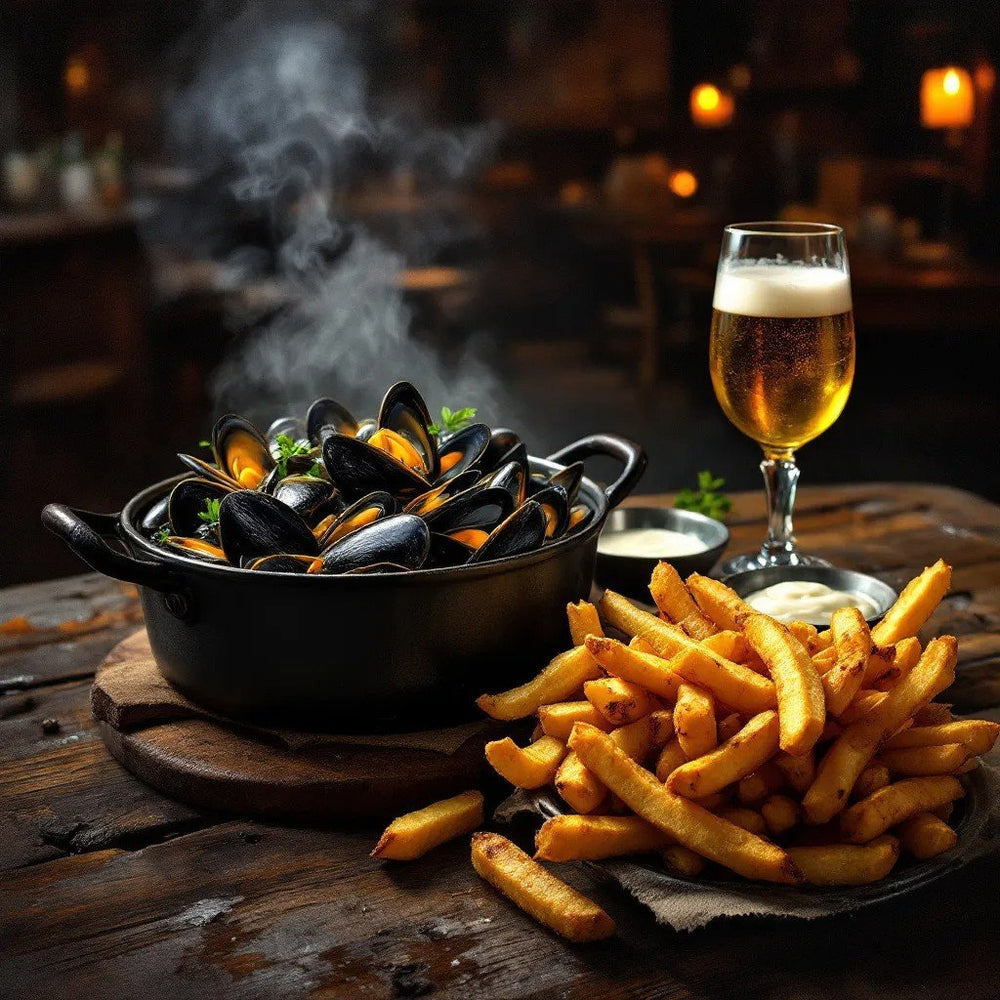
Black-shelled mussels steamed in white wine, shallots, and parsley arrive in a traditional pot, their briny sweetness perfumed with herbs and butter. Paired with golden, twice-fried potatoes—crisp outside, fluffy within—this is Belgian coastal dining at its essence. Born in the cafés of Bruges and Brussels, the dish marries the North Sea's bounty with Flemish precision.
Credits: The Painted Passport
Local cuisine study in Bruges, Belgium

☕︎ Local Flavor

Den Dyver

Rating: 5★ | Price: $$$ | Coordinates: 51.2058° N, 3.2248° E

The most serious Belgian beer-cuisine restaurant in Bruges — a canalside dining room on the Dijver whose kitchen has spent three decades developing a cooking style that pairs every course with a specific Trappist, lambic, or regional ale, treating Belgian beer with the same seriousness that French restaurants bring to wine. The waterzooi is prepared in the traditional Bruges manner using local freshwater fish from the Flemish polder rivers, and the moules-frites arrive in a copper pot with a bottle of Rodenbach Grand Cru.

View Entry Details

Bistro De Schaar

Rating: 4★ | Price: $$ | Coordinates: 51.2077° N, 3.2186° E

The most honest kitchen in the Sint-Anna quarter — a neighbourhood bistro serving traditional Flemish cooking to a clientele of local residents who have been eating the same menu of stoofvlees, paling in 't groen, and Bruges wafels for years. The interior is dark wood and tiled floor, the prices are fair, and the service operates without the theatrical attention that tourist restaurants around the Markt perform. The Flemish beef stew is braised in Westmalle Dubbel and served with hand-cut frites and homemade mayonnaise.

View Entry Details

Café Vlissinghe (est. 1515)

Rating: 5★ | Price: $ | Coordinates: 51.2090° N, 3.2205° E

The oldest café in Bruges, in continuous operation since 1515 — a single room of dark wood, Belgian lace curtains, and iron stove whose interior has changed little in five centuries of serving the city. The current menu is simple: Belgian ales on tap, jenever from the local Filliers distillery, and cold cuts on a wooden board. The garden behind the café, accessible through a low doorway, is one of the most pleasant outdoor spaces in the city on a warm afternoon.

View Entry Details

The Chocolate Line

Rating: 5★ | Price: $$ | Coordinates: 51.2082° N, 3.2247° E

The finest chocolate atelier in Bruges — a shop on the Simon Stevinplein run by Dominique Persoone, a chocolatier whose experimental approach to flavour has made the Chocolate Line the single most interesting food destination in a city whose chocolate shops collectively constitute a serious claim to being the world capital of the medium. The single-origin bars and fresh ganaches are produced daily in the atelier behind the shop, and the praline selection changes seasonally with the availability of ingredients from the Belgian countryside.

View Entry Details

🛌︎ Boutique Stays

Hotel De Orangerie

Rating: 5★ | Price: $$$$ | Coordinates: 51.2060° N, 3.2248° E

A 15th-century convent converted into the most intimate luxury hotel in Bruges — a canalside property on the Dijver whose 20 rooms occupy a restored Flemish Gothic building whose stone walls and original timber beams preserve the specific atmosphere of a building that has stood through six centuries of Bruges' rise, decline, and extraordinary preservation. The hotel's terrace extends directly over the canal, and the early morning view of the water and the medieval roofline from the breakfast room is the best available from any property in the city.

View Entry Details

Relais Bourgondisch Cruyce

Rating: 5★ | Price: $$$$ | Coordinates: 51.2063° N, 3.2251° E

A pair of restored 15th-century Flemish merchant houses at the junction of the Groenerei and the Dijver — the most photographed canal intersection in Bruges — whose 16 rooms occupy a building whose stepped-gable facade has appeared in paintings, engravings, and photographs of the city for centuries. The location is architectural: guests are positioned inside the view that defines Bruges globally, rather than looking at it from across the water.

View Entry Details

Hotel Heritage

Rating: 5★ | Price: $$$ | Coordinates: 51.2091° N, 3.2237° E

A neoclassical mansion on the Niklaas Desparsstraat — a quiet street two minutes from the Markt — whose 24 rooms combine the original 19th-century architectural fabric with a level of comfort that places it among the best hotels in the Flemish cities. The building was constructed in 1869 for a prominent Bruges banking family and maintains the specific character of a private house rather than a commercial hotel, which in a city of 50,000 with a UNESCO-listed historic centre is a meaningful distinction.

View Entry Details

Maison de Sneppe B&B

Rating: 4★ | Price: $$ | Coordinates: 51.2070° N, 3.2188° E

A family-run B&B in a 17th-century Flemish townhouse in the Sint-Anna quarter — the quietest and most genuinely local neighbourhood of the medieval centre, away from the day-tripper circulation of the Markt and the Burg. The rooms are simply furnished in the Flemish tradition and the owners maintain the property with the specific attentiveness that only a genuinely family-operated establishment can sustain. The Sint-Anna windmills are visible from the upper floor windows.

View Entry Details

📍︎ Field Study

Groeningemuseum

Rating: 5★ | Price: $ | Coordinates: 51.2052° N, 3.2244° E

The definitive collection of Flemish Primitive painting — a small museum on the Dijver whose rooms contain the works that established northern European painting: Jan van Eyck's Madonna with Canon van der Paele, Hans Memling's Moreel Triptych, and Hieronymus Bosch's Last Judgment. These paintings were made in Bruges at the height of its commercial power in the 15th century and have not left since. The Groeningemuseum occupies perhaps 90 minutes of serious attention but represents one of the most concentrated accumulations of great painting in northern Europe.

View Entry Details

Rozenhoedkaai Viewpoint

Rating: 5★ | Price: Free | Coordinates: 51.2067° N, 3.2251° E

The Rozenhoedkaai — the Quay of the Rosary — is the most photographed location in Bruges and arguably the most compositionally perfect urban canal view in northern Europe: the Dijver bends here between the medieval Belfort tower rising above the roofline and the stepped-gable facades of the Groenerei reflected in the still water below. The composition is best at the blue hour before sunrise, when the canal retains its mirror quality and the medieval city is entirely empty of the 8 million annual visitors who arrive by 10 AM.

View Entry Details

Belfort (Belfry of Bruges)

Rating: 5★ | Price: $ | Coordinates: 51.2082° N, 3.2246° E

The 13th-century Belfort rising 83 metres above the Markt is the defining landmark of Bruges — a UNESCO World Heritage monument whose 366-step interior staircase passes the original 47-bell carillon mechanism before arriving at the octagonal lantern with a panoramic view over the entire historic centre and the flat Flemish polder landscape beyond. The carillon plays every quarter hour and at noon a full 15-minute concert is performed by the city carillonneur from the bell chamber above the city.

View Entry Details

Bruges Canal Boat Tour

Rating: 5★ | Price: $ | Coordinates: 51.2058° N, 3.2248° E

The 30-minute open boat tour that departs from five landing stages around the canal network and covers the Groenerei, the Minnewater, and the Langerei from water level — the only way to see the relationship between the stepped-gable facades and the stone bridge arches that defines the city's visual identity. The tours run from March to November and the early morning departures, before the queues form, offer the most accurate experience of the canal in stillness.

View Entry Details

Typography

Archival Note: A formal technical study of Bruges, Belgium—archiving the coordinates, elevation, and environmental data that define the region. This data serves as a vital record for our ongoing global field study, allowing us to reconstruct the regional atmosphere with archival precision before our physical arrival.

Botanical and pigment specimen study for Bruges, Belgium Colors of Bruges, Belgium
Coordinates
51.2093° N, 3.2247° E — West Flanders, coastal plain, northwestern Belgium
Historical Epoch
Flemish county established 9th century. Peak trading port 12th–15th century. Decline after silting of the Zwin channel 1490s. Habsburg rule 1477. UNESCO World Heritage inscription 2000. Population: 118,000 metro.
Elevation
3–10 m / 10–33 ft — flat Flemish polder landscape, canal-drained coastal plain at near sea level
Atmosphere
Oceanic (Cfb). Mild, wet summers averaging 22°C, cool winters with frequent overcast and light rain. The Flemish light is soft and diffuse year-round — the same quality that made Bruges the subject of the greatest northern European painting tradition of the 15th century. Fog from the North Sea coast arrives in autumn and renders the canal city in a grey that the Flemish Primitives understood intimately.
Observation Hour
07:00. The blue hour before sunrise finds the Groenerei and Rozenhoedkaai canals in perfect stillness, the stepped-gable facades reflected in the water before the first tourist boats launch and the surface is broken. The medieval city is empty at this hour in a way that is impossible to experience at any other time of day.
Primary Pigment
Flemish Brick (#B5623E) and Groenerei Slate (#7A8A8C)
Best Time to Visit
April through June — the Flemish spring brings the canal-side trees into leaf, the light is soft and consistent, and the crowds have not yet reached peak summer density. The city's medieval architecture reads most clearly in the spring when the brick facades are still clean from winter rain and the canal reflections are unbroken by afternoon boat traffic.
Avoid Visiting
July through August — peak tourist density, the Markt and Rozenhoedkaai are congested by 10 AM, and hotel prices reach their maximum. The quality of the experience in the most visited areas degrades significantly.

Behind The Scenes

Nathan

Note from the Founder

Hey, did you know this fun fact about Bruges, Belgium? Bruges was so completely bypassed by the Industrial Revolution — a consequence of its harbour silting in the 1490s and the shift of Flemish trade to Antwerp — that its medieval urban fabric survived entirely intact while every other comparable city in northern Europe was rebuilt. The UNESCO inscription in 2000 recognised not just the architecture but the specific accident of economic decline that preserved it.
Thank you for exploring the Bruges, Belgium series with us. We hope these notes have inspired you to add this incredible destination to your own passport—we are so glad you're here. — Nathan

The Magnets

The Coasters

The Canvas

Some of our Favorites