London, England

Big Ben rises above the Thames at dusk, its golden face burning against a deep blue London sky while Westminster Bridge glows in perfect reflection below. This watercolor study of Big Ben and the Houses of Parliament captures that luminous contrast of amber warmth and cool twilight water.
Original Series / Visual Study
Regional Dossier

LONDON, ENGLAND | "The Great Wen"

London is one of the most layered cities on earth, two thousand years of continuous settlement compressed into a capital where Roman walls, medieval guildhalls, Georgian terraces, and Victorian railway stations occupy the same city block. The Portland stone facades of Regent Street, designed by John Nash in the 1810s, frame the deep red of the double-decker buses in a color contrast so specific to this city that it has become one of the most recognized street scenes in the world. Christopher Wren rebuilt London after the Great Fire of 1666, designing St. Paul's Cathedral and 51 parish churches in 35 years, an act of architectural ambition that permanently defined the Thames skyline. The city expanded through the 18th and 19th centuries, absorbing surrounding villages while preserving the distinct character of each neighbourhood, Bloomsbury's academic quietness, Mayfair's calculated elegance, and the specific domestic peace of the Georgian streets in Islington.

The colors are specific and restrained: deep red buses against Portland stone cream, the black of Hackney Carriages, British Racing Green of park railings, and the pale silver of the Thames on an overcast afternoon. A palette of confident understatement, a city that has always known exactly how much color is enough.

Select Size
Add to the collection for /

$65.00

Finding the Stillness

It's hard to put the "vibe" of a place into words, so we put together a few images that we think show the quiet side of London, England. These are just some of the textures and small moments that felt special to us while we were exploring.

London, England visual study 01
London, England / No. 01 via Yaopey Yong
The Thames flows softly beneath a purple-streaked sky as the Houses of Parliament glow against the approaching twilight. A lone figure sits by the water's edge, framed by overhanging leaves and the warm light of a Victorian lamp, finding solitude in one of the world's great cities. The calm water reflects the day's last colors, while boats drift past the illuminated Gothic arches, a reminder that even in London, there are moments of perfect stillness.
London, England visual study 02
London, England / No. 02 via Chloe Christine
The soft, overcast sky casts an even glow across the weathered red telephone box and honey-colored stonework of Big Ben, creating a sense of timeless calm in this historic corner of Westminster. There's something deeply grounding about standing here, where the smooth glass panes and ribbed metal of the phone booth contrast with the ornate Victorian architecture surrounding it. The muted palette and gentle light invite you to pause and simply breathe in the layered history of this remarkable city.
London, England visual study 03
London, England / No. 03 via Nicole Reyes
The soft golden light catches Tower Bridge's iconic towers while crimson flowers frame the scene, creating an unexpectedly tranquil view of this famous landmark. There's something deeply calming about watching the turquoise suspension cables arc across the pale sky, their delicate lines contrasting with the solid Victorian stonework below. Standing here, with the gentle rustle of leaves overhead and blooms at your feet, you feel the city slow down just long enough to let you breathe it all in.

Where to wander

Archival Note: A curated field study of London, England, prioritizing cultural relevance and archival merit. These locations have been meticulously researched and vetted to ensure they represent the most authentic atmosphere for your own expedition.

Local Cuisine Spotlight
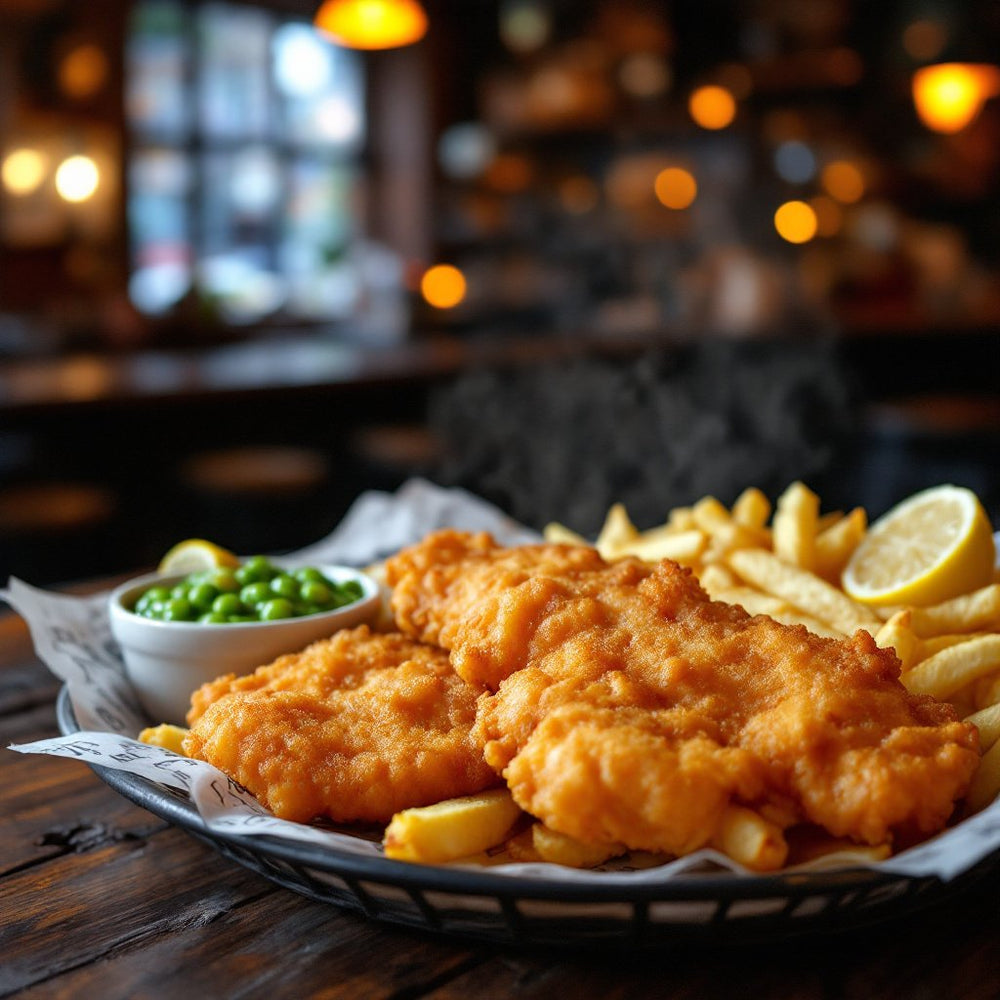
The quintessential British plate: flaky white cod encased in golden beer batter, served alongside hand-cut chips and a wedge of lemon on old newspaper. Perfected in the East End chippies of the Victorian era, this is the dish that working-class London carried into the 20th century as its defining culinary identity.
Credits: THE PAINTED PASSPORT
Local cuisine study in London, England

☕︎ Local Flavor

St. JOHN Restaurant

Rating: 4.7★ | Price: $$$ | Coordinates: 51.5203° N, 0.1021° W

Discover the restaurant that rewrote British food culture — a converted Smithfield smokehouse where Fergus Henderson introduced nose-to-tail eating to a dining world that had largely forgotten it. The interior is bare white plaster, plain wooden tables, and a single large central dining room that strips away every decorative ambition to put absolute attention on what arrives on the plate — roasted marrow bones with parsley salad, braised pig cheek, whole roasted birds for two. St. JOHN is a physical manuscript of the argument that British culinary identity had always been about restraint, honesty, and the refusal to waste — a document that restored the lineage of British farmhouse cooking to its rightful place in the canon.

View Entry Details

Borough Market

Rating: 4.6★ | Price: $$ | Coordinates: 51.5055° N, 0.0909° W

Navigate the iron and glass market hall that has occupied the south end of London Bridge since 1014 — one of the oldest continuously operating food markets in the world, where Victorian cast-iron columns support a roof that covers the finest concentration of British and European produce in the city. Neal Yard Dairy brings raw-milk territorial cheeses from the English countryside, Monmouth Coffee runs a roastery operation that helped define the London specialty coffee movement, and the bread and charcuterie stalls source from small producers who would otherwise have no urban platform. Borough Market is an anchor for the city agricultural identity — a place that documents the lineage between the English countryside and the London table, preserving supply chains and producer relationships that the supermarket model was designed to eliminate.

View Entry Details

Rules Restaurant

Rating: 4.6★ | Price: $$$$ | Coordinates: 51.5116° N, 0.1228° W

Step into London oldest restaurant — established in 1798 on Maiden Lane in Covent Garden and operating continuously ever since, its walls covered in theatrical cartoons, oil portraits, and game trophies that have accumulated like the rings of a very old tree. The menu is an unironic archive of English game cookery: grouse from the Pennines in season, venison from the restaurant own Teesdale estate, steak and kidney pudding in suet crust, and a treacle tart that requires no commentary. Rules is a physical manuscript of the English dining room as a cultural institution — a place that has been documenting the transition of British public life, from Victorian gentleman club to Edwardian theatre supper to contemporary archive, for over two centuries.

View Entry Details

Dishoom Covent Garden

Rating: 4.7★ | Price: $$ | Coordinates: 51.5115° N, 0.1227° W

Settle into a reconstruction of the Irani café culture that once defined Bombay social landscape — a design language of dark wood booths, aged mirrors, ceiling fans, and the smell of slow-cooked black dal that has been on the heat since the previous morning. The house black dal — simmered for 24 hours with butter and cream until it reaches the specific consistency of something that has been cooking since before you arrived — is one of the most precisely realised dishes in London. Dishoom documents the Parsi and Irani contribution to Bombay urban fabric at a moment when that tradition is disappearing in its city of origin — an archive of a café culture that London has preserved more faithfully than Mumbai.

View Entry Details

🛌︎ Boutique Stays

Claridges Hotel

Rating: 4.9★ | Price: $$$$ | Coordinates: 51.5127° N, 0.1478° W

Inhabit the Art Deco masterpiece on Brook Street in Mayfair that has served as the unofficial annexe of every European royal house since the 1850s — a hotel where the original Victorian bones were transformed in the 1920s into one of the finest Art Deco interiors in the world, all geometric marble floors, mirrored corridors, and a foyer that feels like it was designed for arrivals rather than check-ins. The suites were designed by David Linley and Diane von Furstenberg — each one a distinct meditation on British craftsmanship, using Cumbrian slate, English wool, and bespoke joinery from workshops that still practice pre-industrial techniques. Claridges is the most architecturally ambitious hotel in London and a physical manuscript of how Britain has historically defined luxury: through restraint, material quality, and the specific pleasure of a room that has been thought about carefully.

View Entry Details

The Zetter Townhouse Clerkenwell

Rating: 4.7★ | Price: $$$ | Coordinates: 51.5224° N, 0.1049° W

Rest in a converted Georgian townhouse on St. John Square in Clerkenwell, the neighbourhood that holds more architectural history per square metre than almost anywhere else in London — Roman amphitheatre foundations beneath a pub, a 12th-century priory of the Knights Hospitaller, and the printing and watch-making workshops that gave the area its particular character for three centuries. The interior is an eccentric accumulation of Victorian curios, mismatched antique furniture, taxidermy, and velvet upholstery that feels like being inside the study of a very well-traveled collector rather than a designed hotel experience. The Zetter Townhouse preserves the lineage of the Georgian London townhouse as a domestic space — an archive of the specific residential intelligence that produced some of the most liveable rooms ever built.

View Entry Details

The Ned London

Rating: 4.6★ | Price: $$$ | Coordinates: 51.5143° N, 0.0918° W

Unearth the former Midland Bank headquarters on Poultry in the City of London — Edwin Lutyens 1924 Portland stone monument, one of the finest bank buildings ever constructed, converted into a hotel that preserved the original banking hall as a multi-restaurant atrium of extraordinary spatial ambition. The ground floor banking hall retains Lutyens original Travertine columns, marble counters, and the specific quality of light that a space designed to convey financial permanence produces — it is one of the most beautiful rooms in London. The Ned documents the transition of the City of London from industrial financial capital to cultural institution — a building that has preserved the architectural ambition of the 1920s banking sector as a living, usable space rather than a museum piece.

View Entry Details

Hazlitts Hotel Soho

Rating: 4.7★ | Price: $$$ | Coordinates: 51.5140° N, 0.1313° W

Sleep in a hotel occupying three Georgian townhouses on Frith Street in Soho, named after the essayist William Hazlitt who died in one of the rooms in 1830 — a property that has maintained the domestic character of its Georgian origins with such fidelity that it feels less like a hotel and more like staying in a very well-appointed private house. Each of the 30 rooms is furnished with antiques sourced specifically for the period — four-poster beds, roll-top baths, Victorian writing desks — and the absence of a restaurant, bar, or lobby creates the specific intimacy of a place that trusts its guests to find their own evening. Hazlitts is an anchor for Soho identity as London literary and creative quarter — a place that documents the continuity of the Georgian house as an intellectual habitat across two centuries of the neighbourhood transformation.

View Entry Details

📍︎ Field Study

Tower of London Entry Ticket

Rating: 4.7★ | Price: $$ | Coordinates: 51.5081° N, 0.0759° W

Navigate a thousand years of English history within the original Norman keep that William the Conqueror began constructing in 1078 on the north bank of the Thames — a building whose concentric defensive walls, towers, and moat document the evolution of military architecture from the 11th century to the Tudor period. The Crown Jewels, displayed in the Waterloo Barracks, include the Imperial State Crown set with the 317-carat Cullinan II diamond, the Sovereign Orb, and the Coronation Spoon — objects used continuously in the coronation ceremony since the 13th century. The Tower of London is the most concentrated physical archive of English state power ever assembled — a building that has functioned as royal residence, prison, treasury, mint, and armoury, each function leaving its specific material trace in the fabric of the walls.

View Entry Details

British Museum Highlights Guided Tour

Rating: 4.8★ | Price: $ | Coordinates: 51.5194° N, 0.1269° W

Navigate the largest and most encyclopaedic museum on earth — eight million objects spanning two million years of human history, housed in Robert Smirke 1852 Greek Revival building with Norman Foster Great Court, the largest covered public square in Europe, at its centre. The Rosetta Stone, the Elgin Marbles, the Lewis Chessmen, Lindow Man, and the Sutton Hoo helmet are among the objects that anchor the permanent collection — each one a primary document of a civilisation that produced it, and each one the subject of ongoing debates about ownership, context, and the responsibility of institutional collecting. The British Museum is the most ambitious cultural archive ever assembled under a single roof — an institution that has been actively documenting the breadth of human material culture since 1753 and that remains the defining monument to the Enlightenment project of universal knowledge.

View Entry Details

Westminster and Whitehall Walking Tour

Rating: 4.8★ | Price: $ | Coordinates: 51.4994° N, 0.1248° W

Walk the mile between Westminster Bridge and Trafalgar Square that contains the highest concentration of Gothic Revival, Baroque, and Neoclassical architecture in Britain — the Palace of Westminster, Westminster Abbey, the Banqueting House, the Foreign and Commonwealth Office, and the National Gallery, each one a deliberate architectural statement about the nature of English power. Charles Barry and Augustus Pugin Palace of Westminster, rebuilt after the 1834 fire, chose Perpendicular Gothic specifically to connect the new democratic legislature to a medieval constitutional tradition — a decision that was simultaneously historically dishonest and architecturally brilliant. This walk is a guided reading of how England has used architecture to construct its national identity — documenting the transition from divine monarchy to constitutional democracy through the specific language of stone, proportion, and ornament.

View Entry Details

Thames at Twilight River Cruise

Rating: 4.7★ | Price: $$ | Coordinates: 51.5074° N, 0.1278° W

Board a river cruiser from Westminster Pier as the evening light drops over the Embankment and the city transitions from working capital to illuminated monument — passing the Tate Modern in the former Bankside Power Station, the dome of St. Paul Cathedral above Ludgate Hill, the HMS Belfast at her mooring, and Tower Bridge opening its Victorian Gothic bascules against the darkening sky. The Thames has been the operational spine of London since the Roman settlement of Londinium in 43 CE — every trade route, every invasion, every coronation procession, and every act of commerce that built the city was organised around this river. This cruise documents the city as Wren, Hawksmoor, and the Victorian engineers intended it to be seen — from the water, at the hour when the stone turns gold and the river holds the last of the light before the city switches on.

View Entry Details

Typography

Archival Note: A formal technical study of London, England, archiving the coordinates, elevation, and environmental data that define the region. This data serves as a vital record for our ongoing global field study, providing the technical foundation behind every atmospheric detail captured in our visual work.

Botanical and pigment specimen study for London, England Colors of London, England
Coordinates
51.5074° N, 0.1278° W — South-East England, Thames River basin, Greater London
Historical Epoch
Roman Londinium from 43 CE. Norman conquest and Tower of London from 1066. Medieval guild city from 1215. Great Fire and Wren reconstruction 1666–1711. Georgian expansion under Nash from 1811. Victorian industrial capital and global empire from 1837.
Elevation
0–245 m / 0–804 ft, flat Thames basin with gentle hills across the northern and southern boroughs
Atmosphere
Oceanic (Cfb). Mild, overcast, and famously damp for much of the year, with warm summers and cool wet winters. The diffused northern light that makes the city so atmospherically consistent is a direct product of this climate, grey skies that flatten shadows and soften everything.
Observation Hour
19:30. Golden hour on the Portland stone facades of the West End as the summer sun drops toward the horizon, the cream stone warming to amber and the Thames catching the last light in a long silver reflection below the Victoria Embankment.
Primary Pigment
Portland Stone Cream (#E8DCC8) and Routemaster Red (#CC0000)
Best Time to Visit
April through June, the London spring light is extraordinary, the parks are in full bloom, and the city has not yet reached the tourist pressure of the summer peak.
Avoid Visiting
July through August, peak crowds at every major site, hotel prices at their highest, and the Tube unbearable in the heat.

Behind The Scenes

Nathan

Note from the Founder

Hey, did you know this fun fact about London, England? The name London derives from Londinium, the Roman settlement founded in 43 CE. The city has been continuously occupied for nearly 2,000 years, one of the oldest living capitals in the world.
Thank you for exploring the London, England series with us. We hope these notes have inspired you to add this incredible destination to your own passport—we are so glad you're here. — Nathan

Some of our Favorites