Alberobello, Italy

An original watercolor print from The Painted Passport archive — designed to bring the light, color, and atmosphere of your favorite destinations into your home.
Original Series / Visual Study
Regional Dossier

Alberobello, Italy | Where the Stone Beehives Dream

Alberobello sits in the sun-warmed heel of Italy's boot, a UNESCO World Heritage town where nearly 1,500 trulli -- those ancient whitewashed stone huts with conical limestone roofs -- cluster together on hillsides like something from a storybook that forgot to end. The light here arrives golden and thick, especially in the late afternoon when it catches the pale limestone and turns the whole hillside the color of warm honey. This pocket of Puglia has been inhabited for centuries, shaped by peasant farmers who built their homes without mortar so they could be quickly dismantled to avoid property taxes under Bourbon rule -- a beautiful act of quiet rebellion frozen in stone. Walking through Rione Monti at dusk, with woodsmoke drifting from the conical chimneys and fig trees pushing through old walls, feels less like sightseeing and more like stepping sideways through time.

The watercolor palette of Alberobello draws heavily from the earth itself -- raw limestone whites, chalky bone, and the particular grey-blue of aged slate rooftops that seem to absorb the sky. Warm terracotta, dusty sage from wild herbs clinging to ancient walls, and the deep cobalt of a southern Italian sky at noon all press into the scene with generous confidence. Where shadows fall across the trulli, soft violet and cool lavender emerge, giving every painted impression of this place a quiet, dreamlike quality that resists being rushed.

Select Size
Add to the collection for /

$65.00

Finding the Stillness

It's hard to put the "vibe" of a place into words, so we put together a few images that we think show the quiet side of Alberobello, Italy. These are the textures and small moments we've archived to capture the stillness of this corner of the world.

Alberobello, Italy visual study 01
Alberobello, Italy / No. 01 via Gabriel Hebert
The morning light falls clean and sharp across the whitewashed walls of these ancient trulli, making the limestone glow against a sky so blue it looks painted. Symbols — a crescent moon, a cross, outstretched hands — are daubed in white lime on the grey conical roofs, each one a quiet language carried forward from another century. Flower boxes, a wooden bench, a vine creeping over a doorway: small signs that people still live and work inside these fairy-tale forms.
Alberobello, Italy visual study 02
Alberobello, Italy / No. 02 via Жанна Алимкулова
Brilliant midday sun washes over the ancient limestone path, casting sharp shadows beneath the iconic conical rooftops of Alberobello's trulli district. The air feels warm and still, broken only by the quiet color of bougainvillea and terracotta pots spilling over with blooms. A visitor standing here would feel transported — suspended between a fairy tale and a living village unchanged by centuries.
Alberobello, Italy visual study 03
Alberobello, Italy / No. 03 via K
From above, Alberobello reveals itself as a living mosaic of whitewashed walls and ash-gray conical roofs, the trulli rippling outward from the historic Rione Monti district like stone waves frozen mid-motion. What most overlook is the subtle tonal variation in the trulli roofs — no two share quite the same shade, ranging from pale limestone to deep charcoal, each telling a different story of age and weathering. At the edges of the ancient quarter, the abrupt transition to flat-roofed modern buildings creates an almost theatrical border, as if the old town exists inside its own quiet parenthesis.

Where to wander

Archival Note: A curated field study of Alberobello, Italy, prioritizing cultural relevance and archival merit. While we haven't touched down here yet, we've meticulously vetted these locations through our global network of contributors to ensure they represent the most authentic atmosphere for your own expedition.

Local Cuisine Spotlight
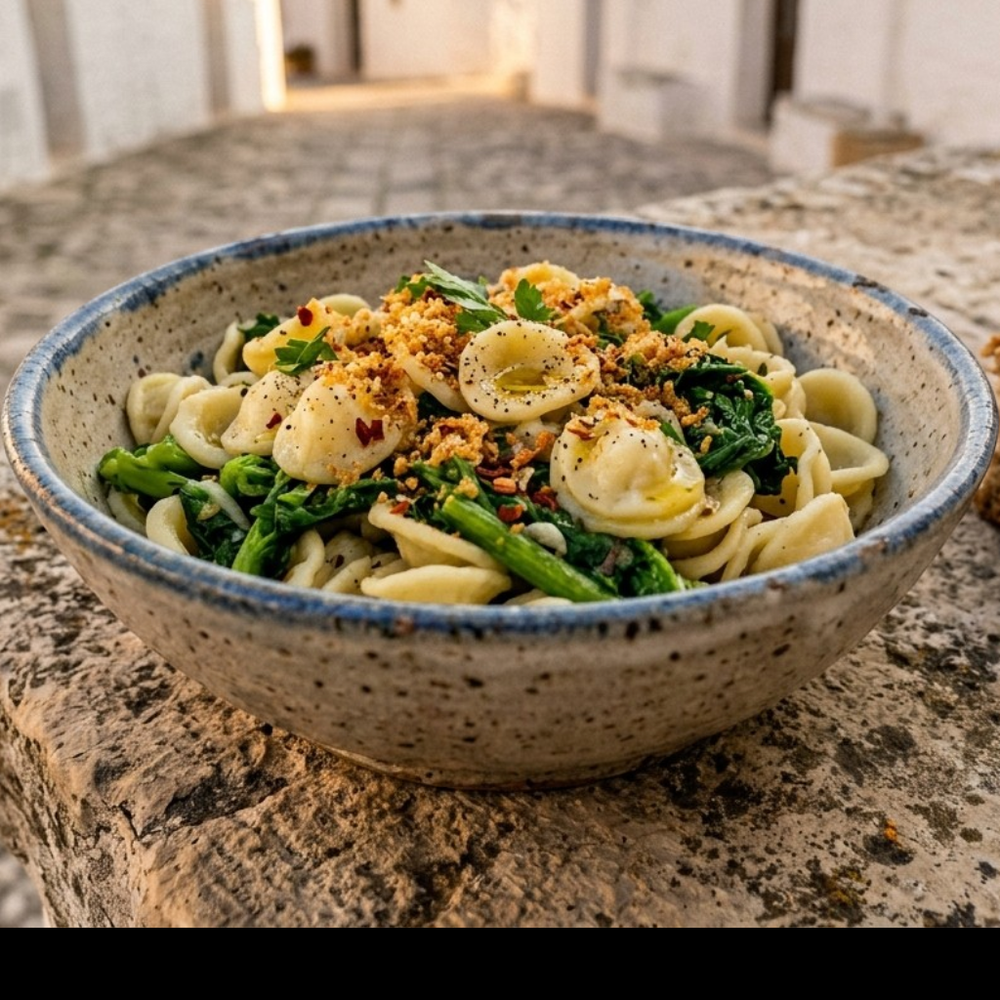
Orecchiette con cime di rapa is the soul of Puglia in a bowl — chewy ear-shaped pasta embracing bitter braised turnip greens, warmed with garlic, chili flakes, and olive oil, then crowned with crisp toasted breadcrumbs that add a satisfying golden crunch to every bite.
Credits: The Painted Passport
Local cuisine study in Alberobello, Italy

☕︎ Local Flavor

Ristorante Il Poeta Contadino

Rating: 5* | Price: $$$ | Coordinates: 40.7822° N, 17.2401° E

Widely regarded as Alberobello's finest dining room, this elegant restaurant presents inventive takes on Puglian classics using hyper-local seasonal ingredients. The orecchiette with cime di rapa and anchovy crumble is a dish that genuinely stops conversation mid-bite. An impressive regional wine list and impeccable service make every meal here feel like a special occasion.

View Entry Details

Trattoria Terra Madre

Rating: 4* | Price: $$ | Coordinates: 40.7818° N, 17.2395° E

This beloved no-frills trattoria serves honest, generous Puglian cooking the way nonnas have made it for generations. The slow-braised lamb with roasted peppers and the fave e cicoria bean purée are soul-warming staples that locals return to again and again. The rustic stone interior and communal wooden tables create an atmosphere of genuine conviviality.

View Entry Details

Focacceria da Nunzia

Rating: 4* | Price: $ | Coordinates: 40.7831° N, 17.2408° E

A tiny counter-service gem where the focaccia barese emerges from a wood-fired oven golden, pillowy, and crowned with juicy cherry tomatoes and olives. Nunzia herself often works the counter, chatting warmly with customers while assembling panini stuffed with local burrata and sun-dried tomatoes. It is the perfect midday stop for an affordable, utterly delicious taste of Puglia.

View Entry Details

Enoteca Cannavina Wine Bar

Rating: 4* | Price: $$ | Coordinates: 40.7826° N, 17.2403° E

Nestled in a vaulted stone cellar, this intimate enoteca specializes in natural and artisan wines from the Valle d'Itria and beyond. The knowledgeable sommelier guides guests through bold Primitivos and crisp Verdecas paired with a rotating board of local cheeses, taralli, and cured meats. The low lighting and jazz-tinged playlist make it the ideal spot for a long, leisurely evening.

View Entry Details

🛌︎ Boutique Stays

Il Pinnacolo Trullo Suite

Rating: 5* | Price: $$$ | Coordinates: 40.7829° N, 17.2405° E

Sleep inside an authentic centuries-old trullo with its iconic conical stone roof arching above your bed. The suite blends rustic whitewashed walls with modern comforts like a rainfall shower and plush linens. Waking up in the heart of the UNESCO zone with birdsong and cobblestone views is an experience unlike anything else.

View Entry Details

Trullidea Boutique Hotel

Rating: 4* | Price: $$ | Coordinates: 40.7815° N, 17.2398° E

This charming cluster of restored trulli houses a boutique hotel with individually decorated rooms full of local ceramics and warm amber lighting. The attentive staff offer homemade pastries each morning and can arrange private tours of the Rione Monti district. Its central location means the Valle d'Itria countryside is just steps from your door.

View Entry Details

Masseria Il Frantoio

Rating: 5* | Price: $$$$ | Coordinates: 40.7750° N, 17.2280° E

Set on a working olive farm just outside town, this luxurious masseria surrounds guests with ancient olive groves and the scent of wild herbs. Rooms are lavishly appointed with antique Puglian furniture and hand-embroidered fabrics that tell regional stories. The estate hosts candlelit farm-to-table dinners that feel like a warm invitation into an Italian family home.

View Entry Details

Trullo dell'Arco Guesthouse

Rating: 4* | Price: $$ | Coordinates: 40.7835° N, 17.2412° E

A family-run guesthouse tucked into a quiet alley of the Rione Aia Piccola, offering genuine Southern Italian hospitality at every turn. Each trullo unit features a private terrace draped in bougainvillea, perfect for sipping an evening Primitivo wine. The owners share insider tips on hidden local gems that most tourists never discover.

View Entry Details

📍︎ Field Study

Rione Monti Trulli District

Rating: 5* | Price: Free | Coordinates: 40.7830° N, 17.2407° E

The most iconic neighborhood in Alberobello, Rione Monti is a dense hillside labyrinth of over 1,000 trulli that has earned UNESCO World Heritage status. Wandering its narrow lanes at dawn or dusk, when tour groups thin out, reveals an almost dreamlike quality to the whitewashed stone. Many trulli still bear ancient symbolic markings on their cone tips, each carrying its own mystical meaning.

View Entry Details

Trullo Sovrano

Rating: 4* | Price: $ | Coordinates: 40.7820° N, 17.2399° E

The only two-storey trullo in Alberobello, Trullo Sovrano offers a rare glimpse into how a prosperous 18th-century family actually lived within these remarkable stone structures. Original furnishings, kitchen tools, and religious artifacts are preserved throughout its surprisingly spacious interior rooms. An enthusiastic local guide brings the history to vivid life with stories of the family who called it home.

View Entry Details

Church of Sant'Antonio da Padova

Rating: 4* | Price: Free | Coordinates: 40.7833° N, 17.2410° E

Built in the 1920s in the remarkable form of a giant trullo, this beloved church is a stunning architectural fusion of traditional vernacular style and sacred purpose. Inside, soft light filters through small windows onto colorful frescoes and a beautifully carved wooden altar. Attending an evening mass here, with choral music echoing off the curved stone walls, is genuinely moving.

View Entry Details

Valle d'Itria Countryside Cycling Route

Rating: 5* | Price: $ | Coordinates: 40.7700° N, 17.2200° E

Rent a bicycle in town and pedal out into the breathtaking Valle d'Itria, where dry-stone walls, olive groves, and cherry orchards stretch endlessly under an enormous Puglian sky. The mostly flat terrain makes it accessible for all fitness levels, and scattered masserie offer stops for fresh ricotta and a glass of chilled rosato. This is the most rewarding way to understand why this corner of southern Italy captures hearts so completely.

View Entry Details

Typography

Archival Note: A formal technical study of Alberobello, Italy—archiving the coordinates, elevation, and environmental data that define the region. This data serves as a vital record for our ongoing global field study, allowing us to reconstruct the regional atmosphere with archival precision before our physical arrival.

Botanical and pigment specimen study for Alberobello, Italy Colors of Alberobello, Italy
Coordinates
40.7830° N, 17.2407° E — Rione Monti Trulli District, Alberobello, Puglia, Italy
Historical Epoch
Alberobello's trulli tradition dates to at least the 14th century, when Itria Valley peasants built mortarless homes to evade Neapolitan taxation. The town received Royal Assent as a settlement only in 1797, and UNESCO recognised its trulli in 1996.
Elevation
416 m / 1,365 ft - Alberobello sits on a gentle ridge in the Murge plateau of Puglia, high enough to catch evening breezes off the Adriatic.
Atmosphere
Csa - Hot-summer Mediterranean. Long, dry, intensely sunny summers give way to mild winters with occasional rain. Spring and autumn are gentle, fragrant, and ideal for walking.
Observation Hour
17:30 - The late afternoon sun drops low and floods the pale limestone trulli in a thick amber wash, casting long soft shadows between the cones and turning the whitewashed walls the color of warm cream.
Primary Pigment
Limestone White (#EDE8DC) and Warm Slate (#8E9BAA)
Best Time to Visit
April through June - Wildflowers bloom across the Valle d'Itria, temperatures are warm but not scorching, and the trulli lanes are pleasantly uncrowded.
Avoid Visiting
July through August - Peak summer brings intense heat above 35C and overwhelming day-tripper crowds that can make the narrow trulli lanes feel airless and rushed.

Behind The Scenes

Nathan

Note from the Founder

Hey, did you know this fun fact about Alberobello, Italy? Alberobello contains more than 1,500 trulli, many still inhabited. The conical roofs are built without mortar using a technique called corbelling, and the grey limestone pinnacles are often carved with ancient symbols whose meanings remain debated by historians.
Thank you for exploring the Alberobello, Italy series with us. We hope these notes have inspired you to add this incredible destination to your own passport—we are so glad you're here. — Nathan

Some of our Favorites