Shop the Collection

To help you build your own global archive, we've prepared this collection of watercolor studies from our research into St. John’s, Newfoundland. These artifacts are designed to bring the stillness of this corner of the world into your home.

The Painted Passport®

A lovely, high-res reminder for your fridge or workspace. This watercolor magnet is the perfect small token to remember your St. John’s, Newfoundland adventure.

St. John’s, Newfoundland | Original Series Decorative Magnet | The Painted Passport®
Add to Collection / $18
Exclusive Series Artifact

The Painted Passport®

This high-fidelity canvas is a beautiful way to anchor a room and keep your memories of St. John’s, Newfoundland fresh long after you've returned home.

St. John’s, Newfoundland | Original Series Gallery Canvas | The Painted Passport® detail St. John’s, Newfoundland | Original Series Gallery Canvas | The Painted Passport® detail St. John’s, Newfoundland | Original Series Gallery Canvas | The Painted Passport® detail St. John’s, Newfoundland | Original Series Gallery Canvas | The Painted Passport® detail
Add to Collection / $65

The Painted Passport®

A wonderful companion for your morning coffee. This coaster captures the atmosphere of St. John’s, Newfoundland in a functional, beautiful way.

St. John’s, Newfoundland | Original Series Hardboard Coaster | The Painted Passport®
Add to Collection / $18
Exclusive Series Artifact

The Spirit of the Land

Archival Note: A curated field study of St. John’s, Newfoundland, prioritizing the specific atmospheric stillness of the region. These artifacts have been meticulously sourced from our global archival partners to represent the area's unique cultural frequency and environmental character. This selection serves as a formal observation for our ongoing global archive, vetted for its visual accuracy and archival merit.

St. John’s, Newfoundland study No. 01
St. John’s, Newfoundland / 01 VIA / Introspectivedsgn
The colorful row houses of St. John's stretch toward the harbor under soft, overcast skies, their painted facades glowing even in muted light. Rain-slicked streets reflect the morning's passage, while distant hills frame this coastal city with an ancient, watchful presence. There's something deeply comforting about how the buildings huddle together here, as if the community itself is drawn close against the Atlantic winds.
St. John’s, Newfoundland study No. 02
St. John’s, Newfoundland / 02 VIA / Introspectivedsgn
The colorful houses climb up the rocky hillside in layers, each one finding its perch among the ancient stone and hardy vegetation that clings to this rugged coast. Soft, even light settles over the scene, muting the palette just enough to feel contemplative, while the still water below mirrors the quiet of the moment. There's something deeply reassuring about places like this—where people have built their lives against the elements, painting their homes in cheerful hues that stand as small declarations of permanence and hope.
St. John’s, Newfoundland study No. 03
St. John’s, Newfoundland / 03 VIA / Introspectivedsgn
The soft blush of twilight settles over St. John's harbour, where the city lights begin their evening dance across the water. From this elevated vantage point near the old fortifications, you can feel the cool Atlantic air and sense the centuries of stories held in these weathered stones and chimneys. There's something profoundly calming about watching a harbour city transition from day to night, the modern buildings and historic architecture sharing the same gentle glow.

Where to wander

Archival Note: A curated field study of St. John’s, Newfoundland, prioritizing cultural relevance and archival merit. While we haven't touched down here yet, we’ve meticulously vetted these locations through our global network of contributors to ensure they represent the most authentic atmosphere for your own expedition.

Local Cuisine Spotlight
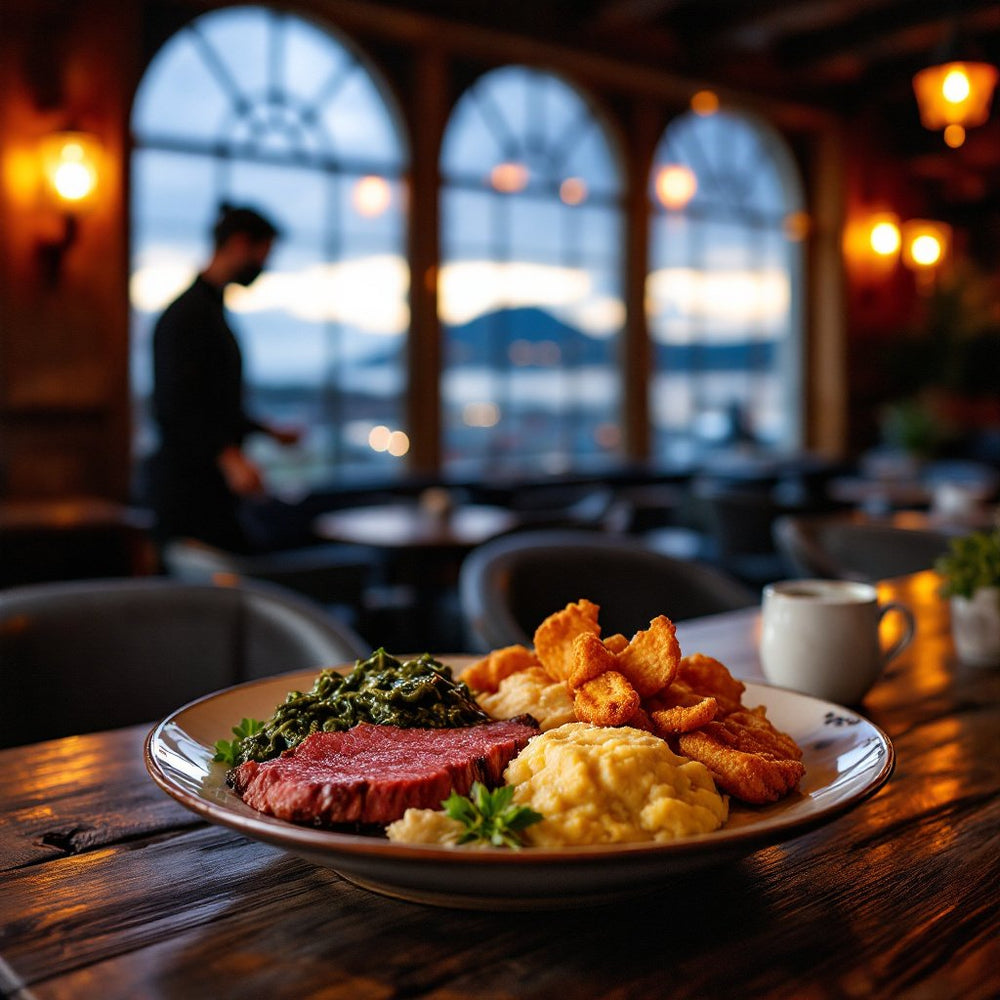
Salt beef bathed in gentle steam, flanked by golden turnip, creamy mashed potato, and dark cabbage stewed until tender—this is Newfoundland's soul on a plate. Born from centuries of preserving meat through harsh winters, Jiggs Dinner transforms humble ingredients into something deeply comforting, a Sunday tradition that binds families across the island's weathered coastlines.
Credits: The Painted Passport
Local cuisine study in St. John’s, Newfoundland

☕︎ Local Flavor

Chinched Bistro

Rating: 4.9★ | Price: $$$ | Coordinates: 47.5617° N, 52.7063° W

Chinched Bistro is the most technically accomplished restaurant in St. John's — a warm, intimate dining room on the ground floor of a Victorian townhouse on Duckworth Street where chef Shaun Hussey has been building a menu around the extraordinary and underappreciated culinary tradition of Newfoundland since 2012, treating the salt cod and seal, the Fogo Island partridgeberries and bakeapples, the Dildo cold-water shrimp and the Petty Harbour crab, and the wild game of the Avalon Peninsula as the primary vocabulary of a kitchen that is simultaneously documenting the island's culinary heritage and reinterpreting it with serious classical technique. Chinched is where you understand that Newfoundland has one of the most distinct and historically deep food cultures in North America — shaped by 500 years of isolation, a fishing economy, and the specific ecology of the boreal island — and that the best of it belongs in the same conversation as any serious regional cuisine on the continent.

View Entry Details

🛌︎ Boutique Stays

Murray Premises Hotel

Rating: 4.8★ | Price: $$$ | Coordinates: 47.5621° N, 52.7006° W

The Murray Premises Hotel occupies the most historically resonant building in St. John's — a converted 1846 merchant warehouse complex on Beck's Cove at the foot of Water Street, where five floors of hand-cut stone and timber-frame construction that once housed the salt cod and seal oil trade of the British Empire's most easterly city now contain 67 rooms and suites whose exposed beams, stone walls, and original wide-plank floors make the Atlantic Canadian merchant vernacular into a genuinely distinctive hospitality experience. The hotel sits in the St. John's downtown historic district two blocks from the harbour front, within walking distance of George Street, the Rooms cultural centre, and the Signal Hill trail to Cabot Tower — which means that staying at the Murray Premises is simultaneously staying in the physical archive of the city's 500-year commercial history and at the most convenient base for exploring its living contemporary identity.

View Entry Details

📍︎ Field Study

The Rooms Provincial Museum

Rating: 4.8★ | Price: $$ | Coordinates: 47.5664° N, 52.7057° W

The Rooms is the most architecturally striking cultural institution in Atlantic Canada — a building whose dramatic silhouette of stacked boxes references the traditional Newfoundland fishing outport 'rooms' (the waterfront structures where fish were processed and stored) and that houses the provincial museum, art gallery, and archives on a hill above the city with panoramic views of the harbour and Signal Hill from the upper galleries. The permanent collections document the full sweep of Newfoundland and Labrador history and culture: the Maritime Archaic Indigenous occupation going back 9,000 years, the Beothuk Nation whose extinction in 1829 is one of the most documented and most sorrowful events in Canadian Indigenous history, the arrival of European fishermen in the 15th century, and the 20th-century debate over Confederation that ended with the 1949 vote that brought Newfoundland into Canada by a margin of fewer than 7,000 votes. The view from the Rooms terrace — the city below, the harbour beyond it, and the Atlantic on the horizon — is the most reflective available position for thinking about what Newfoundland is.

View Entry Details

Typography

Archival Note: A formal technical study of St. John’s, Newfoundland—archiving the coordinates, elevation, and environmental data that define the region. This data serves as a vital record for our ongoing global field study, allowing us to reconstruct the regional atmosphere with archival precision before our physical arrival.

Botanical and pigment specimen study for St. John’s, Newfoundland Colors of St. John’s, Newfoundland
Coordinates
47.5615° N, 52.7126° W — Avalon Peninsula, Newfoundland, Atlantic Canada
Historical Epoch
Cabot Landing 1497 / Transatlantic Fishery Hub / Confederation 1949
Elevation
0–168 m / 0–551 ft — harbour at sea level rising steeply to Signal Hill above the Narrows
Atmosphere
Subpolar Oceanic (Cfc). Cool foggy summers where July averages 16°C, heavy Atlantic snowfall from November through April, and the specific horizontal fog of the Grand Banks that rolls through the Narrows with no warning.
Observation Hour
18:30. The low June sun enters from the northwest and catches the uphill facades of Jellybean Row at full saturation — the primary reds and yellows of the clapboard at maximum intensity against the harbour grey below.
Primary Pigment
Jellybean Red (#C0392B) and Narrows Grey (#7F8C8D)
Best Time to Visit
July through September — iceberg season extends into July, fog clears for the clearest Atlantic light of the year, and the Signal Hill hiking trails are at full access
Avoid Visiting
November through March — heavy Atlantic snowfall, frequent blizzard closures, and the raw subarctic wind off the Grand Banks makes extended outdoor exploration difficult

The Local Tongue

Language is the invisible architecture of St. John’s, Newfoundland. These entries document the regional vocabulary—capturing the "texture" of local speech that standard translations often miss. Hand-curated expressions reflecting the specific spirit and daily rhythm of the region.
Archival study of English cultural texture

via / Introspectivedsgn

Primary Language English
Regional Dialect Newfoundland English (Avalon Peninsula)

Scrunchions

Scrunchions are small cubes of salt pork fat rendered until crisp and golden in a cast-iron pan — the canonical garnish for fish and brewis and the oldest cooking technique in the Newfoundland kitchen, carried here by West Country English fishermen in the 1600s and unchanged since.

The Rock

The Rock is the affectionate and occasionally rueful name Newfoundlanders use for the island itself — acknowledging the granite-and-quartzite landscape that defines the province's character, its isolation, and the specific hardness required to live at the edge of the North Atlantic for four centuries.

Bes' kind

Bes' kind is the highest compliment in Newfoundland vernacular — meaning something is the very best, excellent, or as good as it gets. It functions as both an affirmation and a term of warm approval, and signals immediately that you are speaking with someone from the island rather than the mainland.

Wait! before you go...

Before you head over to St. John’s, Newfoundland, we’ve audited the essential data points for this corner of the world. These notes cover the logistics—from currency ratios to transit hubs—to help you navigate the landscape with clarity.
🚲 Getting Around Best explored on foot in the downtown core — the hill between Water Street and Duckworth Street is compact. A rental car is essential for Signal Hill, Cape St. Mary's, and the wider Avalon Peninsula.
⚖️ Cash or Card 80% Card, 20% Cash. Downtown restaurants and hotels are fully card-friendly. Keep Canadian cash for the Saturday farmers market, smaller outport communities, and ferry terminals.
☁️ Good to Know George Street is a one-block pedestrian pub district with more bars per square foot than anywhere in North America — it operates loudly Thursday through Sunday and quiets entirely midweek. Book Signal Hill hiking early in summer and check the fog forecast before heading to the cliff path above the Narrows.
🏧 ATMs Royal Bank of Canada, Scotiabank, and TD Bank ATMs are clustered on Water Street and Duckworth Street in the downtown core. ATM access becomes unreliable west of the Avalon Peninsula — withdraw cash before driving toward the outports or the Argentia ferry.
💳 Currency The Canadian Dollar (CAD). St. John's prices at a moderate level — a good downtown hotel runs $150–$280 CAD, the farmers market and fish and chip shops remain the most affordable food options in the city.
🔌 Plugs Type A and B (120V, 60Hz) — standard North American outlets throughout, identical to the United States. European visitors need a Type C or G adapter.
🛡️ Safety St. John's is a safe, well-lit harbour city. The primary practical risks are Atlantic weather — fog can reduce visibility to near zero along the Signal Hill headland with no warning — and the steep uneven cobblestone streets of the historic district that require attentive footing after rain.
✈️ Airports St. John's International Airport (YYT) is 6 km northwest of downtown with direct service from Toronto, Montreal, Ottawa, Halifax, and London Heathrow. Air Canada and WestJet operate the primary routes. Taxi to downtown is 15 minutes.

Behind The Scenes

Nathan

Note from the Founder

Hey, did you know this fun fact about St. John’s, Newfoundland? St. John's operates on Newfoundland Standard Time — UTC−3:30 — a half-hour offset that exists nowhere else in Canada and makes it the only jurisdiction in the western hemisphere running on a half-hour increment rather than a full-hour time zone.
Thank you for exploring the St. John’s, Newfoundland series with us. We hope these notes have inspired you to add this incredible destination to your own passport—we are so glad you're here. — Nathan

Some of our Favorites