Shop the Collection

To help you build your own global archive, we've prepared this collection of watercolor studies from our research into Rovinj, Croatia. These artifacts are designed to bring the stillness of this corner of the world into your home.

Original Series Decorative Magnet

A personal study of Rovinj, Croatia, captured in high-fidelity watercolor and prepared for your collection.

Rovinj, Croatia | Rovinj Coastal Town View | Original Series Decorative Magnet
Add to Collection / $18
Exclusive Series Artifact

Original Series Gallery Canvas

This high-fidelity canvas is a beautiful way to anchor a room and keep your memories of Rovinj, Croatia fresh long after you've returned home.

Rovinj, Croatia | Rovinj Coastal Town View | Original Series Gallery Canvas detail Rovinj, Croatia | Rovinj Coastal Town View | Original Series Gallery Canvas detail Rovinj, Croatia | Rovinj Coastal Town View | Original Series Gallery Canvas detail Rovinj, Croatia | Rovinj Coastal Town View | Original Series Gallery Canvas detail
Add to Collection / $65

Original Series Hardboard Coaster

A personal study of Rovinj, Croatia, captured in high-fidelity watercolor and prepared for your collection.

Rovinj, Croatia | Rovinj Coastal Town View | Original Series Hardboard Coaster
Add to Collection / $18
Exclusive Series Artifact

The Spirit of the Land

Archival Note: A curated field study of Rovinj, Croatia, prioritizing the specific atmospheric stillness of the region. These artifacts have been meticulously sourced from our global archival partners to represent the area's unique cultural frequency and environmental character. This selection serves as a formal observation for our ongoing global archive, vetted for its visual accuracy and archival merit.

Rovinj, Croatia study No. 01
Rovinj, Croatia / 01 VIA / Music Meets heaven
The pastel buildings of Rovinj stack up from the harbor in shades of ochre, salmon, and weathered yellow, their shuttered windows catching the clear midday light. Several boats rest in the turquoise water—working vessels with practical lines rather than pleasure crafts—while the bell tower rises above the roofline like a patient landmark. The scene has the unhurried quality of a coastal town where the water and the architecture have been in conversation for centuries, both shaped by salt air and summer sun.
Rovinj, Croatia study No. 02
Rovinj, Croatia / 02 VIA / Frans Ruiter
The old town rises dark against a deepening blue sky, its silhouette broken only by the illuminated bell tower and scattered windows glowing amber in the dusk. The water lies quiet, reflecting the last pale traces of sunset where a few boats rest at anchor. The air here would be still and cooling, carrying that particular hush that settles over coastal places in the moments between day and night.
Rovinj, Croatia study No. 03
Rovinj, Croatia / 03 VIA / Eleanor Ye
The weathered brick on the left building has crumbled in places, exposing layers of terracotta and ochre that mirror the painted facades across the narrow street. A simple directional sign points toward Sv. Eufemija, guiding visitors through passages where air conditioning units hang beside centuries-old shutters. The alley opens just enough for afternoon light to reach the cobblestones, where a few tourists pause in the shade between the rust-colored walls.

Where to wander

Archival Note: A curated field study of Rovinj, Croatia, prioritizing cultural relevance and archival merit. While we haven't touched down here yet, we’ve meticulously vetted these locations through our global network of contributors to ensure they represent the most authentic atmosphere for your own expedition.

Local Cuisine Spotlight
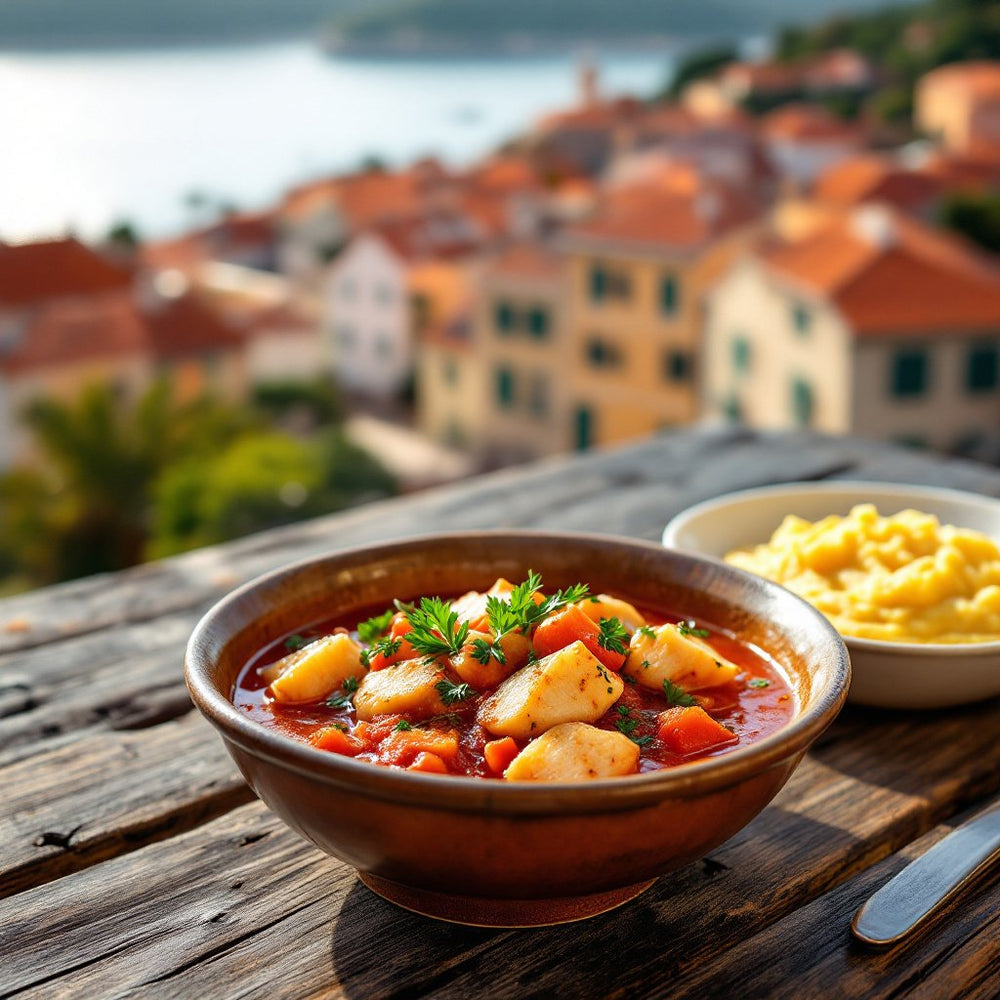
This hearty Croatian fish stew showcases tender chunks of local Adriatic catch simmered in a tomato-based broth with carrots and fresh herbs. The dish, known as brudet or brodet along the Istrian coast, reflects centuries of fishing tradition in Rovinj, where the catch of the day meets paprika-spiced simplicity. Served alongside creamy polenta, it embodies the region's blend of Italian and Slavic culinary influences.
Credits: The Painted Passport
Local cuisine study in Rovinj, Croatia

☕︎ Local Flavor

Monte Restaurant

Rating: 5* | Price: $$$ | Coordinates: 45.0817 N, 13.6389 E

Chef Danijel Đekić earned Croatia's first Michelin star here, transforming Istrian ingredients into revelatory tasting menus that honor regional tradition while embracing creative evolution. Local Adriatic fish, hand-foraged herbs from the countryside, and autumn's prized white truffles appear in dishes that tell stories of this peninsula's biodiversity. The intimate dining room, tucked into old town's narrow lanes, seats barely twenty—a temple of Croatian gastronomy where each course reflects seasons and proximity to source.

View Entry Details

Konoba Veli Jože

Rating: 4.5* | Price: $$ | Coordinates: 45.0808 N, 13.6381 E

This family tavern serves Istrian home cooking in a rustic stone interior hung with copper pots, fishing nets, and black-and-white photographs of Rovinj's seafaring past. The menu changes based on morning market finds and what the fishing boats bring—perhaps brodet stew simmered for hours, or fuži pasta with wild asparagus and truffles when spring arrives. Three generations have cooked here, maintaining recipes and techniques that define authentic Istrian comfort food without pretension or tourist compromise.

View Entry Details

Puntulina Restaurant

Rating: 4.5* | Price: $$$ | Coordinates: 45.0802 N, 13.6372 E

Built into the rocks where the old town meets the sea, this restaurant offers tables literally suspended above the Adriatic, where waves crash below during evening meals. The kitchen emphasizes pristine seafood—scampi, John Dory, sea bass—prepared simply to honor freshness, accompanied by Istrian wines that few visitors discover beyond the peninsula. Sunset reservations are coveted for good reason: the amber light reflecting off Venetian-era facades creates a setting that embeds itself in memory.

View Entry Details

La Puntulina Gelato & Patisserie

Rating: 4.5* | Price: $ | Coordinates: 45.0819 N, 13.6394 E

This tiny gelateria on the old town's main square makes small-batch gelato daily using Istrian ingredients—olive oil from nearby groves, figs from roadside trees, honey from peninsula apiaries, and seasonal fruit from farmers they know by name. The pistachio comes from Sicily, but the spirit is purely local, reflecting the Italian influence that shaped Istrian culture for centuries. A scoop enjoyed while watching the harbor at dusk costs mere kunas yet delivers disproportionate joy.

View Entry Details

🛌︎ Boutique Stays

Hotel Adriatic

Rating: 4.5* | Price: $$$ | Coordinates: 45.0811 N, 13.6387 E

This historic harborfront hotel from 1912 positions you at the pulse of Rovinj's old town, where the scent of pine and saltwater drifts through windows overlooking fishing boats and the basilica's bell tower. The Adriatic has housed artists and travelers for over a century, maintaining elegant simplicity in its renovated rooms while preserving the soul of a grand Croatian seaside retreat. Morning coffee on the terrace as the sun illuminates Istria's coastline is worth the splurge alone.

View Entry Details

Grand Park Hotel Rovinj

Rating: 5* | Price: $$$ | Coordinates: 45.0795 N, 13.6298 E

Perched on a forested peninsula south of the old town, this architectural marvel blends seamlessly into ancient holm oak groves, with floor-to-ceiling windows framing the Adriatic in every suite. The design honors Istrian heritage through local stone and contemporary Croatian art, while the spa incorporates indigenous botanicals like immortelle and lavender. It's a modern sanctuary that respects its surroundings, offering both seclusion and a ten-minute coastal walk into Rovinj's historic heart.

View Entry Details

Apartments Mara

Rating: 4* | Price: $$ | Coordinates: 45.0842 N, 13.6401 E

Run by a local family for three generations, these spotless apartments sit just outside the old town walls where residential Rovinj begins and the crowds thin. Mara herself often leaves homemade fig preserves and a bottle of Istrian Malvazija wine as welcome gifts, embodying the genuine hospitality that defines smaller Croatian establishments. The location offers authentic neighborhood life—morning markets, local bakeries, and the freedom to cook with ingredients from nearby farms.

View Entry Details

Villa Tuttorotto

Rating: 4.5* | Price: $$ | Coordinates: 45.0768 N, 13.6354 E

This restored Istrian stone villa from the 18th century sits among olive groves and vineyards on the outskirts of Rovinj, offering tranquil gardens and a pool shaded by centuries-old oaks. The owners maintain working relationships with local winemakers and truffle hunters, often arranging private tastings and foraging experiences that reveal Istria's agricultural soul. Each room features traditional beamed ceilings and terracotta floors, preserving architectural heritage while providing modern comfort for travelers seeking rural authenticity.

View Entry Details

📍︎ Field Study

St. Euphemia's Basilica

Rating: 5* | Price: $ | Coordinates: 45.0809 N, 13.6385 E

This Baroque church crowns Rovinj's peninsula, its 60-meter bell tower—modeled after Venice's San Marco—visible from every approach to the city and serving as a maritime beacon for centuries. Inside rests the marble sarcophagus of St. Euphemia, Rovinj's patron saint, whose remains miraculously washed ashore in 800 AD according to local legend. Climb the tower's narrow stairs for panoramic views across terracotta rooftops to the Adriatic and distant Italian Alps, understanding immediately why this hilltop settlement has captivated inhabitants since Roman times.

View Entry Details

Grisia Street Art Colony

Rating: 4.5* | Price: $ | Coordinates: 45.0813 N, 13.6383 E

This steep, cobbled street climbing toward St. Euphemia has served as Rovinj's artistic heart since the 1960s, lined with galleries showcasing local painters, sculptors, and ceramicists inspired by Istrian light and coastline. Every August, the street transforms into an open-air exhibition where artists display works directly on the stones—a tradition spanning six decades. The studios here aren't tourist traps but working spaces where you'll find serious Croatian artists continuing a legacy that made Rovinj a pilgrimage site for painters throughout the 20th century.

View Entry Details

Golden Cape Forest Park

Rating: 4.5* | Price: $ | Coordinates: 45.0692 N, 13.6247 E

This protected peninsula south of town preserves over 100 hectares of Mediterranean woodland—Austrian Baron Hütterott planted these pines, oaks, and cypresses in the 19th century, creating a legacy that now offers shaded coastal trails and hidden swimming coves. The footpaths wind past quarries where Romans extracted stone for their empire, revealing layers of history beneath the forest floor. Locals swim from the smoothed rock platforms year-round, joining the Adriatic with a naturalness that reflects Croatian coastal culture's deep connection to the sea.

View Entry Details

Rovinj Market

Rating: 4.5* | Price: $ | Coordinates: 45.0827 N, 13.6396 E

Operating since medieval times in the square beside the harbor, this morning market gathers Istrian farmers, fishermen, and foragers selling what the peninsula yields—wild asparagus in spring, cherries in June, truffles in autumn, olive oil pressed from ancient groves. Vendors speak the local Istrian dialect, a Romance language blending Italian and Croatian, reflecting this border region's complex cultural identity. Arrive early to see the social fabric of Rovinj unfold: neighbors greeting each other, recipes exchanged, the daily rhythm of a town still connected to its agricultural roots.

View Entry Details

Typography

Archival Note: A formal technical study of Rovinj, Croatia—archiving the coordinates, elevation, and environmental data that define the region. This data serves as a vital record for our ongoing global field study, allowing us to reconstruct the regional atmosphere with archival precision before our physical arrival.

Botanical and pigment specimen study for Rovinj, Croatia Colors of Rovinj, Croatia
Coordinates
45.0809° N, 13.6385° E - Istrian Peninsula, Adriatic Coast
Historical Epoch
Romans built the first settlement, then Venetian rule from 1283 shaped the architecture and dialect that still color daily life. The bell tower, the lions, the fishing traditions all arrived under La Serenissima, and the town has kept that graceful blend of Italian elegance and Croatian warmth ever since.
Elevation
0-15 m / 0-49 ft - harbor waterfront to the Church of St. Euphemia hilltop
Atmosphere
Cfa - Humid Subtropical. Summers are warm and dry with afternoon sea breezes that make waterfront dining a pleasure, while winters stay mild enough that cafes rarely close their terraces for long.
Observation Hour
18:30 - The setting sun gilds St. Euphemia's bell tower in amber while casting the harbor in rose and violet reflections. Colors deepen from pastel to saturated, and the stone facades glow warmly against the cooling Adriatic.
Primary Pigment
Terracotta Warmth (#D4725E) and Adriatic Azure (#2E8B9E)
Best Time to Visit
May or September bring warm Adriatic water, golden light, and half the crowds of summer, with restaurant terraces still full but tables actually available.
Avoid Visiting
August sees the town packed shoulder to shoulder, hotel prices triple, and dinner reservations impossible without booking days ahead during peak European holiday season.

The Local Tongue

Language is the invisible architecture of Rovinj, Croatia. These entries document the regional vocabulary—capturing the "texture" of local speech that standard translations often miss. Hand-curated expressions reflecting the specific spirit and daily rhythm of the region.
Archival study of Croatian cultural texture

via / Denis

Primary Language Croatian
Regional Dialect Istrian Croatian (with Italian influence)

Batana

Batana refers to the traditional flat-bottomed wooden fishing boat that has defined Rovinj's harbor for centuries. These vessels are painted in deep blues and greens, their oars creaking in rhythm as local fishermen row out at dawn, and UNESCO has recognized the batana as intangible cultural heritage for the way it carries generations of maritime tradition.

Bura

Bura is the fierce northeastern wind that sweeps down from the mountains, clearing the sky to impossible blue and whipping the Adriatic into whitecaps. When the bura blows, locals tie down cafe umbrellas and fishing boats rock hard against their moorings, but the air afterward smells clean as pine and the light turns crystalline across the old town rooftops.

Fjera

Fjera is the August art fair when Grisia Street transforms into an open-air gallery, paintings propped against ancient stone walls while artists in paint-spattered aprons chat with visitors over glasses of Malvazija. The tradition began in 1967 and now fills the narrow lane with watercolors of harbor scenes, the scent of oil paint mingling with grilled fish from nearby konobas.

Wait! before you go...

Before you head over to Rovinj, Croatia, we’ve audited the essential data points for this corner of the world. These notes cover the logistics—from currency ratios to transit hubs—to help you navigate the landscape with clarity.
🚲 Getting Around The old town is entirely walkable, and bicycles are the local favorite for reaching Golden Cape Forest Park or nearby beaches along well-marked paths. Parking outside the historic center costs around 10 kuna per hour, so most visitors leave cars at their accommodation and explore on foot.
⚖️ Cash or Card Cards work almost everywhere now, but carrying some cash makes sense for the morning market stalls where farmers sell truffles and lavender honey, or for tipping the fisherman who rows you to a hidden beach. Many small konobas and ice cream stands still prefer euros or kuna in hand.
☁️ Good to Know Locals eat dinner late, rarely before 20:00, so booking a table for 18:30 means you will dine alone while restaurants are still setting up. Arriving after sunset not only gets you better harbor views but also puts you in rhythm with how Rovinj actually lives, when the town slows down and conversation flows over wine.
🏧 ATMs Look for Zagrebacka Banka or Privredna Banka machines near the main square and harbor, which offer fair exchange rates and clear English instructions. Avoid the independent ATMs in souvenir shops that advertise zero commission but use terrible exchange rates that cost far more than a standard bank fee.
💳 Currency Croatia uses the Euro now, having adopted it in 2023, which simplifies everything for European visitors. A coffee costs around 2 euros, a scoop of gelato 1.50, and a beautiful seafood dinner for two with local wine runs about 60-80 euros at a good konoba.
🔌 Plugs Type C and F outlets with 230V. Bring a European two-pin adapter if coming from UK or US, the same kind used throughout the continent.
🛡️ Safety Rovinj is remarkably safe, the biggest worry being slippery cobblestones after rain or navigating steep stone steps after a few glasses of Malvazija. Keep an eye on belongings at crowded harbor cafes during peak season, but the town feels genuinely relaxed and welcoming year-round.
✈️ Airports PUY (Pula Airport) is 40 km south, about 45 minutes by shuttle bus or taxi which costs around 40-50 euros. Several budget airlines fly here from across Europe, and the coastal drive into Rovinj passes vineyards and olive groves that give a beautiful first impression of Istria.

Behind The Scenes

Nathan

Note from the Founder

Hey, did you know this fun fact about Rovinj, Croatia? St. Euphemia's weathervane statue on top of the bell tower acts as a giant wind indicator for fishermen, and locals claim they can predict the weather just by watching which way she turns. The 1758 copper saint weighs over 300 kilograms and has guided boats home for centuries.
Thank you for exploring the Rovinj, Croatia series with us. We hope these notes have inspired you to add this incredible destination to your own passport—we are so glad you're here. — Nathan

Some of our Favorites