Shop the Collection

To help you bring a piece of your journey home, we've put together this collection of watercolor studies from our time in Prague, Czech Republic. These are our favorite ways to keep the spirit of the trip alive.

Original Series Hardboard Coaster

A wonderful companion for your morning coffee. This coaster captures the atmosphere of Prague, Czech Republic in a functional, beautiful way.

Prague, Czech Republic | Original Series Hardboard Coaster
Add to Collection / $18
Exclusive Series Artifact

Original Series Gallery Canvas

This high-fidelity canvas is a beautiful way to anchor a room and keep your memories of Prague, Czech Republic fresh long after you've returned home.

Prague, Czech Republic | Original Series Gallery Canvas detail Prague, Czech Republic | Original Series Gallery Canvas detail Prague, Czech Republic | Original Series Gallery Canvas detail Prague, Czech Republic | Original Series Gallery Canvas detail
Add to Collection / $65

Original Series Decorative Magnet

A lovely, high-res reminder for your fridge or workspace. This watercolor magnet is the perfect small token to remember your Prague, Czech Republic adventure.

Prague, Czech Republic | Original Series Decorative Magnet
Add to Collection / $18
Exclusive Series Artifact

The Spirit of the Land

Archival Note: Documented personally during our time in Prague, Czech Republic. While we leverage a global network of contributors to provide these high-fidelity visual artifacts, each selection is curated to reflect the specific, quiet frequencies we experienced on the ground. These textures serve as a formal study of the unhurried light and environmental character that defined our journey.

Prague, Czech Republic study No. 01
Prague, Czech Republic / 01 VIA / Hieu Vu
The soft light filtering through this magnificent baroque library reveals centuries of knowledge preserved beneath an ornately frescoed ceiling, where angels and scholars seem to dance in eternal conversation. The warm wooden floors and towering shelves create an almost sacred quiet, the kind of silence that invites contemplation and makes you acutely aware of all the minds that have sought wisdom in this very space. Standing here, you can feel the weight of history not as a burden, but as a gentle reminder that beauty and learning have always been worth preserving.
Prague, Czech Republic study No. 02
Prague, Czech Republic / 02 VIA / Flora Hon
The terra-cotta rooftops of Prague cascade down the hillside like a warm blanket spread across centuries of history, their earthy tones glowing softly under the afternoon sun. Church spires rise gracefully above the sea of tiles, while the green hills beyond cradle the city in a gentle embrace. Standing here, framed by swaying branches, you can almost hear the quiet rhythm of a place where time moves differently—where stone and sky have learned to breathe together.
Prague, Czech Republic study No. 03
Prague, Czech Republic / 03 VIA / Nathan Lilly
The warm glow of streetlamps catches the cream and burgundy panels of tram 8539 as it glides through Prague's cobblestone streets, its green route number cutting through the night like a gentle beacon. There's something deeply comforting about watching public transport move through an old European city after dark—the way the illuminated windows promise warmth, the soft rumble against ancient stones, the patient rhythm of a place that's been carrying people home for generations. In this stillness, you can almost feel the city breathing, suspended between its storied past and the simple necessity of getting someone to their destination.

Where to wander

Archival Note: These recommendations were curated personally during our time in Prague, Czech Republic to capture the textures that defined the quiet frequencies of the trip. Every entry here is a place we genuinely love; we hope these notes inspire you to wander off the main path and discover the same stillness we found on the ground.

Local Cuisine Spotlight
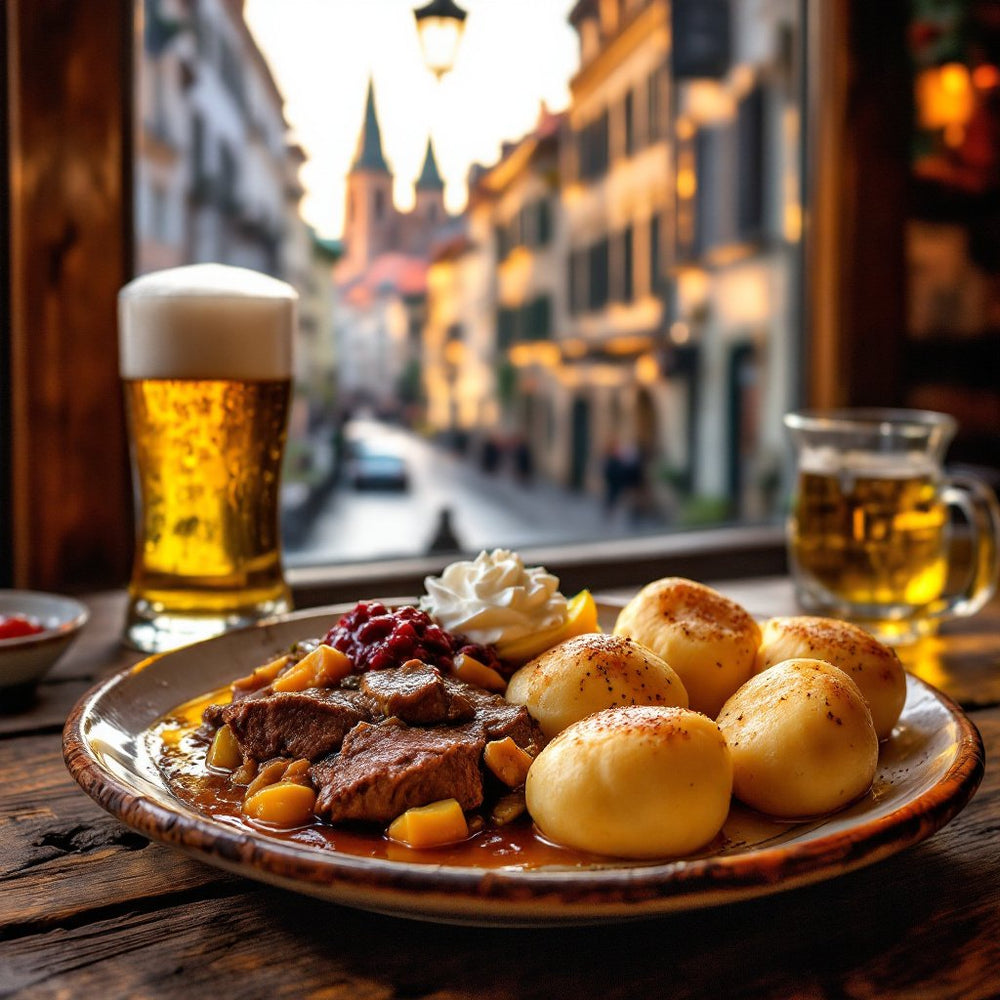
This beloved Czech roast features tender beef sirloin blanketed in a velvety cream sauce enriched with root vegetables and a whisper of lemon. The marriage of savory meat with cranberry compote and bread dumplings—those pillowy knedlíky that soak up every drop of sauce—represents centuries of Bohemian comfort cooking at its finest.
Credits: The Painted Passport
Local cuisine study in Prague, Czech Republic

☕︎ Local Flavor

Lokál Dlouhááá

Rating: 4.7★ | Price: $$ | Coordinates: 50.0891° N, 14.4201° E

Discover the restaurant that restored the reputation of Czech cooking in its own city — a long, vaulted dining hall in the Old Town where the tank-fresh Pilsner Urquell arrives in a perfectly conditioned glass and the svickova na smetane, braised beef sirloin in root vegetable cream sauce with bread dumplings and cranberry, is made to a standard that the communist-era canteens permanently damaged. The space is a reconstruction of the interwar Czech pub as a social institution — long communal tables, bentwood chairs, tile floors, and a kitchen that sources its produce from verified Czech suppliers. Lokalong is a physical manuscript of the argument that Czech food culture had always been defined by quality and restraint, and that the decades of institutional catering were an aberration rather than the tradition.

View Entry Details

Café Savoy

Rating: 4.7★ | Price: $$$ | Coordinates: 50.0831° N, 14.4021° E

Step into the most architecturally magnificent café in Prague — a late 19th-century Neo-Renaissance room on the Malá Strana embankment with a coffered ceiling five meters high, gilded pilasters, and a light that falls through the tall windows in the particular way that Central European café architects understood intuitively. The breakfast menu is built around the house-baked viennoiserie that emerges from the downstairs bakery from 6am — croissants, koláče with poppy seed and quark, and a rye bread that takes three days to ferment and proof. Café Savoy preserves the lineage of the Austro-Hungarian coffee house as a specifically Czech social institution — a place where the morning belongs to the bread, the newspaper, and the unhurried cup.

View Entry Details

La Degustation Bohême Bourgeoise

Rating: 4.8★ | Price: $$$$ | Coordinates: 50.0878° N, 14.4237° E

Navigate the most ambitious fine dining address in the Czech Republic — a one-Michelin-star restaurant in the Old Town where chef Oldrich Sahajdák constructs multi-course tasting menus built entirely from the recipes and ingredients of the Bohemian culinary tradition, reinterpreted through the lens of modern technique without sacrificing their essential identity. Fermented carp, smoked eel from Trebon, venison from the Bohemian Forest, and wild mushrooms from the forests north of Prague arrive in sequences of seven to eleven courses that document the Czech larder with forensic specificity. La Degustation is a physical manuscript of the argument that Central European cuisine has its own canon — as precise, as historically grounded, and as worthy of serious attention as the French tradition that has overshadowed it.

View Entry Details

Manifesto Market Holešovice

Rating: 4.6★ | Price: $$ | Coordinates: 50.1034° N, 14.4486° E

Discover the open-air food and culture market that has become the most accurate barometer of where Prague's food scene is heading — a collection of repurposed shipping containers in the Holešovice industrial district, where the city's most interesting small producers and chefs operate without the overhead of a permanent restaurant. Trdelník with tahini, Czech craft beer from microbreweries that did not exist five years ago, bánh mì made by a Vietnamese-Czech chef whose family arrived in the 1980s, and natural wine poured by a sommelier who sources from small Moravian producers — the range is specifically contemporary Prague. Manifesto documents the transition of the Holešovice quarter from heavy industry to creative district — preserving the spatial character of the factory era while filling it with the energy of a city that has been reinventing itself since 1989.

View Entry Details

🛌︎ Boutique Stays

Augustine Hotel Prague

Rating: 4.8★ | Price: $$$$ | Coordinates: 50.0896° N, 14.4021° E

Inhabit a hotel occupying seven historic buildings in Malá Strana including the 13th-century St. Thomas Monastery, where the Augustinian monks brewed their dark lager from the 13th century until 1951 and where the original Gothic vaulted cellars now serve as the hotel bar. The interior by Rocco Forte architects layers contemporary Czech design — furniture by Czech craftsmen, textiles in the dark amber and forest green of the Bohemian palette — within medieval and Baroque stonework that has been documented and preserved rather than restored into uniformity. Augustine is the most architecturally layered hotel in Prague and a physical manuscript of seven centuries of continuous use of a single urban site — from monastic brewery to secret police archive to luxury hotel, each transition leaving its material trace in the fabric of the walls.

View Entry Details

Hotel Josef Prague

Rating: 4.7★ | Price: $$$ | Coordinates: 50.0894° N, 14.4215° E

Rest in the most architecturally significant modern hotel in Prague — Eva Jiricna's 2002 building in the Jewish Quarter, a glass-and-steel structure whose transparent staircase and double-height atrium represent the finest example of contemporary Czech architecture operating in direct dialogue with its historic surroundings. The rooms are precise and spare: white walls, oak floors, and a palette that references the Czech Functionalist tradition of the 1920s without reproducing it nostalgically. Hotel Josef is an anchor for the argument that contemporary architecture can be built in a UNESCO historic centre without apology — a building that documents the transition of the Jewish Quarter from century of neglect to living urban fabric.

View Entry Details

Mandarin Oriental Prague

Rating: 4.8★ | Price: $$$$ | Coordinates: 50.0861° N, 14.4019° E

Unearth a 14th-century Dominican monastery in Malá Strana converted into one of the finest hotels in Central Europe — the original Gothic and Renaissance nave of the monastery church now serves as a spa, its barrel-vaulted ceiling and stone floors preserved intact while the treatment rooms occupy the former monastic cells arranged along the original cloister. The location places you between Prague Castle and Charles Bridge in the most historically concentrated neighbourhood in the city, within walking distance of every significant monument from the Baroque period. Mandarin Oriental Prague preserves the lineage of the Dominican presence in Malá Strana across seven centuries — a building that has served simultaneously as a place of contemplation, education, and now restoration, without losing its fundamental spatial character.

View Entry Details

Mosaic House Design Hotel

Rating: 4.6★ | Price: $$ | Coordinates: 50.0785° N, 14.4168° E

Rest in a sustainably designed boutique hotel in the New Town, built within a 1930s Functionalist building whose clean geometric facade and rational interior logic were preserved and extended by Czech designers who understand the tradition they are working within. The hotel operates one of the most considered sustainability programs in Czech hospitality — 95% LED lighting, greywater recycling, and a food and beverage operation that sources exclusively from Czech producers within 200km. Mosaic House documents the lineage of the Czech Functionalist movement as a living architectural tradition — a building that has been updated without being replaced, proving that the best 20th-century Czech architecture ages well when it is taken seriously.

View Entry Details

📍︎ Field Study

Prague Castle and St. Vitus Cathedral Guided Tour

Rating: 4.8★ | Price: $$ | Coordinates: 50.0900° N, 14.4005° E

Ascend to the largest ancient castle complex in the world — a 70,000 square metre fortified compound above the left bank of the Vltava that has been the seat of Bohemian kings, Holy Roman Emperors, and Czech presidents for over a thousand years, its skyline defined by the Gothic spires of St. Vitus Cathedral whose construction began in 1344 and was not completed until 1929. The cathedral's nave contains the tomb of St. Wenceslas, the 10th-century duke whose memory structured Czech national identity through nine centuries of foreign rule, and the Art Nouveau windows designed by Alfons Mucha in 1931 that represent the most significant Czech contribution to the Gothic revival tradition. Prague Castle is the most concentrated physical archive of Czech statehood ever assembled — a complex that has been documenting the continuity of Bohemian political ambition from the Premyslid dynasty to the present day.

View Entry Details

Old Town Prague and Astronomical Clock Walking Tour

Rating: 4.8★ | Price: $ | Coordinates: 50.0874° N, 14.4213° E

Navigate the medieval street grid of Prague's Old Town with a specialist guide who can trace the specific layers of Gothic, Renaissance, Baroque, and Art Nouveau architecture that accumulated without a single major fire or wartime destruction to interrupt the sequence — a continuity of urban fabric that is almost without parallel in Central Europe. The Astronomical Clock, installed in 1410 and still functioning on its original mechanism, is the third-oldest astronomical clock in the world and the only one still in operation — it displays solar time, lunar time, the position of the sun in the zodiac, and the Babylonian time system simultaneously. This walk is a guided reading of a city that survived the 20th century largely intact — documenting the specific urban intelligence that produces a street plan still navigable on a map drawn in 1650.

View Entry Details

Cesky Krumlov Day Trip from Prague

Rating: 4.8★ | Price: $$ | Coordinates: 48.8127° N, 14.3175° E

Journey three hours south to the most intact medieval town in Central Europe — a UNESCO World Heritage Site on a horseshoe bend of the Vltava River in South Bohemia, where the second-largest castle complex in the Czech Republic rises above a town of 13,000 whose Baroque and Renaissance street plan has remained essentially unchanged since the 17th century. The castle theatre, built in 1682 and preserved with its original Baroque stage machinery, painted backdrops, and period costumes intact, is one of only a handful of functioning Baroque theatres in the world. Cesky Krumlov is a physical manuscript of the Bohemian Renaissance and Baroque periods in their most complete surviving form — a town that documents what Central European urban culture looked like before industrialisation, nationalism, and the 20th century rewrote the landscape.

View Entry Details

Prague Jewish Quarter and Cemetery Tour

Rating: 4.9★ | Price: $$ | Coordinates: 50.0903° N, 14.4185° E

Walk through the most intact surviving medieval Jewish Quarter in Central Europe — six synagogues built between the 13th and 19th centuries, a town hall with a Hebrew clock whose hands run counterclockwise, and the Old Jewish Cemetery where 12,000 gravestones mark over 100,000 burials layered in up to twelve depths because the community was forbidden from expanding beyond their allotted land for three centuries. The Pinkas Synagogue's interior walls are inscribed with the names of the 77,297 Bohemian and Moravian Jews murdered in the Holocaust — a memorial that functions simultaneously as an architectural space and a primary historical document. Josefov is the most concentrated archive of Central European Jewish history still standing — a quarter that survived the Nazi occupation not through luck but through the specific decision to preserve it as a museum of an exterminated people, which failed in its intended meaning and succeeded as an act of preservation.

View Entry Details

Typography

Archival Note: We have personally documented these geographic specs for Prague, Czech Republic to ensure every watercolor study is anchored in real-world data. By cataloging the precise elevation, light cycles, and historical epochs, we provide a technical foundation that justifies the atmospheric stillness captured in our visual artifacts.

Botanical and pigment specimen study for Prague, Czech Republic Colors of Prague, Czech Republic
Coordinates
50.0755° N, 14.4378° E — Central Bohemia, Vltava River basin, Czech Republic
Historical Epoch
Celtic settlement 500 BCE. Prague Castle from 870 CE. Holy Roman Empire capital 1355. Baroque reconstruction after Thirty Years War 1648. Independent Czechoslovakia 1918. Czech Republic 1993.
Elevation
177–399 m / 581–1,309 ft — river basin city surrounded by gently wooded hills on all sides
Atmosphere
Continental (Dfb). Warm summers, cold winters with frost and snow. Spring and autumn light is exceptional — clear, low-angled, specific to the Central European river basin latitude.
Observation Hour
19:15. Golden hour on the Baroque domes and Gothic spires, limestone facades turning from pale grey to warm amber, and the Vltava catching the last light below Charles Bridge in a long copper reflection.
Primary Pigment
Baroque Terracotta (#C4622D) and Vltava Copper (#8B6914)
Best Time to Visit
April through June — the Bohemian spring light is extraordinary, the chestnut trees along the embankment are in bloom, and the city has not yet reached the summer tourist peak.
Avoid Visiting
July through August — maximum crowds on Charles Bridge and in the Old Town Square, hotel prices at their highest, and the best restaurants fully booked.

The Local Tongue

Language is the invisible architecture of Prague, Czech Republic. These entries document the regional vocabulary—capturing the "texture" of local speech that standard translations often miss. Hand-curated expressions reflecting the specific spirit and daily rhythm of the region.
Archival study of Czech cultural texture

via / Jarod Barton

Primary Language Czech
Regional Dialect Prague Czech (Pražská čeština)

Pohoda

The Czech concept of well-being that encompasses ease, contentment, and the pleasure of a situation where nothing is being demanded of you — a Sunday afternoon, a cold beer in a garden, a conversation with nowhere to go. Pohoda explains why Prague still has functioning neighborhood pubs in every quarter and why the city has a quality of life that its architecture alone cannot account for.

Knedlík

The bread dumpling that is the structural foundation of Czech cuisine — a steamed cylinder of white bread dough dense enough to absorb the gravies and sauces that Czech cooking produces in abundance. Knedlík is not a side dish; it is the point. The quality of a Czech restaurant is honestly assessed by whether the dumpling is made in-house or arrives from a factory in Kladno.

Hospoda

The traditional Czech pub — a social institution defined by a permanent regular clientele, a single reliable beer on tap at a correct temperature, and the understanding that a shared table is shared in companionable silence unless conversation is invited. The hospoda is the primary unit of Czech civil society — the place where the city thinks, disagrees, reconciles, and maintains its particular social temperature.

Wait! before you go...

Before you head over to Prague, Czech Republic, we wanted to share a few basic tips we picked up along the way. These notes cover the simple things—like how to get around or what to do about cash—so you can spend less time worrying and more time just enjoying the place.
🚲 Getting Around Prague has an excellent metro — three lines, 61 stations — supplemented by one of Europe's most extensive tram networks. A 24-hour pass for 120 CZK covers all transport. The historic centre is compact: most major sites are within 20 minutes on foot.
⚖️ Cash or Card Aim for a 70/30 card-to-cash ratio. Most restaurants, shops, and transport accept card, but smaller hospody, market stalls, and some historic attractions still prefer cash. Keep 500-1000 CZK in your wallet for any edge case — Prague remains largely a cash-friendly city.
☁️ Good to Know Prague is a city of early evenings — dinner begins at 6pm and the old city quiets by midnight in the residential quarters. Arrive at popular restaurants without a reservation on weekends at your peril. Book ahead for anything above a basic hospoda.
🏧 ATMs ATMs are found throughout the historic centre and at all transport hubs. Always use bank-affiliated machines — Česká spořitelna, ČSOB, or Komerční banka — rather than the independent yellow Euronet machines, which charge significantly higher fees for foreign cards.
💳 Currency The local currency is the Czech Crown (CZK / Kč). The Czech Republic is EU but has not adopted the Euro — do not accept prices in Euros without verifying the rate. Withdraw CZK from bank ATMs on arrival; rates are far better than exchange offices.
🔌 Plugs The Czech Republic uses Type C and Type E plugs with 230V and 50Hz. Most modern electronics are dual-voltage and need only a simple adapter. Czech sockets are the standard European recessed type — any European travel adapter works without modification.
🛡️ Safety Prague is a very safe city with standard urban awareness. Pickpocketing is the primary concern on the Charles Bridge and in the Old Town Square. Keep your wallet in a front pocket in crowded tourist areas for a completely trouble-free visit.
✈️ Airports The primary gateway is Václav Havel Airport Prague (PRG), 17km northwest of the centre. Bus 119 connects to the Nádraží Veleslavín metro station in 20 minutes for 40 CZK. No direct rail link exists; taxis cost approximately 500-700 CZK to the Old Town.

Behind The Scenes

Nathan

Note from the Founder

Hey, did you know this fun fact about Prague, Czech Republic? Charles Bridge was built using egg yolks mixed into the mortar for extra strength — villages across Bohemia sent cartloads of eggs to Prague during its construction between 1357 and 1402.
Thank you for exploring the Prague, Czech Republic series with us. We hope these notes have inspired you to add this incredible destination to your own passport—we are so glad you’re here. — Nathan

The Magnets

The Coasters

The Canvas