







Local Cuisine Spotlight


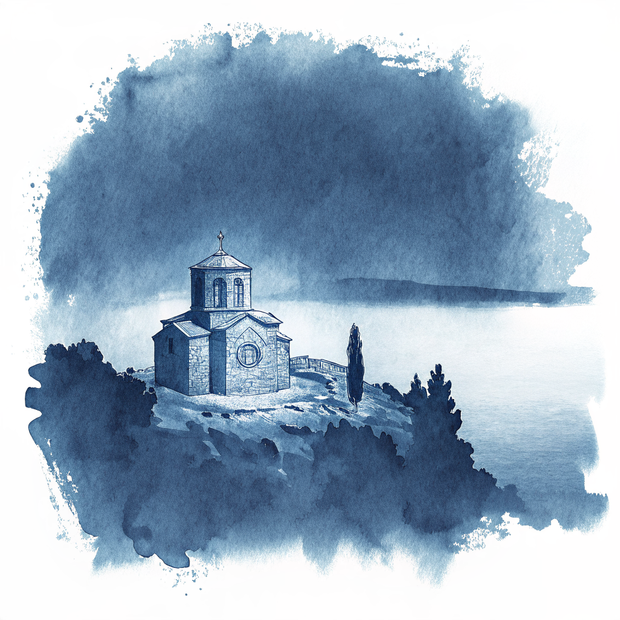
Now representing Ohrid — 6 original pieces, each hand-crafted in watercolor.
Ohrid sits at the edge of one of Europe's oldest and deepest lakes, a town so layered with history that Byzantine frescoes and Roman amphitheaters share the same hillside. The old town climbs steeply above the water, its cobblestones worn smooth by centuries of pilgrims, scholars, and fishermen. Light here does something particular in the late afternoon, turning the limestone facades a deep amber and scattering gold across the surface of Lake Ohrid until the water looks almost solid. This is a place where Slavic literacy was born, where Saints Clement and Naum established schools in the ninth century that gave the world the Cyrillic alphabet, and that weight of meaning still settles quietly over every courtyard and church doorway.
Every canvas is painted from a real place. Explore the map to see exactly where each scene lives — and wander Ohrid the way a traveler would, one landmark at a time.
Keep Exploring
Bring us your own photograph and we'll hand-frame it in the same museum-quality frames as our watercolors.
Custom Framing
Send us the moment you never want to forget and we'll frame it by hand in the same museum-quality frames we use for our watercolors. Choose your size below, check out, and we'll email you a secure link to upload your photo.
Archival Note: A curated field study of Ohrid, North Macedonia, prioritizing the specific atmospheric stillness of the region. These artifacts have been meticulously sourced from our global archival partners to represent the area's unique cultural frequency and environmental character. This selection serves as a formal observation for our ongoing global archive, vetted for its visual accuracy and archival merit.


Archival Note: A curated field study of Ohrid, North Macedonia, prioritizing cultural relevance and archival merit. These locations have been meticulously researched and vetted to ensure they represent the most authentic atmosphere for your own expedition.
Archival Note: A formal technical study of Ohrid, North Macedonia, archiving the coordinates, elevation, and environmental data that define the region. This data serves as a vital record for our ongoing global field study, providing the technical foundation behind every atmospheric detail captured in our visual work.
 Colors of Ohrid, North Macedonia

via / Emir Bozkurt


