Shop the Collection

To help you bring a piece of your journey home, we've put together this collection of watercolor studies from our time in Oaxaca, Mexico. These are our favorite ways to keep the spirit of the trip alive.

Original Series Decorative Magnet

A lovely, high-res reminder for your fridge or workspace. This watercolor magnet is the perfect small token to remember your Oaxaca, Mexico adventure.

Oaxaca, Mexico | Catedral de la Asunción | Original Series Decorative Magnet
Add to Collection / $18
Exclusive Series Artifact

Original Series Gallery Canvas

This high-fidelity canvas is a beautiful way to anchor a room and keep your memories of Oaxaca, Mexico fresh long after you've returned home.

Oaxaca, Mexico | Catedral de la Asunción | Original Series Gallery Canvas detail Oaxaca, Mexico | Catedral de la Asunción | Original Series Gallery Canvas detail Oaxaca, Mexico | Catedral de la Asunción | Original Series Gallery Canvas detail Oaxaca, Mexico | Catedral de la Asunción | Original Series Gallery Canvas detail
Add to Collection / $65

Original Series Hardboard Coaster

A wonderful companion for your morning coffee. This coaster captures the atmosphere of Oaxaca, Mexico in a functional, beautiful way.

Oaxaca, Mexico | Catedral de la Asunción | Original Series Hardboard Coaster
Add to Collection / $18
Exclusive Series Artifact

The Spirit of the Land

Archival Note: Documented personally during our time in Oaxaca, Mexico. While we leverage a global network of contributors to provide these high-fidelity visual artifacts, each selection is curated to reflect the specific, quiet frequencies we experienced on the ground. These textures serve as a formal study of the unhurried light and environmental character that defined our journey.

Oaxaca, Mexico study No. 01
Oaxaca, Mexico / 01 VIA / Anastasiia Malai
A white Beetle sits at a quiet intersection. Saturated ochre and teal walls meet the texture of sun-baked cobblestone. The scent of distant copal and the stillness of the southern highlands.
Oaxaca, Mexico study No. 02
Oaxaca, Mexico / 02 VIA / Analuisa Gamboa
Vibrant threads tell the story of the loom. Geometric patterns in zapotec blue and cochineal red hang in the soft courtyard light. The rhythmic pull of the pedal and the patience of the weaver.
Oaxaca, Mexico study No. 03
Oaxaca, Mexico / 03 VIA / Jhovani Morales
Morning light and a sea of cempasúchil and velvet roses. The vendor finds her center amidst the burst of color. The scent of earth and tradition on market day.

Where to wander

Archival Note: These recommendations were curated personally during our time in Oaxaca, Mexico to capture the textures that defined the quiet frequencies of the trip. Every entry here is a place we genuinely love; we hope these notes inspire you to wander off the main path and discover the same stillness we found on the ground.

Local Cuisine Spotlight
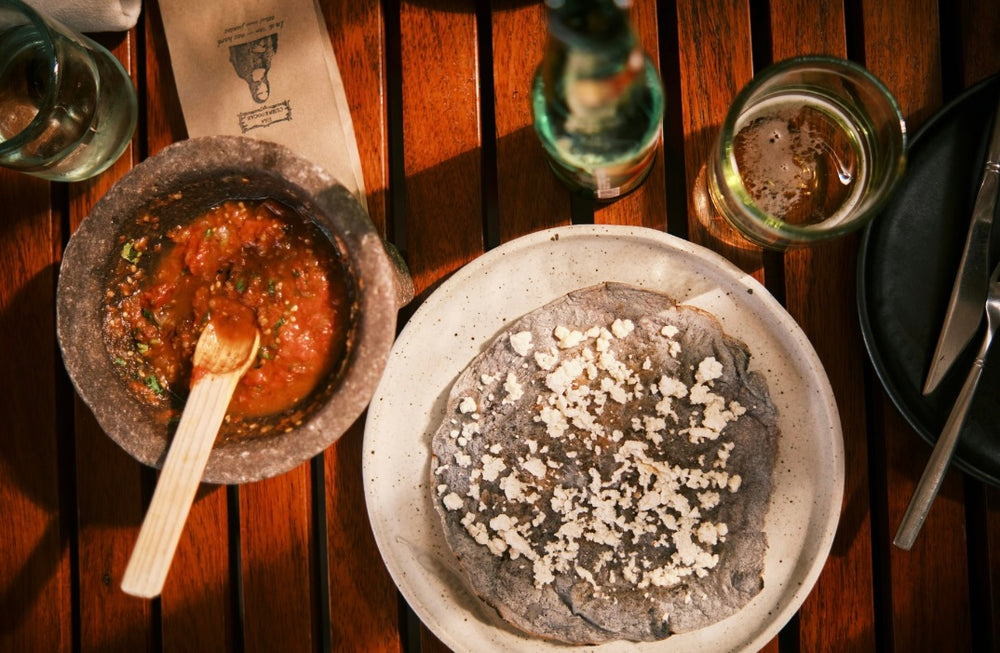
Hand-pressed blue heirloom corn charred over an open comal. Earthy, dense, and finished with the sharp salinity of fresh queso. Accompanied by salsa roja hand-ground in volcanic stone - a rustic architecture of smoke and friction.
Credits: Sergi Ferrete
Local cuisine study in Oaxaca, Mexico

☕︎ Local Flavor

Evening Street Food & Neighborhood Kitchens

Rating: 4.9★ | Price: $$ | Coordinates: 17.0608° N, 96.7253° W

Traverse the twilight corridors of the city to locate the subtle smoke plumes of tlayuda stalls and comales laden with tetelas. Focus on the geometry of the folded masa and the complex acidity of fermented pineapple vinegars that define the Oaxacan palate. This nocturnal survey is an anchor for the city’s identity, showcasing the resilience of communal eating practices in an evolving urban landscape.

View Entry Details

The Art of Oaxacan Chocolate Workshop

Rating: 4.8★ | Price: $$ | Coordinates: 17.0621° N, 96.7235° W

Ascend into the history of Mesoamerican currency by hand-roasting fermented cacao beans over a traditional comal. Inhale the volatile oils of cinnamon and almond as you transform raw nibs into a rich, granular paste used for both ritual and sustenance. It is a physical study of Oaxacan identity, where the bitterness of the bean represents a pre-Hispanic past sweetened by colonial trade.

View Entry Details

Ancestral Mezcal & Palenque Study

Rating: 4.9★ | Price: $$$ | Coordinates: 16.9482° N, 96.4011° W

Unearth the alchemy of the maguey at a family-run distillery where the scent of roasting agave hearts permeates the earthen floor. Observe the distillation in clay pots—a method predating industrial copper—where the liquid capture of smoke and soil reflects the terroir of the Tlacolula Valley. This experience functions as a biological manuscript, documenting the transition from wild botanical life to the sacred "spirit" of the Oaxacan people.

View Entry Details

Traditional Cooking Class with Minerva Lopez

Rating: 5.0★ | Price: $$$ | Coordinates: 17.0605° N, 96.7251° W

Navigate the sensory geography of the local markets before retreating to a private garden kitchen to decant the secrets of the metate. Grind toasted chiles and cacao into a thick, obsidian paste of Mole Negro, feeling the rhythmic resistance of volcanic stone against grain. This immersion serves as a culinary archive, preserving the lineage of Oaxacan matriarchs through the tactile transmission of ancestral recipes.

View Entry Details

🛌︎ Boutique Stays

Pug Seal Oaxaca

Rating: 4.8★ | Price: $$$$ | Coordinates: 17.0612° N, 96.7271° W

Navigate a surrealist interpretation of Oaxacan history through bold murals and avant-garde furniture housed within a meticulously restored Zapotec-Mediterranean villa. Every corner is a visual thesis on the "Zapotec Soul," blending mythic iconography with luxury comfort. This hotel is a physical manuscript of the city’s storytelling tradition, where the walls themselves narrate the evolution of Oaxacan consciousness.

View Entry Details

La Betulia Bed and Breakfast

Rating: 4.9★ | Price: $$ | Coordinates: 17.0721° N, 96.7225° W

Engage with the residential rhythm of the Xochimilco district from this bright, architecturally airy retreat that emphasizes local textures and communal light. Note the use of artisanal textiles and hand-poured tiles that ground the guest in the city’s specific material heritage. It acts as a curated archive of Oaxacan hospitality, prioritizing the quietude of the neighborhood over the central plaza’s kinetic energy.

View Entry Details

Hotel Azul de Oaxaca

Rating: 4.7★ | Price: $$$ | Coordinates: 17.0658° N, 96.7265° W

Discover a dialogue between contemporary Oaxacan art and colonial structure within this boutique sanctuary designed by legendary local artists like Francisco Toledo. Examine the interplay of water, light, and slate-gray basalt that characterizes the minimalist courtyards. This space serves as a cultural repository, bridging the gap between the city’s ancient craft traditions and its modern intellectual movements.

View Entry Details

Quinta Real Oaxaca

Rating: 4.6★ | Price: $$$$ | Coordinates: 17.0636° N, 96.7239° W

Inhabit the hallowed halls of the former 16th-century Convent of Santa Catalina de Siena, where thick stone walls and frescoed archways provide a monastic silence. Walk upon original terracotta tiles and dine amidst the skeletal beauty of the "Wash Basins" courtyard, framed by heavy Spanish colonial timber. The property is a living historical manuscript, documenting the Dominican Order's architectural imprint on the New World.

View Entry Details

📍︎ Field Study

Ethnobotanical Garden & Textile Museum

Rating: 4.8★ | Price: $$ | Coordinates: 17.0664° N, 96.7225° W

Discover the symbiotic relationship between Oaxacan flora and indigenous craft through a curated walk of the former Santo Domingo monastery grounds. Observe the rare cacti and agave species that provided both the fibers and the dyes for the textiles housed in the nearby museum. This journey is a biological and material archive, illustrating the ecological foundations of Oaxacan cultural sovereignty.

View Entry Details

San Martín Tilcajete: Alebrije Workshop

Rating: 5.0★ | Price: $$ | Coordinates: 16.8583° N, 96.6972° W

Enter the workshops of master woodcarvers to observe the transformation of copal wood into intricate, phantasmagorical spirit guides. Document the use of natural pigments—pomegranate, lime, and indigo—to create the vivid geometric patterns that define these sculptures. This excursion preserves the lineage of Zapotec woodcarving, proving that mythic imagination remains a primary export of the Oaxacan valleys.

View Entry Details

Hierve el Agua & Ancient Hydrology

Rating: 4.9★ | Price: $$$ | Coordinates: 16.8661° N, 96.2758° W

Explore the calcified "frozen waterfalls" and the intricate irrigation systems carved into the cliffside over 2,500 years ago. Touch the mineral-rich waters that continue to deposit travertine, creating a surreal landscape of white stone and turquoise pools. This site serves as a vital piece of the city's puzzle, documenting the sophisticated water management strategies of pre-colonial civilizations.

View Entry Details

Monte Albán Archaeological Study

Rating: 4.7★ | Price: $$ | Coordinates: 17.0438° N, 96.7677° W

Ascend the Great Plaza to witness the Zapotec mastery of urban planning and astronomical alignment etched into the mountaintop. Study the "Danzantes" stone reliefs, which record a cryptic history of conquest and ritual through stylized human anatomy. Monte Albán remains the definitive anchor for the city's identity, a petrified record of the first great metropolis of Mesoamerica.

View Entry Details

Typography

Archival Note: We have personally documented these geographic specs for Oaxaca, Mexico to ensure every watercolor study is anchored in real-world data. By cataloging the precise elevation, light cycles, and historical epochs, we provide a technical foundation that justifies the atmospheric stillness captured in our visual artifacts.

Botanical and pigment specimen study for Oaxaca, Mexico Colors of Oaxaca, Mexico
Coordinates
17.0654° N, 96.7244° W — Southern Mexico, Sierra Juárez highlands
Historical Epoch
Zapotec civilization at Monte Albán from 500 BCE. Spanish colonial foundation in 1529 CE. Benito Juárez birthplace and capital of the state. Independence from Spain in 1821.
Elevation
1,555 m / 5,102 ft — high-altitude valley ringed by pine-forested mountains
Atmosphere
Semi-Arid Highland (BSk). Warm dry winters with clear blue skies, summer rainy season June through September, mild temperatures year-round at altitude.
Observation Hour
16:45. The late afternoon light falls golden and warm across the jade green stone of Santo Domingo church and the carved stone facades of the Centro, producing the amber-on-green palette that defines Oaxaca at dusk.
Primary Pigment
Adobe Sienna (#A66E4E)
Best Time to Visit
October through November — dry season peaks, skies clear for the Sierra Juárez views and the Day of the Dead celebrations fill the city with color
Avoid Visiting
June through August — peak rainy season brings daily afternoon downpours and the chocolate-brown Río Atoyac floods

The Local Tongue

Language is the invisible architecture of Oaxaca, Mexico. These entries document the regional vocabulary—capturing the "texture" of local speech that standard translations often miss. Hand-curated expressions reflecting the specific spirit and daily rhythm of the region.
Archival study of Spanish cultural texture

via / Arturo Garcia

Primary Language Spanish
Regional Dialect Oaxaqueño

Mezcaleando

More than just drinking mezcal; it is the slow, ritualistic process of "mezcaling." In Oaxaca, we don't take shots; we "kiss" the spirit. This study captures the smoke-heavy air of a palenque at dusk, where the heat of the earth meets the agave.

Tequio

A Zapotec concept of "collective labor" for the good of the community. It’s the invisible thread that keeps the vibrant colors of the city and the remote mountain paths intact. You feel it in the shared pride of the artisans and the meticulous care of the local plazas.

Guetza

The root of Guelaguetza, meaning "gift" or "to give." It’s the spirit of reciprocal exchange that defines the Oaxacan heart. Whether it’s a shared meal or a story told on a street corner, there is an inherent grace in the way the locals offer a piece of their world to the traveler.

Wait! before you go...

Before you head over to Oaxaca, Mexico, we wanted to share a few basic tips we picked up along the way. These notes cover the simple things—like how to get around or what to do about cash—so you can spend less time worrying and more time just enjoying the place.
🚲 Getting Around Walking is the best way to experience Centro. For longer distances, use "Sitio" taxis (yellow cabs with base numbers) or colectivos (shared maroon-and-white taxis) for trips to neighboring craft villages.
⚖️ Cash or Card 80% Cash / 20% Card. You will need cash for nearly everything: markets, street stalls, small mezcalerías, and taxis. High-end restaurants and boutique hotels in Centro will accept major credit cards.
☁️ Good to Know "Oaxaqueño time" is real; the city moves at a deliberate, slow pace. Also, be mindful of bloqueos (protest roadblocks)—they are a common form of local political expression and may occasionally affect transit times to the airport or Hierve el Agua.
🏧 ATMs Plentiful in the Centro Histórico. Use bank-affiliated ATMs (Santander, BBVA, or Banamex) located inside well-lit foyers for the best rates and security. Avoid independent kiosks on the street.
💳 Currency Mexican Peso (MXN). While the symbol is "$", all prices are in Pesos. Small denominations ($20, $50, $100) are essential for markets and street food.
🔌 Plugs Type A and Type B (standard North American two-pin or three-pin plugs). The standard voltage is 127V at 60Hz.
🛡️ Safety Oaxaca is one of Mexico’s safest states. Standard urban precautions apply: keep your bag zipped in crowded markets (like 20 de Noviembre) and stick to well-lit main streets (Andador Turístico) after dark.
✈️ Airports Oaxaca International Airport (OAX / Xoxocotlán). It is a small, efficient terminal located approximately 25–30 minutes south of the Centro Histórico.

Behind The Scenes

Nathan

Note from the Founder

Hey, did you know this fun fact about Oaxaca, Mexico? Oaxaca produces more mezcal denominations of origin than any other Mexican state, with over 30 agave species legally authorized for production, and the state is simultaneously the richest in Mexico for indigenous languages with 16 distinct ethnolinguistic groups still speaking their native tongues.
Thank you for exploring the Oaxaca, Mexico series with us. We hope these notes have inspired you to add this incredible destination to your own passport—we are so glad you’re here. — Nathan

The Magnets

The Coasters

The Canvas