Shop the Collection

To help you build your own global archive, we've prepared this collection of watercolor studies from our research into Montevideo, Uruguay. These artifacts are designed to bring the stillness of this corner of the world into your home.

Original Series Decorative Magnet

A personal study of Montevideo, Uruguay, captured in high-fidelity watercolor and prepared for your collection.

Montevideo, Uruguay | Plaza Independencia Palm Trees | Original Series Decorative Magnet
Add to Collection / $18
Exclusive Series Artifact

Original Series Gallery Canvas

This high-fidelity canvas is a beautiful way to anchor a room and keep your memories of Montevideo, Uruguay fresh long after you've returned home.

Montevideo, Uruguay | Plaza Independencia Palm Trees | Original Series Gallery Canvas detail Montevideo, Uruguay | Plaza Independencia Palm Trees | Original Series Gallery Canvas detail Montevideo, Uruguay | Plaza Independencia Palm Trees | Original Series Gallery Canvas detail
Add to Collection / $65

Original Series Hardboard Coaster

A personal study of Montevideo, Uruguay, captured in high-fidelity watercolor and prepared for your collection.

Montevideo, Uruguay | Plaza Independencia Palm Trees | Original Series Hardboard Coaster
Add to Collection / $18
Exclusive Series Artifact

The Spirit of the Land

Archival Note: A curated field study of Montevideo, Uruguay, prioritizing the specific atmospheric stillness of the region. These artifacts have been meticulously sourced from our global archival partners to represent the area's unique cultural frequency and environmental character. This selection serves as a formal observation for our ongoing global archive, vetted for its visual accuracy and archival merit.

Montevideo, Uruguay study No. 01
Montevideo, Uruguay / 01 VIA / Nikolai Kolosov
Clear afternoon light bathes Montevideo's diverse architecture in sharp detail, where a striking red-brick tower stands as the focal point among art deco and contemporary structures. The lush green trees interspersed throughout the urban landscape soften the city's geometric forms, while the expansive sky and distant green hills beyond create a sense of openness rare in dense urban cores. This moment captures the city's character—a blend of vintage charm and modern development, bathed in the warm sunshine typical of a perfect South American day.
Montevideo, Uruguay study No. 02
Montevideo, Uruguay / 02 VIA / Nikolai Kolosov
The brilliant blue sky and sharp shadows create a striking contrast between the ornate early 20th-century architecture and the utilitarian modern high-rise behind it. Standing in this narrow street canyon would offer cool shade from the historic facades while the open plaza beyond glows with warm sunlight and tropical vegetation. The scene captures the layered history of Montevideo, where elegant Belle Époque elegance coexists with mid-century modernism.
Montevideo, Uruguay study No. 03
Montevideo, Uruguay / 03 VIA / Alex Brites
This photograph captures Montevideo's iconic Rambla and urban waterfront in ideal conditions, with the city's distinctive architecture rising behind the sand. The deep turquoise water creates a striking contrast against the sandy beach and red-tiled promenade below. Often overlooked are the scattered palm trees dotting the grassy areas, which add subtle tropical character to this South American capital's otherwise temperate coastal landscape.

Where to wander

Archival Note: A curated field study of Montevideo, Uruguay, prioritizing cultural relevance and archival merit. While we haven't touched down here yet, we've meticulously vetted these locations through our global network of contributors to ensure they represent the most authentic atmosphere for your own expedition.

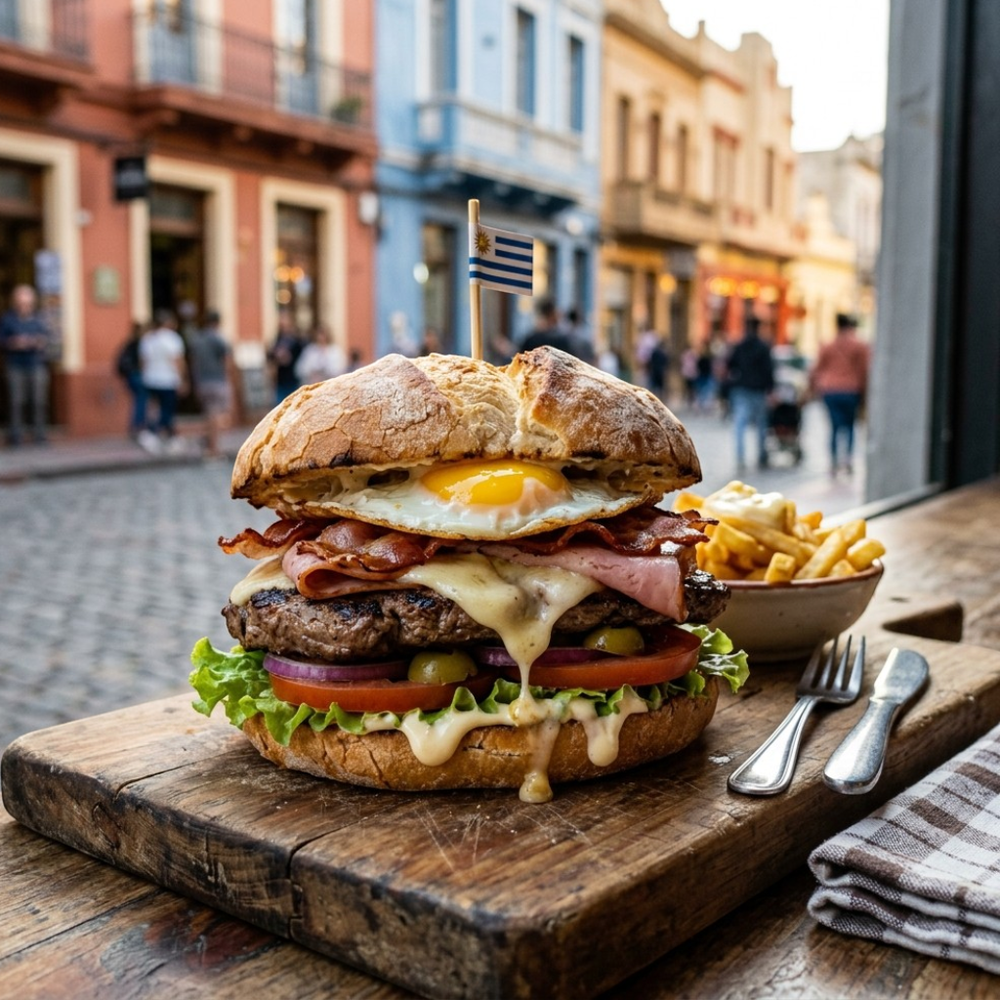
Local Cuisine Spotlight
This magnificent burger layers succulent beef, crispy bacon, creamy melted cheese, and a perfectly runny fried egg between a crusty artisanal bun. Topped with fresh lettuce, ripe tomato, and red onion, each ingredient shines in this Montevidean street food masterpiece. Served with golden fries, it's a sensory celebration of texture and flavor that captures the soul of local cuisine.
Credits: THE PAINTED PASSPORT
Local cuisine study in Montevideo, Uruguay

☕︎ Local Flavor

Jacinto Restaurant

Rating: 5* | Price: $$$ | Coordinates: -34.9063, -56.1901

Jacinto champions hyper-local ingredients inside a beautifully converted Ciudad Vieja storefront with exposed brick and candlelight. Chef Mariana Muñoz transforms humble Uruguayan produce — think pumpkin, smoked river fish, and aged cheeses — into refined, soulful plates. The seasonal tasting menu changes monthly and always ends with a dulce de leche dessert worth planning a trip around.

View Entry Details

El Palenque Mercado del Puerto

Rating: 5* | Price: $$ | Coordinates: -34.9078, -56.1956

No visit to Montevideo is complete without pulling up a stool at El Palenque inside the legendary iron-roofed Mercado del Puerto. Enormous parrilleros grill whole cuts of beef over wood coals while smoke curls up through the skylights in a theatrical display. Order the chorizo, tira de asado, and a cold Pilsen — simplicity has never tasted so triumphant.

View Entry Details

La Fonda del Pez

Rating: 4* | Price: $$ | Coordinates: -34.9071, -56.1885

This beloved Ciudad Vieja bistro specializes in fresh Río de la Plata seafood with a relaxed, neighborhood-tavern spirit that regulars guard jealously. The fish chowder loaded with corvina, clams, and herbs is comfort food at its most sincere. Friendly servers know the menu deeply and will steer you toward whatever the fishermen brought in that morning.

View Entry Details

Café Brasilero

Rating: 4* | Price: $ | Coordinates: -34.9068, -56.1878

Founded in 1877, Café Brasilero is Montevideo's oldest café and still one of its most atmospheric, with dark wood panels and literary ghosts around every corner. Writers, professors, and curious travelers share marble tables over strong cortados and flaky pasteles de hojaldre. Come in the late afternoon when golden light pours through the arched windows and time seems to genuinely slow down.

View Entry Details

🛌︎ Boutique Stays

Alma Historica Boutique Hotel

Rating: 5* | Price: $$$ | Coordinates: -34.9058, -56.1913

Nestled in the heart of Ciudad Vieja, this restored colonial mansion wraps you in warm terracotta tones and handpicked Uruguayan artwork. Each room tells a story through antique furnishings paired with modern comforts like rainfall showers. Wake up to espresso on your private balcony overlooking cobblestone streets.

View Entry Details

Hotel Cottage Carrasco

Rating: 5* | Price: $$$$ | Coordinates: -34.8941, -56.0647

Tucked inside Carrasco's leafy residential neighborhood, this legendary Tudor-style property feels like a countryside retreat minutes from the sea. Lush gardens, a heated pool, and gracious staff create an atmosphere of effortless elegance and calm. The Sunday brunch beneath century-old trees is an unmissable local institution.

View Entry Details

Esplendor by Wyndham Montevideo

Rating: 4* | Price: $$$ | Coordinates: -34.9074, -56.1888

This sleek design hotel sits steps from the iconic Puerta de la Ciudadela, blending industrial chic with genuine Uruguayan warmth. Rooftop views stretch over the old city's terracotta rooftops all the way to the Río de la Plata horizon. The lobby bar pours excellent local tannat wines every evening without pretension.

View Entry Details

Posada del Faro Punta Carretas

Rating: 4* | Price: $$ | Coordinates: -34.9215, -56.1621

A charming guesthouse just blocks from the beloved Punta Carretas shopping village and the rambla promenade, offering intimate rooms with bright seaside palettes. The owners greet every guest by name and stock the kitchen with homemade medialunas each morning. It is the kind of place that turns a short trip into a long one.

View Entry Details

📍︎ Field Study

Rambla de Montevideo

Rating: 5* | Price: Free | Coordinates: -34.9125, -56.1672

Stretching nearly 22 kilometers along the Río de la Plata, Montevideo's rambla is the city's living room, jogging track, and sunset theater all in one. Families picnic on the rocks, joggers weave past mate-sipping retirees, and fishermen cast lines in complete peace. Walking even a short stretch at golden hour, with the wide silver river glowing, is quietly one of South America's great urban experiences.

View Entry Details

Ciudad Vieja Historic Quarter

Rating: 5* | Price: Free | Coordinates: -34.9063, -56.1952

Montevideo's original colonial peninsula is a beautifully imperfect tapestry of art deco facades, crumbling balconies draped in bougainvillea, and reborn cultural spaces. Wander from the Plaza Independencia past the Solís Theatre to hidden courtyards where murals burst from every wall. The neighborhood rewards slow walkers who look up, peek through archways, and say yes to every unmarked gallery door.

View Entry Details

Museo Nacional de Artes Visuales

Rating: 4* | Price: $ | Coordinates: -34.9003, -56.1673

Housed inside Parque Rodó, Uruguay's premier fine arts museum holds the country's largest collection of national painting and sculpture spanning three centuries of creative identity. Pedro Figari's vivid candombe scenes and Joaquín Torres García's constructivist masterworks are absolute highlights that stop you mid-step. The park setting means you can wander outside afterward and decompress among eucalyptus trees and swan-filled lagoons.

View Entry Details

Feria de Tristán Narvaja

Rating: 5* | Price: Free | Coordinates: -34.9002, -56.1742

Every Sunday morning this sprawling street market transforms Tristán Narvaja avenue into an irresistible maze of secondhand books, vintage vinyl, handmade leather goods, and steaming street food stalls. Locals arrive early with their thermoses of mate and treat the whole affair as a sacred weekend ritual of browsing and conversation. Even if you buy nothing, the energy, color, and the smell of fresh churros make it the best two hours you will spend in the city.

View Entry Details

Typography

Archival Note: A formal technical study of Montevideo, Uruguay—archiving the coordinates, elevation, and environmental data that define the region. This data serves as a vital record for our ongoing global field study, allowing us to reconstruct the regional atmosphere with archival precision before our physical arrival.

Botanical and pigment specimen study for Montevideo, Uruguay Colors of Montevideo, Uruguay
Coordinates
34.9011° S, 56.1645° W — Montevideo city center, Uruguay
Historical Epoch
Founded by the Spanish in 1724 as a military outpost against Portuguese expansion, Montevideo grew into one of South America's most progressive capitals, abolishing slavery early and pioneering welfare reforms under Jose Batlle y Ordonez in the early 20th century.
Elevation
0-60 m / 0-197 ft - Montevideo is a low-lying coastal city with gentle rolling terrain rising slightly inland from the Rio de la Plata shoreline.
Atmosphere
Cfa - Humid Subtropical. Mild four-season climate with warm summers and cool winters. Rain is distributed year-round, and the river air keeps temperatures moderate even in the height of summer.
Observation Hour
07:30 - Morning light off the Rio de la Plata produces a soft silver-gold diffusion that makes Ciudad Vieja facades glow without harsh shadow. The hour before 09:00 is quiet, cool, and painterly.
Primary Pigment
Rio Silver (#B8C4C8) and Colonial Ochre (#C8963E)
Best Time to Visit
November through March - long warm days, beach promenade culture at its peak, and the energy of Carnival season building through February.
Avoid Visiting
June through August - the Southern Hemisphere winter brings grey skies, cold river winds, and a noticeably quieter, shuttered city feel.

The Local Tongue

Language is the invisible architecture of Montevideo, Uruguay. These entries document the regional vocabulary—capturing the "texture" of local speech that standard translations often miss. Hand-curated expressions reflecting the specific spirit and daily rhythm of the region.
Archival study of Spanish cultural texture

via / Nikolai Kolosov

Primary Language Spanish
Regional Dialect Rioplatense Spanish

Rambla

Rambla refers to the sweeping coastal promenade that runs nearly 22 kilometers along Montevideo's shoreline. It is not merely a road but a daily ritual - locals walk it at dusk with a thermos of mate tucked under one arm, and the smell of salt air and river wind is as much a part of the experience as the pavement underfoot.

Mate

Mate is a bitter, grassy herbal infusion shared from a gourd and metal straw, but its deeper meaning is one of connection and presence. Strangers on a park bench pass the gourd without ceremony, and the act of accepting it is understood as a gesture of trust - the warmth of the vessel against the palm is as familiar to Uruguayans as a handshake.

Murga

Murga is a theatrical and musical form of Carnival performance unique to the Rio de la Plata region, blending satire, costume, and choral singing into something entirely its own. During February the streets of Montevideo fill with the sound of drums and painted faces, and the performances carry pointed political commentary wrapped inside joyful, almost defiant spectacle.

Wait! before you go...

Before you head over to Montevideo, Uruguay, we’ve audited the essential data points for this corner of the world. These notes cover the logistics—from currency ratios to transit hubs—to help you navigate the landscape with clarity.
🚲 Getting Around Montevideo's public bus network called STM covers the city thoroughly and costs very little, making it the most practical way to move between neighborhoods. Taxis and ride-hail apps like Uber and Cabify are reliable for late nights and cross-city journeys with luggage.
⚖️ Cash or Card Cards are accepted widely in restaurants, hotels, and larger shops, but smaller markets, the Ferias, and older neighborhood cafes strongly prefer cash. Carrying a modest amount of Uruguayan pesos for daily incidentals is a practical habit that avoids friction at the best local spots.
☁️ Good to Know Uruguayans are warm but take their personal space seriously in the first meeting - a firm handshake rather than a cheek kiss is common among strangers. Meal times run late by most standards, with dinner rarely beginning before 21:00 and restaurants only filling after 22:00, especially on weekends.
🏧 ATMs ATMs are widely available throughout Montevideo, particularly in Pocitos, Centro, and Ciudad Vieja, and most accept international Visa and Mastercard without issue. Withdrawal limits per transaction can be modest, so taking out slightly more in a single visit saves on per-transaction fees from home banks.
💳 Currency The Uruguayan Peso (UYU) is the national currency and is used for all everyday transactions from bus fares to market empanadas. US dollars are informally accepted in some tourist-facing businesses but change is always returned in pesos, so converting at a bank or official exchange house gives the best rate.
🔌 Plugs Uruguay uses Type C and Type L outlets at 220V, 50Hz. A universal travel adapter is recommended, especially for Type L which has three round pins in a line.
🛡️ Safety Montevideo is one of the safer capitals in South America and the Ciudad Vieja and Pocitos neighborhoods are generally comfortable to walk at night. Standard city awareness applies - keep bags close in crowded markets and around the Old Port area after dark, and avoid displaying expensive electronics unnecessarily.
✈️ Airports Carrasco International Airport (MVD) is Montevideo's only commercial airport, located about 20 kilometers east of the city center in the Carrasco neighborhood. Taxis, remises, and the COT shuttle bus all connect the airport to the city, with journey times of around 30 to 45 minutes depending on traffic.

Behind The Scenes

Nathan

Note from the Founder

Hey, did you know this fun fact about Montevideo, Uruguay? Uruguay was the first country in Latin America to legalize the sale of cannabis nationally, in 2013. It also achieved near-universal literacy and secular public education in the early 20th century, and consistently ranks among the region's most stable democracies.
Thank you for exploring the Montevideo, Uruguay series with us. We hope these notes have inspired you to add this incredible destination to your own passport—we are so glad you're here. — Nathan

Some of our Favorites