Shop the Collection

To help you build your own global archive, we've prepared this collection of watercolor studies from our research into Maun, Botswana. These artifacts are designed to bring the stillness of this corner of the world into your home.

Original Series Decorative Magnet

A personal study of Maun, Botswana, captured in high-fidelity watercolor and prepared for your collection.

Maun, Botswana | Original Series Decorative Magnet
Add to Collection / $18
Exclusive Series Artifact

Original Series Gallery Canvas

This high-fidelity canvas is a beautiful way to anchor a room and keep your memories of Maun, Botswana fresh long after you've returned home.

Maun, Botswana | Original Series Gallery Canvas detail Maun, Botswana | Original Series Gallery Canvas detail Maun, Botswana | Original Series Gallery Canvas detail Maun, Botswana | Original Series Gallery Canvas detail
Add to Collection / $65

Original Series Hardboard Coaster

A personal study of Maun, Botswana, captured in high-fidelity watercolor and prepared for your collection.

Maun, Botswana | Original Series Hardboard Coaster
Add to Collection / $18
Exclusive Series Artifact

The Spirit of the Land

Archival Note: A curated field study of Maun, Botswana, prioritizing the specific atmospheric stillness of the region. These artifacts have been meticulously sourced from our global archival partners to represent the area’s unique cultural frequency and environmental character. This selection serves as a formal observation for our ongoing global archive, vetted for its visual accuracy and archival merit.

Maun, Botswana study No. 01
Maun, Botswana / 01 VIA / Benjamin Olivier Schaeuffele
As daylight fades over the quiet waters of Maun, Botswana, a breathtaking canvas of fiery oranges and deep reds stretches across the African sky, signaling the peaceful end of another beautiful day. The gentle reflections shimmering on the floodplains remind us of nature’s quiet resilience and the pure, untouched magic of the Okavango Delta. It’s a view that invites you to pause, breathe deeply, and feel entirely connected to the heartbeat of the wild.
Maun, Botswana study No. 02
Maun, Botswana / 02 VIA / Roger Brown
There is something deeply moving about watching a majestic elephant stride gracefully alongside the water's edge, completely at peace in its natural kingdom. The sudden flight of a bird captures a beautiful, fleeting moment of harmony and shared life in the heart of the wild. It’s a powerful reminder of the gentle strength that thrives when nature is left to flourish exactly as it was meant to.
Maun, Botswana study No. 03
Maun, Botswana / 03 VIA / Kebs Visuals
An incredible display of raw nature unfolds as a pod of hippos relaxes in the calm, reed-lined waters of the Delta. The striking sight of one hippo opening its jaws wide breaks the stillness, offering a captivating glimpse into the vibrant daily rhythms of the African wild. Immersed in this peaceful, sprawling landscape, it is a beautiful reminder of the untamed wonders that thrive when nature is left to dictate its own pace.

Where to wander

Archival Note: A curated field study of Maun, Botswana, prioritizing cultural relevance and archival merit. While we haven't touched down here yet, we’ve meticulously vetted these locations through our global network of contributors to ensure they represent the most authentic atmosphere for your own expedition.

Local Cuisine Spotlight
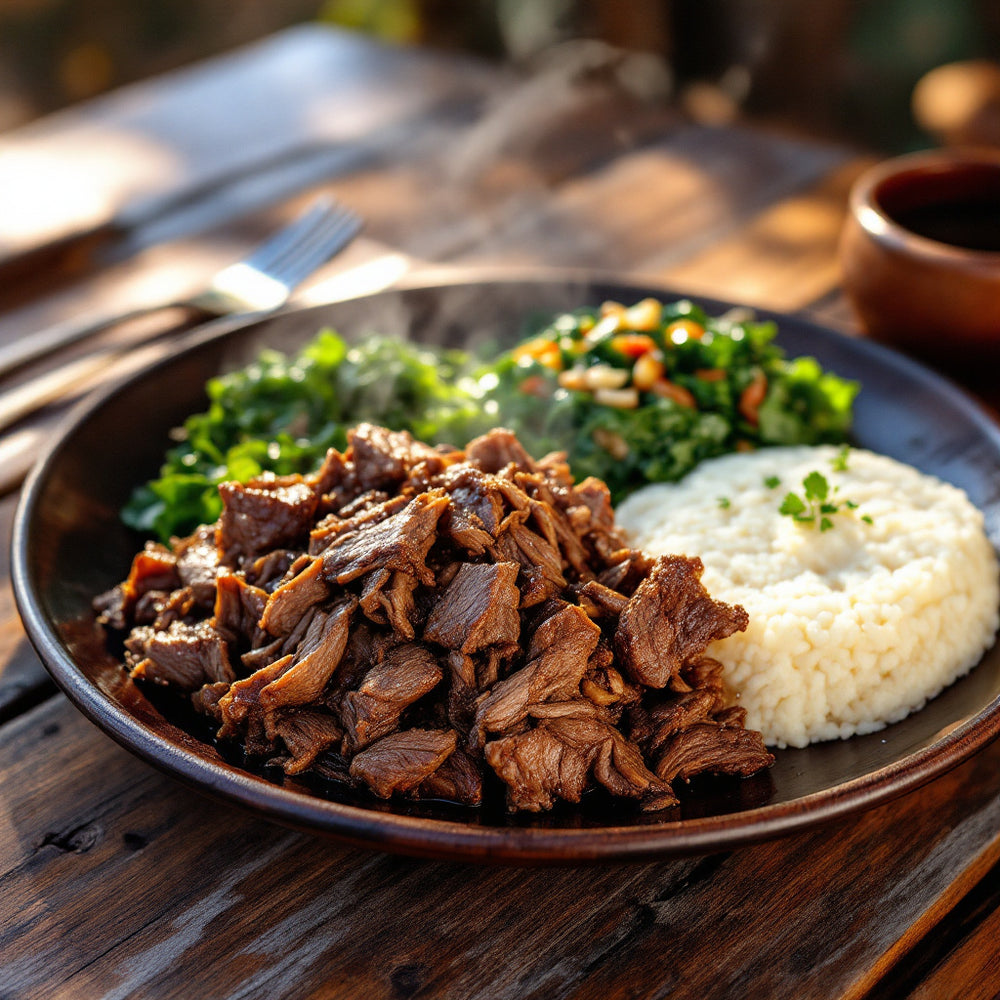
A steaming plate of traditional Seswaa brings the rich culinary heritage of Botswana to life, offering a true taste of local comfort and hospitality. The beautifully shredded, slow-cooked beef sits alongside fluffy pap and vibrant greens, creating a wholesome meal meant to be shared and celebrated. It is a delicious reminder of how food connects us to culture, filling both the plate and the heart with warmth.
Credits: Nathan S
Local cuisine study in Maun, Botswana

☕︎ Local Flavor

Old Bridge Backpackers: Riverside Campfire Dining

Rating: 4.7★ | Price: $$ | Coordinates: 19.9867° S, 23.4256° E

Eat on the riverbank of the Thamalakane at the most socially embedded dining spot in Maun, where the Old Bridge Backpackers campfire produces a rotating menu of Botswana braai, seswaa slow-cooked beef, and grilled freshwater fish from the delta channels alongside the cold Chibuku opaque beer and St Louis lager that define the Maun social register. The setting — canvas chairs on the sand, fig trees overhead, the sound of hippos in the reeds across the water — is the most honest expression of the Maun experience available to a visitor, and the guests around the fire on any given evening are the most useful network of safari operators, pilots, guides, and long-term researchers you will encounter in Botswana.

View Entry Details

Bon Arrivée Restaurant

Rating: 4.6★ | Price: $$$ | Coordinates: 19.9823° S, 23.4178° E

Dine at the most consistently reliable restaurant in Maun, a lodge-style dining room at the Sedia Riverside Hotel where the kitchen produces a menu that treats the Botswana bush pantry — mopane worm, seswaa, morogo wild spinach, and sorghum porridge — as primary source material alongside the international options that sustain the town's large NGO and safari industry workforce. The restaurant faces the Thamalakane River and the evening light on the water at dusk, when the francolins call and the first hippos begin to move, is the most atmospheric dinner hour in the Maun calendar.

View Entry Details

Maun Market and Self-Catering Circuit

Rating: 4.4★ | Price: $ | Coordinates: 19.9845° S, 23.4134° E

Navigate the Maun Fresh Produce Market and the adjacent roadside vendors along the Shorobe Road, where the Batswana women sell the dried mopane worms, fresh morogo, sorghum, and the extraordinary variety of wild fruits of the Kalahari edge that underpin the local diet. The mopane worm — the dried caterpillar of the Gonimbrasia belina moth — is the most protein-rich and culturally significant food in northern Botswana, and tasting it fried in chilli at a market stall is the most direct entry point into the Batswana food culture available in Maun.

View Entry Details

Thamalakane River Lodge: Sundowner Dinner

Rating: 4.8★ | Price: $$$ | Coordinates: 19.9712° S, 23.4089° E

Take a sundowner boat cruise along the Thamalakane and return to the riverside deck for dinner at the lodge that positions you closest to the point where the Okavango's floodwaters meet the Kalahari. The kitchen produces a three-course menu organized around the Botswana game and bush ingredient tradition, and the combination of the river light, the hippo sounds, and the Milky Way overhead on a clear Kalahari night — at an elevation where light pollution is genuinely absent — is the most complete Maun dining experience available to a visitor.

View Entry Details

🛌︎ Boutique Stays

Old Bridge Backpackers

Rating: 4.8★ | Price: $$ | Coordinates: 19.9867° S, 23.4256° E

Camp or take a room at the most socially essential address in Maun, a riverside property under enormous fig trees on the Thamalakane where the social infrastructure of the entire Botswana overland and safari community converges every evening around the campfire. Old Bridge is where the mokoro guides find clients, where the light aircraft pilots compare notes on the delta flooding, where the overlanders plan the Nxai Pan and Makgadikgadi routes, and where the most honest and practical information about current delta conditions is freely available. It is the beating heart of Maun's traveler community and the most useful single address in Botswana.

View Entry Details

Thamalakane River Lodge

Rating: 4.8★ | Price: $$$ | Coordinates: 19.9712° S, 23.4089° E

Settle into the most scenically positioned lodge in the greater Maun area, a riverside property where the chalets face the Thamalakane and the hippos surface in the channel below the deck at dusk with a regularity that makes the encounter feel like a scheduled appointment rather than a wildlife sighting. The lodge is the most practical base for organizing mokoro excursions, bush walks, and light aircraft flights into the delta, and the combination of the river setting, the Kalahari night sky, and the proximity to the wildlife makes it the most complete Maun experience available without flying into the delta itself.

View Entry Details

Audi Camp

Rating: 4.6★ | Price: $$ | Coordinates: 19.9934° S, 23.4312° E

Occupy a shaded campsite or chalet at the most efficiently organized overland camp in Maun, a property that has served as the primary operational base for overlanding expeditions into the northern Botswana circuit for over thirty years. Audi Camp is where the trucks are loaded, the permits are checked, the guides are briefed, and the route into Moremi, Chobe, and the Makgadikgadi is confirmed before departure. The camp is adjacent to the airport, within twenty minutes of the mokoro launch point at Boro, and functions as the most practical logistics hub in town.

View Entry Details

Sedia Riverside Hotel

Rating: 4.5★ | Price: $$$ | Coordinates: 19.9823° S, 23.4178° E

Inhabit the most established mid-range hotel in Maun, a riverside property with a pool, conference facilities, and the Bon Arrivée Restaurant that has served the town's NGO, diplomatic, and safari industry workforce since the 1980s. The Sedia is the most reliably comfortable accommodation option in Maun for visitors who need consistent Wi-Fi, air conditioning, and a proper bed after days in the bush, and the location on the Thamalakane ensures that the return to town is accompanied by the sounds of the delta rather than the dust of the main road.

View Entry Details

📍︎ Field Study

Okavango Delta: Mokoro Excursion

Rating: 4.9★ | Price: $$$ | Coordinates: 19.5000° S, 22.8000° E

Climb into a mokoro — the flat-bottomed dugout canoe of the Bayei people, poled from the stern through the papyrus channels of the Okavango — and enter the most silent and most biodiverse aquatic wilderness in Africa. The mokoro excursion from Boro or Seronga takes you through a labyrinth of water lily channels, papyrus tunnels, and palm islands where the proximity to elephants, hippos, sitatunga, and the extraordinary birdlife of the delta is unmediated by a vehicle window. The silence of the mokoro, broken only by the pole entering the water and the calls of the fish eagle, is the most powerful single experience available in Botswana and the reason the Okavango was designated a UNESCO World Heritage Site in 2014.

View Entry Details

Moremi Game Reserve: Safari Drive

Rating: 4.9★ | Price: $$$$ | Coordinates: 19.1667° S, 23.5000° E

Drive into the most wildlife-rich game reserve in Africa, the 4,871 km² Moremi Game Reserve that occupies the eastern portion of the Okavango Delta and protects the full spectrum of the Botswana mega-fauna — lion, leopard, cheetah, wild dog, elephant, buffalo, and the rare sitatunga antelope in the permanent swamps. The Chief's Island and the Xakanaxa Lagoon are the two primary destinations for wildlife density, and the wild dog denning season from June through August is the most extraordinary wildlife spectacle available anywhere in southern Africa. Moremi is the reason Botswana has established itself as the premier high-end safari destination on the continent.

View Entry Details

Makgadikgadi Pans: Quad Bike and Baobab Walk

Rating: 4.8★ | Price: $$$ | Coordinates: 20.5000° S, 25.5000° E

Drive three hours southeast of Maun to the Makgadikgadi Salt Pans — one of the largest salt flats in the world, the desiccated remnant of an ancient super-lake whose shorelines are marked by the baobab trees that stand like sentinels above the flat white horizon. The quad bike crossing at dawn, when the light on the salt crust turns from pink to white and the heat shimmer begins to distort the horizon, is the most spatially disorienting landscape experience in southern Africa. In November and December, the onset of the rains triggers the largest zebra migration in the world, a movement of 30,000 animals from the Boteti River to the Nxai Pan that is one of the great undocumented wildlife events on earth.

View Entry Details

Okavango Delta: Light Aircraft Scenic Flight

Rating: 4.9★ | Price: $$$$ | Coordinates: 19.9733° S, 23.4314° E

Board a Cessna from Maun Airport and fly north into the Okavango Delta at low altitude, where the aerial view of the delta's papyrus channels, hippo pools, elephant paths, and palm islands resolves into a spatial logic that is impossible to understand from the ground. The delta covers 15,000 km² of the Kalahari and the aerial approach reveals the full geometry of the flood — the channels that fan outward from the panhandle, the islands that have been built by termites and colonized by palms, and the hippo pods that look like grey boulders from above until one of them moves. The scenic flight is the essential geographic orientation for anyone who wants to understand the scale of what they are about to enter.

View Entry Details

Typography

Archival Note: A formal technical study of Maun, Botswana—archiving the coordinates, elevation, and environmental data that define the region. This data serves as a vital record for our ongoing global field study, allowing us to reconstruct the regional atmosphere with archival precision before our physical arrival.

Botanical and pigment specimen study for Maun, Botswana Colors of Maun, Botswana
Coordinates
19.9867° S, 23.4256° E — Thamalakane River, southern edge of the Okavango Delta, Botswana
Historical Epoch
San Bushmen inhabit the Kalahari before 30,000 BCE. Bayei people settle the Okavango around 1800 CE. British Bechuanaland Protectorate from 1885. Botswana independence in 1966. Okavango UNESCO inscription in 2014.
Elevation
936 m / 3,071 ft. Kalahari Desert plateau at the southern margin of the Okavango floodplain.
Atmosphere
Semi-Arid Savanna (BSh). Dry season May through October with clear skies and the finest wildlife viewing. Wet season November through April with Kalahari rains and the annual delta flood cycle.
Observation Hour
06:15 AM. The Kalahari dawn arrives sharp and amber before the delta mist burns off, illuminating the reed beds and channel water at their most golden.
Primary Pigment
Okavango Reed Gold (#C8A74A) and Delta Channel Blue (#4A9BB5)
Best Time to Visit
May through October. The dry season brings clear skies, cold nights and the finest wildlife viewing as animals concentrate at the delta channels. The flood pulse peaks in August and September when the inner delta is most spectacular.
Avoid Visiting
January through March. Peak wet season brings heavy rain, flooded roads and the most difficult conditions for 4WD access to Moremi and Makgadikgadi. The delta is beautiful but wildlife disperses and practical challenges are significant.

The Local Tongue

Language is the invisible architecture of Maun, Botswana. These entries document the regional vocabulary—capturing the "texture" of local speech that standard translations often miss. Hand-curated expressions reflecting the specific spirit and daily rhythm of the region.
Archival study of Setswana cultural texture

via / Laura The Explaura

Primary Language Setswana
Regional Dialect Maun Setswana

Dumela (duˈmɛlə)

Hello in Setswana, the national language of Botswana and the greeting used from the Kalahari to the Okavango. Dumela is singular and Dumelang for a group, and using it correctly signals that you understand a country where greeting before any transaction is a genuine cultural requirement, not a formality.

Ke a leboga (kɛ ɑ lɛˈbɔɡə)

Thank you in Setswana, and the correct register for thanking a mokoro poler who has spent four hours reading the papyrus channels by sight. Ke a leboga said with genuine warmth and eye contact signals that you have understood something important about the culture you are visiting.

Pula (ˈpulə)

Rain in Setswana, and the most important word in the Botswana vocabulary. Pula is the national currency, the toast at every celebration, and the deepest aspiration of a semi-arid country where rain determines everything from the delta flooding to the sorghum harvest to the movement of the wildlife.

Wait! before you go...

Before you head over to Maun, Botswana, we’ve audited the essential data points for this corner of the world. These notes cover the logistics—from currency ratios to transit hubs—to help you navigate the landscape with clarity.
🚲 Getting Around Light aircraft charters from Maun Airport connect to every delta camp in 20 to 45 minutes and are the only practical way into the inner delta. 4WD vehicles are essential for Moremi and Makgadikgadi. Taxis cover the town and a rental car is useful for the Boro mokoro launch.
⚖️ Cash or Card 80% Cash, 20% Card. Major hotels and safari operators accept Visa and Mastercard but fuel stations, markets, and local services require Botswana Pula. Carry sufficient cash before heading into any remote delta area.
☁️ Good to Know Always greet before beginning any transaction — skipping the dumela is considered genuinely rude in Batswana culture. Confirm all mokoro, safari, and aircraft bookings in writing since verbal agreements in an informal town can lead to misunderstandings in peak season.
🏧 ATMs ATMs at First National Bank and Barclays Botswana on the main Maun road and at Engen and BP fuel stations. Carry significantly more cash than you think you need since delta camps, mokoro operators, and remote park fees are all cash only.
💳 Currency The Botswana Pula (BWP) is the sole transaction currency. USD and South African Rand are accepted at major lodges but not for everyday purchases. ATMs in Maun dispense Pula reliably so withdraw sufficient cash before entering any remote delta area.
🔌 Plugs Botswana uses Type D and Type G plugs at 230V. Bush camps have limited generator power running for a few hours morning and evening. A portable power bank is absolutely essential for multi-day delta trips. Bring a universal adapter.
🛡️ Safety Maun is a safe and welcoming town for visitors. The main practical risks are the wildlife — never walk along the river after dark and always follow your guide's instructions. In the delta, your guide's judgment is your primary safety instrument.
✈️ Airports Maun Airport (MUB) receives scheduled flights from Johannesburg OR Tambo (2 hrs on Airlink), Gaborone (1 hr), and Kasane (45 min). It is the busiest light aircraft hub in Africa and the departure point for every charter flight into the delta camps.

Behind The Scenes

Nathan

Note from the Founder

Hey, did you know this fun fact about Maun, Botswana? The Okavango is the only major river that flows into a desert and disappears. The Kavango travels 1,600 km from the Angolan highlands and terminates in the Kalahari sands, with the flood pulse taking four months to travel from the panhandle to Maun.
Thank you for exploring the Maun, Botswana series with us. We hope these notes have inspired you to add this incredible destination to your own passport—we are so glad you’re here. — Nathan

The Magnets

The Coasters

The Canvas