Shop the Collection

To help you build your own global archive, we've prepared this collection of watercolor studies from our research into Jeju Island, South Korea. These artifacts are designed to bring the stillness of this corner of the world into your home.

Original Series Decorative Magnet

A personal study of Jeju Island, South Korea, captured in high-fidelity watercolor and prepared for your collection.

Jeju Island, South Korea | Coastal Cliffs and Waterfall | Original Series Decorative Magnet
Add to Collection / $18
Exclusive Series Artifact

Original Series Gallery Canvas

This high-fidelity canvas is a beautiful way to anchor a room and keep your memories of Jeju Island, South Korea fresh long after you've returned home.

Jeju Island, South Korea | Coastal Cliffs and Waterfall | Original Series Gallery Canvas detail Jeju Island, South Korea | Coastal Cliffs and Waterfall | Original Series Gallery Canvas detail Jeju Island, South Korea | Coastal Cliffs and Waterfall | Original Series Gallery Canvas detail Jeju Island, South Korea | Coastal Cliffs and Waterfall | Original Series Gallery Canvas detail
Add to Collection / $65

Original Series Hardboard Coaster

A personal study of Jeju Island, South Korea, captured in high-fidelity watercolor and prepared for your collection.

Jeju Island, South Korea | Coastal Cliffs and Waterfall | Original Series Hardboard Coaster
Add to Collection / $18
Exclusive Series Artifact

The Spirit of the Land

Archival Note: A curated field study of Jeju Island, South Korea, prioritizing the specific atmospheric stillness of the region. These artifacts have been meticulously sourced from our global archival partners to represent the area's unique cultural frequency and environmental character. This selection serves as a formal observation for our ongoing global archive, vetted for its visual accuracy and archival merit.

Jeju Island, South Korea study No. 01
Jeju Island, South Korea / 01 VIA / Ethan Brooke
The long exposure softens the waves crashing against Jusangjeolli's ancient volcanic columns, lending the scene an almost otherworldly stillness. The blue-green water contrasts sharply with the dark, fractured basalt — a reminder that this coastline was shaped by fire, not water. In the distance, the gentle silhouette of Hallasan grounds the frame, placing this raw coastal edge within the larger story of the island.
Jeju Island, South Korea study No. 02
Jeju Island, South Korea / 02 VIA / Coman Yu
Standing atop the volcanic rim, a visitor would feel the warm summer air carried on a gentle sea breeze, the vast blue expanse of the Korea Strait stretching endlessly to the horizon. The soft haze diffuses the midday light, lending the scene a dreamlike, almost watercolor quality that softens the boundary between sky and ocean. Below, the compact coastal town hums quietly with life, dwarfed by the ancient volcanic landscape that frames it.
Jeju Island, South Korea study No. 03
Jeju Island, South Korea / 03 VIA / 교성 김
The foreground reveals delicate purple aster flowers threading through the porous black basalt — a quietly tender contrast most visitors overlook while focused on the cairns. Stacked stone towers, built by travelers as wishes left behind, punctuate the rugged lava field leading toward the sea. In the distance, the flat-topped silhouette of Udo Island floats above the cobalt water like a brushstroke against the hazy sky.

Where to wander

Archival Note: A curated field study of Jeju Island, South Korea, prioritizing cultural relevance and archival merit. While we haven't touched down here yet, we've meticulously vetted these locations through our global network of contributors to ensure they represent the most authentic atmosphere for your own expedition.

Local Cuisine Spotlight
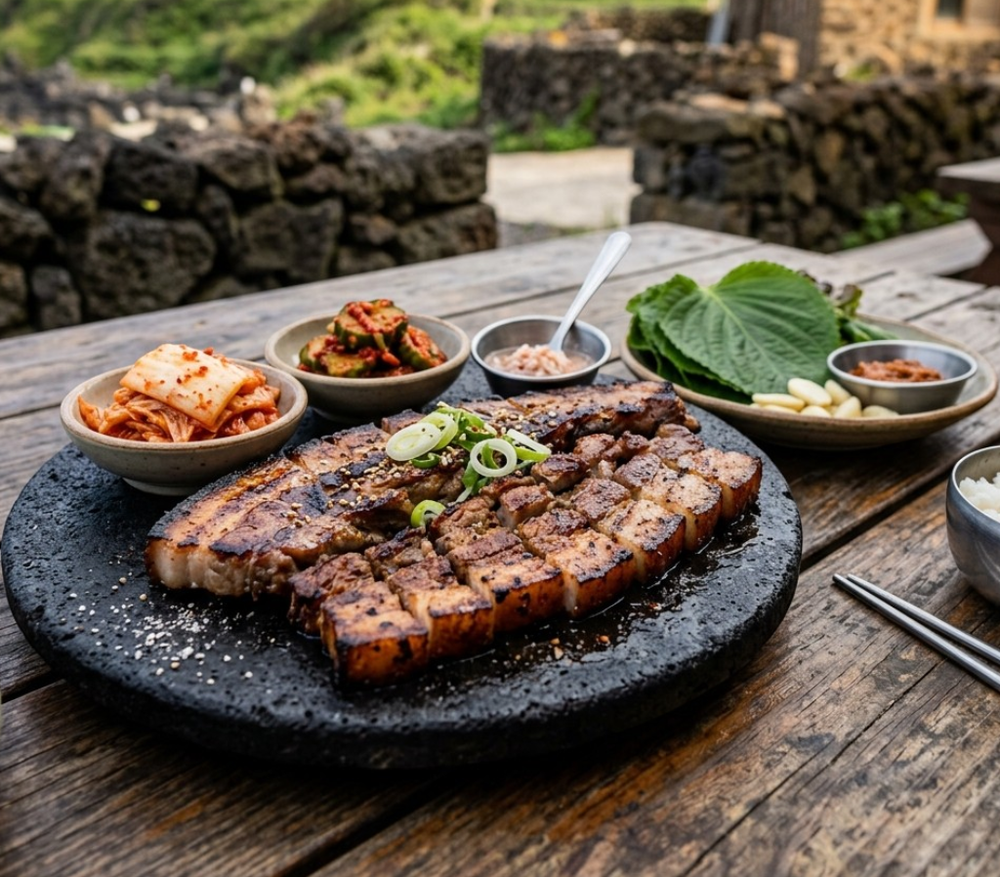
Jeju Heukdwaeji, or black pork belly, is grilled over volcanic stone until deeply charred and richly smoky. Scored for even cooking, its crisp edges give way to tender, juicy layers within. Wrapped in perilla with kimchi and garlic, every bite captures the bold, earthy soul of Jeju Island.
Credits: THE PAINTED PASSPORT
Local cuisine study in Jeju Island, South Korea

☕︎ Local Flavor

Dongmun Sijang Market Food Stalls

Rating: 5* | Price: $ | Coordinates: 33.5132, 126.5294

The bustling Dongmun traditional market is the heartbeat of local Jeju food culture, offering everything from grilled abalone to tangerine tteok rice cakes. Vendors pour generous helpings with proud smiles, eager to share flavors passed down through generations. Arrive hungry and wander freely — every stall reveals a new delicious surprise.

View Entry Details

Haenyeo Restaurant Udo

Rating: 5* | Price: $$$ | Coordinates: 33.5024, 126.9571

Operated by real haenyeo sea women on the tiny island of Udo, this beloved spot serves the freshest raw sea urchin, abalone porridge, and conch salad imaginable. The setting — open air with turquoise waves just meters away — elevates every bite into something deeply memorable. There is no better way to honor Jeju's legendary diving women than by savoring their honest, ocean-fresh cuisine.

View Entry Details

Jeju Black Pork Street (Heukdwaeji Golmok)

Rating: 5* | Price: $$ | Coordinates: 33.4996, 126.5312

This lively strip of charcoal-grill restaurants in Jeju City is the definitive place to taste the island's prized black pork, a breed unique to Jeju with exceptional marbling and depth of flavor. Servers guide you through the grilling process with encouraging enthusiasm, ensuring every slice reaches perfect tenderness. Pair the smoky meat with local makgeolli rice wine for an evening you will talk about long after returning home.

View Entry Details

Café Monsant

Rating: 4* | Price: $$ | Coordinates: 33.3428, 126.8561

Perched on a cliff edge near Seongsan, Café Monsant rewards visitors with sweeping panoramic views of the sunrise peak and the shimmering East China Sea. The signature Jeju hallabong orange latte is bright, fragrant, and absolutely worth every sip. Settle into a window seat, let the scenery wash over you, and linger far longer than you planned.

View Entry Details

🛌︎ Boutique Stays

Lotte Hotel Jeju

Rating: 5* | Price: $$$$ | Coordinates: 33.2457, 126.4128

Perched above Jungmun Beach, this grand resort wraps you in ocean views from nearly every room. The outdoor pools and lush gardens make it easy to forget the rest of the world entirely. Impeccable Korean hospitality and world-class amenities ensure every moment feels genuinely special.

View Entry Details

Shinhwa World Marriott Resort

Rating: 5* | Price: $$$$ | Coordinates: 33.3101, 126.2498

This sprawling resort complex in the western Andeok Valley offers themed entertainment, a water park, and beautifully appointed rooms all in one place. Families will love the seamless blend of relaxation and adventure right outside the door. Sunsets over the nearby hillsides paint the sky in colors you will want to photograph every evening.

View Entry Details

Arve Jeju Hotel & Resort

Rating: 4* | Price: $$$ | Coordinates: 33.4512, 126.9201

Tucked away on Jeju's quieter eastern coast, Arve offers stylish minimalist rooms with private balconies overlooking volcanic stone landscapes. The intimate scale of the property means personalized service that larger hotels simply cannot match. Wake up to birdsong and fresh sea air before exploring the stunning Seongsan sunrise peak nearby.

View Entry Details

Jeju Naturally Guesthouse

Rating: 4* | Price: $$ | Coordinates: 33.5139, 126.5215

This charming boutique guesthouse in Jeju City blends traditional haenyeo fishing-village aesthetics with cozy modern comforts. The owners greet every guest with homemade local snacks and genuinely helpful travel tips. It is the kind of place where you arrive as a traveler and leave feeling like a welcomed friend.

View Entry Details

📍︎ Field Study

Seongsan Ilchulbong (Sunrise Peak)

Rating: 5* | Price: $ | Coordinates: 33.4580, 126.9425

This UNESCO-listed tuff cone rising dramatically from the sea is one of the most iconic and breathtaking sights in all of South Korea. The crater's emerald interior looks almost impossibly lush against the deep blue ocean surrounding it. Climb the stone path just before dawn and you will witness a sunrise that genuinely stops your breath in your chest.

View Entry Details

Hallasan National Park

Rating: 5* | Price: $ | Coordinates: 33.3617, 126.5292

South Korea's highest peak sits at the volcanic heart of Jeju, offering hikers diverse trails through ancient forests, alpine meadows, and lava tube landscapes. The summit crater lake, Baengnokdam, reflects clouds and sky like a perfectly still mirror on clear days. Whether you are an experienced trekker or a casual walker, Hallasan rewards every level of effort with extraordinary natural beauty.

View Entry Details

Manjanggul Lava Tube

Rating: 5* | Price: $ | Coordinates: 33.5283, 126.7714

One of the world's longest and most spectacular lava tubes, Manjanggul stretches over 13 kilometers beneath Jeju's northern countryside in dramatic volcanic formations. Walking through its cool, cathedral-like chambers feels like exploring a secret underground world sculpted by ancient eruptions. The iconic seven-meter lava column at the far end of the accessible section is a humbling reminder of the island's fiery geological origins.

View Entry Details

Olle Trail Route 7

Rating: 5* | Price: $ | Coordinates: 33.2401, 126.3215

Jeju's beloved network of coastal walking trails reaches its most scenic expression on Route 7, which winds along rugged cliffs, black-sand beaches, and quiet tangerine orchards above the sparkling sea. The pace is gentle, the scenery constantly shifting, and every bend in the path reveals a new postcard-worthy composition. Walking this trail feels less like sightseeing and more like slowly falling in love with an island.

View Entry Details

Typography

Archival Note: A formal technical study of Jeju Island, South Korea—archiving the coordinates, elevation, and environmental data that define the region. This data serves as a vital record for our ongoing global field study, allowing us to reconstruct the regional atmosphere with archival precision before our physical arrival.

Botanical and pigment specimen study for Jeju Island, South Korea Colors of Jeju Island, South Korea
Coordinates
33.4890° N, 126.4983° E — Jeju Island, South Korea, centered near Jeju City
Historical Epoch
Jeju was an independent kingdom called Tamna until 938 CE, later absorbed into Goryeo and then Joseon Korea. Its geographic isolation preserved a distinct culture, language, and the haenyeo diving tradition across more than a millennium.
Elevation
0-1,950 m / 0-6,398 ft - Sea level coastline rising to the summit of Hallasan, South Korea's highest peak
Atmosphere
Cfa - Humid Subtropical. Jeju is warmer and wetter than mainland Korea, with mild winters, hot humid summers, and a dramatic typhoon season peaking in late summer.
Observation Hour
06:30 - Sunrise at Seongsan Ilchulbong floods the crater rim in amber and rose, casting long shadows across black volcanic rock and still water below.
Primary Pigment
Volcanic Basalt (#3B3535) and Tangerine Grove (#E8893A)
Best Time to Visit
April through June - Cherry blossoms and canola flower fields peak in spring, bringing warm dry days and the island's most photogenic color before summer humidity arrives.
Avoid Visiting
July through August - Peak typhoon season and summer holiday crowds bring heavy rain, high humidity, and significantly elevated prices across accommodation and transport.

The Local Tongue

Language is the invisible architecture of Jeju Island, South Korea. These entries document the regional vocabulary—capturing the "texture" of local speech that standard translations often miss. Hand-curated expressions reflecting the specific spirit and daily rhythm of the region.
Archival study of Korean cultural texture

via / Derek Tsai

Primary Language Korean
Regional Dialect Jeju dialect (Jejueo), recognized by UNESCO as a critically endangered language distinct from standard Korean.

Haenyeo (해녀)

Haenyeo (해녀) translates literally to 'sea women,' referring to the free-diving women who harvest abalone, sea urchin, and conch from Jeju's cold waters without breathing equipment. The sight of their black wetsuits bobbing at the surface between dives, the sharp whistle of their breath release audible from the shore, is one of the most quietly powerful things a visitor to Jeju can witness.

Oreum (오름)

Oreum (오름) describes the small parasitic volcanic cones that dot Jeju's landscape, each one a miniature crater softened by grass and wildflowers over centuries of dormancy. Standing at the rim of one on a clear morning, with the whole island laid out below and Hallasan presiding over it all, is the kind of moment that reorients a person's sense of scale entirely.

Dol hareubang (돌하르방)

Dol hareubang (돌하르방) means 'stone grandfather' and refers to the large carved basalt figures placed at village entrances and temple gates across the island as protective guardians. Their wide eyes, bulbous noses, and slightly raised hands have a solemn warmth to them, the dark volcanic stone worn smooth in places by generations of hands reaching up to touch them for luck.

Wait! before you go...

Before you head over to Jeju Island, South Korea, we’ve audited the essential data points for this corner of the world. These notes cover the logistics—from currency ratios to transit hubs—to help you navigate the landscape with clarity.
🚲 Getting Around Getting around Jeju is most comfortably done by rental car, which opens up the full coastline and inland oreum trails at a traveler's own pace. Intercity buses connect major attractions reliably but require patience, and taxis are plentiful and reasonably priced within Jeju City itself.
⚖️ Cash or Card Cards are widely accepted at hotels, restaurants, and larger shops across Jeju, making it easy to travel with minimal cash on hand. Smaller market stalls, traditional food vendors at Dongmun Market, and rural roadside stops often prefer cash, so keeping a modest amount of Korean Won available is genuinely useful.
☁️ Good to Know Jeju people carry a quiet pride in their distinct identity, and visitors who show genuine curiosity about haenyeo culture, Jejueo dialect, or the island's volcanic landscape are warmly received. Removing shoes before entering many guesthouses and traditional spaces is expected, and lingering respectfully at haenyeo demonstration sites rather than rushing through shows the kind of regard locals notice and appreciate.
🏧 ATMs ATMs are readily available throughout Jeju City and at major tourist sites, with machines at post offices and 7-Eleven convenience stores being the most reliably international-card-friendly options. More remote areas and smaller villages may have limited ATM access, so withdrawing cash before venturing into the island's interior or eastern coastline is a sensible habit.
💳 Currency The currency is the South Korean Won (KRW), with notes issued in denominations of 1,000, 5,000, 10,000, and 50,000 Won. As a rough guide, 1,000 KRW is approximately 0.75 USD, though travelers should check current exchange rates before arrival as values fluctuate.
🔌 Plugs South Korea uses Type C and Type F outlets at 220V, 60Hz. Most modern electronics handle this voltage automatically, but a plug adapter is recommended for travelers from North America or the UK.
🛡️ Safety Jeju Island is considered one of the safest destinations in East Asia, with very low rates of petty crime and a strong culture of community trust throughout the island. Hikers tackling Hallasan trails should prepare for rapidly changing weather near the summit, register at the trailhead as required, and respect the strict cutoff times enforced by park rangers.
✈️ Airports Jeju International Airport (CJU) sits just west of Jeju City and is one of the busiest airports in South Korea, with frequent domestic connections from Seoul's Gimpo and Gimhae airports running throughout the day. International flights operate primarily from Seoul, so most visitors from outside Korea will connect through Incheon International Airport (ICN) before catching a short domestic flight south to Jeju.

Behind The Scenes

Nathan

Note from the Founder

Hey, did you know this fun fact about Jeju Island, South Korea? Jeju Island is home to the world's longest lava tube system, with Manjanggul stretching over 13 km underground. The island produces around half of all tangerines consumed in South Korea each year, and its haenyeo diving culture is inscribed on UNESCO's Intangible Cultural Heritage list.
Thank you for exploring the Jeju Island, South Korea series with us. We hope these notes have inspired you to add this incredible destination to your own passport—we are so glad you're here. — Nathan

Some of our Favorites