Shop the Collection

To help you build your own global archive, we've prepared this collection of watercolor studies from our research into Ha Giang Loop, Vietnam. These artifacts are designed to bring the stillness of this corner of the world into your home.

Original Series Decorative Magnet

A personal study of Ha Giang Loop, Vietnam, captured in high-fidelity watercolor and prepared for your collection.

Ha Giang Loop, Vietnam | Golden Rice Terrace Fields | Original Series Decorative Magnet
Add to Collection / $18
Exclusive Series Artifact

Original Series Gallery Canvas

This high-fidelity canvas is a beautiful way to anchor a room and keep your memories of Ha Giang Loop, Vietnam fresh long after you've returned home.

Ha Giang Loop, Vietnam | Golden Rice Terrace Fields | Original Series Gallery Canvas detail Ha Giang Loop, Vietnam | Golden Rice Terrace Fields | Original Series Gallery Canvas detail Ha Giang Loop, Vietnam | Golden Rice Terrace Fields | Original Series Gallery Canvas detail
Add to Collection / $65

Original Series Hardboard Coaster

A personal study of Ha Giang Loop, Vietnam, captured in high-fidelity watercolor and prepared for your collection.

Ha Giang Loop, Vietnam | Golden Rice Terrace Fields | Original Series Hardboard Coaster
Add to Collection / $18
Exclusive Series Artifact

The Spirit of the Land

Archival Note: A curated field study of Ha Giang Loop, Vietnam, prioritizing the specific atmospheric stillness of the region. These artifacts have been meticulously sourced from our global archival partners to represent the area's unique cultural frequency and environmental character. This selection serves as a formal observation for our ongoing global archive, vetted for its visual accuracy and archival merit.

Ha Giang Loop, Vietnam study No. 01
Ha Giang Loop, Vietnam / 01 VIA / Vietnam Hidden Light
The serpentine road curves gracefully through the misty valley, its pale asphalt stark against the earth-toned and verdant landscape below. Towering limestone peaks frame the scene in soft, hazy light, while the road's repetitive loops reveal the engineering required to navigate this dramatic terrain. Small scattered houses dot the patchwork of cultivated fields, grounding this grand vista in the daily lives of those who call these mountains home.
Ha Giang Loop, Vietnam study No. 02
Ha Giang Loop, Vietnam / 02 VIA / Pixabay
The soft, diffused light of midday bathes the valley in a ethereal quality, with atmospheric haze softening the distant peaks into layers of blue and green. Standing here would evoke a sense of peaceful solitude, surrounded by the immensity of the forested mountains and the quiet ribbon of the road below winding through patchworks of cultivated fields. The cool mountain air and the gentle murmur of the distant river would underscore the profound tranquility of this remote landscape.
Ha Giang Loop, Vietnam study No. 03
Ha Giang Loop, Vietnam / 03 VIA / Nguyễn Sơn Tùng
This aerial view captures the dramatic serpentine road engineering of Ha Giang Loop, where the asphalt snakes through verdant mountainous terrain. The photograph reveals the intricate construction of hairpin turns carved into the steep hillsides, with vehicles appearing small against the massive landscape. A subtle detail often overlooked is the carefully maintained metal guardrails that trace each curve—delicate linear elements that provide safety while blending into the natural contours of the emerald-covered slopes.

Where to wander

Archival Note: A curated field study of Ha Giang Loop, Vietnam, prioritizing cultural relevance and archival merit. While we haven't touched down here yet, we've meticulously vetted these locations through our global network of contributors to ensure they represent the most authentic atmosphere for your own expedition.

Local Cuisine Spotlight
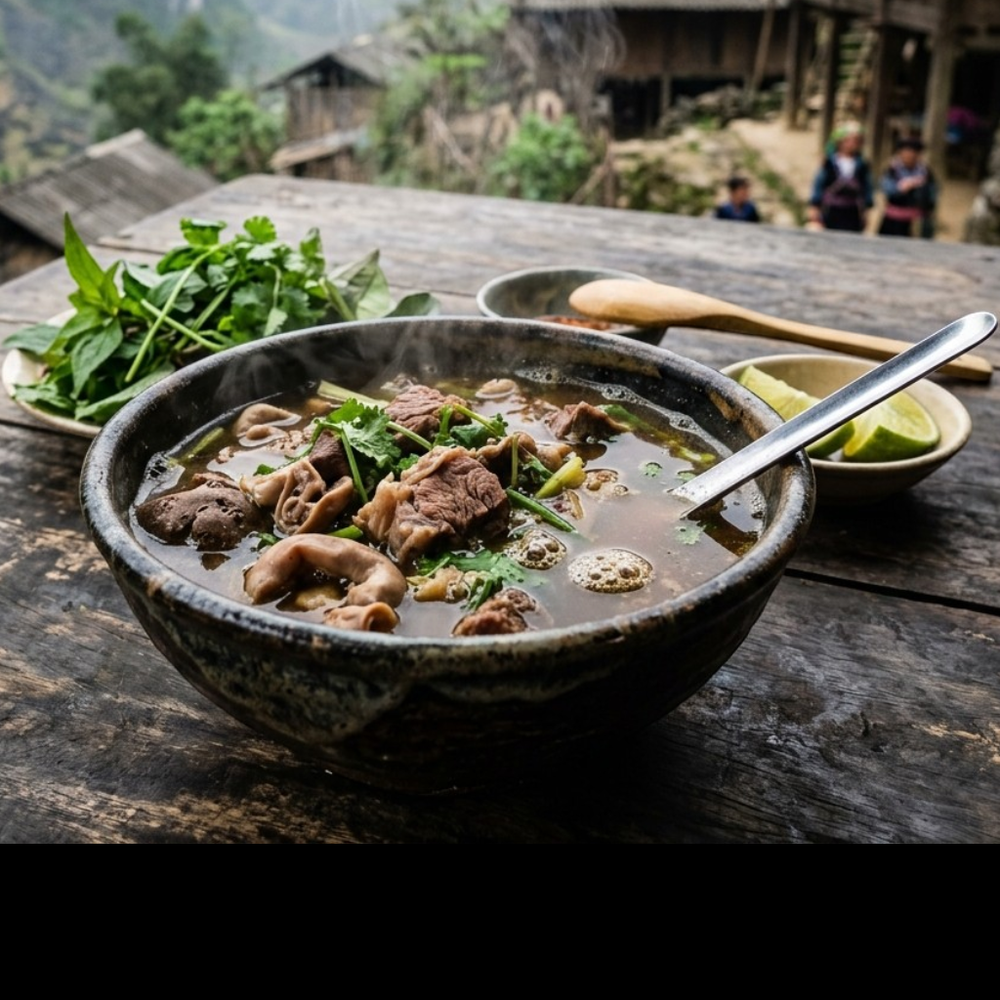
This mountain village soup showcases beef organs simmered until tender in an aromatic, deeply savory broth, crowned with vibrant fresh herbs and green onions. The interplay of rich offal, fragrant broth, and bright citrus creates layers of flavor that warm from the inside out. Served high in the Ha Giang hills, this humble bowl represents generations of resourceful mountain cooking traditions.
Credits: THE PAINTED PASSPORT
Local cuisine study in Ha Giang Loop, Vietnam

☕︎ Local Flavor

Lùng Phìn Sunday Market Food Stalls

Rating: 5* | Price: $ | Coordinates: 23.1892° N, 105.3301° E

Every Sunday, this hillside market transforms into a feast of colors, dialects, and incredible food that draws ethnic minority communities from across the mountains. Grab a steaming bowl of thắng cố — a traditional horse-meat broth slow-cooked with herbs — and sip corn wine poured by smiling vendors. It is raw, real, and one of the most memorable meals you will ever eat.

View Entry Details

Phở Bà Liên, Ha Giang Town

Rating: 5* | Price: $ | Coordinates: 22.8235° N, 104.9841° E

This tiny, decades-old street stall opens before dawn and serves a pho so rich and fragrant it has become a non-negotiable ritual for every loop rider rolling through town. The broth simmers overnight with charred ginger and star anise, ladled over silky hand-cut noodles with fresh herbs piled high. Arrive early — by 8 a.m. the pot is often gone and the plastic stools are empty.

View Entry Details

Đồng Văn Night Market Grills

Rating: 4* | Price: $ | Coordinates: 23.2751° N, 105.3618° E

As the sun drops behind the karst towers, Dong Van's old quarter lanterns flicker on and smoky grill aromas take over the narrow stone streets. Skewers of marinated pork, corn cobs, and sesame sticky rice cakes sizzle over charcoal while Hmong and Lolo vendors chat and laugh around you. It is street food at its most atmospheric and delicious.

View Entry Details

Quán Thắng Cố Mèo Vạc

Rating: 4* | Price: $ | Coordinates: 23.1534° N, 105.4231° E

A beloved local canteen tucked behind Meo Vac market, this humble spot serves the region's most warming dish — thắng cố — in deep clay bowls with fresh chili and lemongrass on the side. The owner, a cheerful Hmong woman, has been cooking the same slow-simmered recipe for over twenty years. Pair it with a glass of millet wine and you will understand why locals swear by it.

View Entry Details

🛌︎ Boutique Stays

Homestay Nặm Đăm Village

Rating: 5* | Price: $ | Coordinates: 23.1765° N, 105.3042° E

Nestled among terraced rice fields in a Dao ethnic village, this traditional stilt-house homestay wraps you in warmth and authenticity. Your hosts prepare hearty meals by firelight and share stories of mountain life. Waking up to misty peaks and roosters crowing is an experience no hotel can replicate.

View Entry Details

Ha Giang Panorama Hostel

Rating: 4* | Price: $ | Coordinates: 22.8231° N, 104.9836° E

Perched on a hillside with sweeping views over Ha Giang town, this social hostel is the perfect launchpad for your loop adventure. The rooftop terrace buzzes every evening with riders swapping route tips and laughing over local rice wine. Clean dorms and private rooms make it ideal for solo and group travelers alike.

View Entry Details

Đồng Văn Stone House Boutique

Rating: 5* | Price: $$ | Coordinates: 23.2747° N, 105.3614° E

Built from traditional gray limestone in the heart of Dong Van's ancient quarter, this boutique property feels like sleeping inside history. Stone walls keep rooms cool in summer and cozy in cooler months, decorated with Hmong textiles and hand-carved wooden furniture. The courtyard garden at sunrise, framed by karst peaks, is purely magical.

View Entry Details

Mèo Vạc Riverside Eco-Lodge

Rating: 4* | Price: $$ | Coordinates: 23.1531° N, 105.4228° E

Tucked beside the turquoise Nho Que River, this eco-lodge offers bamboo bungalows with private balconies that practically hang over the water. Evenings here are impossibly peaceful — just fireflies, river sounds, and a sky crammed with stars. The lodge organizes kayaking and local village walks so you experience the canyon beyond the famous viewpoint.

View Entry Details

📍︎ Field Study

Mã Pí Lèng Pass

Rating: 5* | Price: Free | Coordinates: 23.2003° N, 105.3786° E

Widely considered one of the four great mountain passes of Vietnam, Ma Pi Leng is a heart-stopping ribbon of road carved into sheer limestone cliffs above the Nho Que River gorge. The sweeping panorama of turquoise water thousands of feet below is genuinely breathtaking and worth every kilometer of riding. Pull over at the summit viewpoint and let the scale of it all sink in slowly.

View Entry Details

Đồng Văn Karst Plateau Geopark

Rating: 5* | Price: Free | Coordinates: 23.2700° N, 105.3600° E

Recognized by UNESCO as a Global Geopark, this extraordinary plateau of ancient limestone formations stretches across the northernmost tip of Vietnam with an almost lunar beauty. Walking among the jagged gray rocks and wind-bent trees feels like stepping into another world entirely. The geological history here spans 600 million years, and information panels along trails make the science as fascinating as the scenery.

View Entry Details

Lũng Cú Flag Tower

Rating: 4* | Price: $ | Coordinates: 23.3694° N, 105.3306° E

Standing at Vietnam's northernmost point on a dramatic basalt hill, the Lung Cu Flag Tower is a deeply moving place that carries enormous national pride. The climb up stone steps is rewarded with a 360-degree view of patchwork fields, ethnic minority villages, and the distant Chinese border. Watching the enormous red flag snap in the wind above it all stirs something quietly powerful in every visitor.

View Entry Details

Nho Que River Boat Tour

Rating: 5* | Price: $ | Coordinates: 23.1750° N, 105.3900° E

Gliding by wooden boat along the jade-green Nho Que River at the base of the Ma Pi Leng gorge offers a completely different and unforgettable perspective of the canyon's towering limestone walls. The water reflects the cliffs in shimmering turquoise pools, and the silence down in the gorge feels sacred after the roar of motorbike engines. Most tours last around 30 minutes and depart from a small dock near Meo Vac.

View Entry Details

Typography

Archival Note: A formal technical study of Ha Giang Loop, Vietnam—archiving the coordinates, elevation, and environmental data that define the region. This data serves as a vital record for our ongoing global field study, allowing us to reconstruct the regional atmosphere with archival precision before our physical arrival.

Botanical and pigment specimen study for Ha Giang Loop, Vietnam Colors of Ha Giang Loop, Vietnam
Coordinates
23.2003° N, 105.3786° E — Ma Pi Leng Pass, the geographic and visual heart of the Ha Giang Loop
Historical Epoch
The Dong Van plateau has been contested borderland for centuries, shaped by Chinese Han influence, French colonial rule, and the Viet Minh campaigns of the 1940s and 50s. The crumbling French fort at Dong Van and the H'mong king's palace at Vuong Chi Sinh survive as layered evidence of that complicated history.
Elevation
900-1,800 m / 2,953-5,906 ft - The loop climbs from Ha Giang town through successive passes to the high Dong Van plateau near the Chinese border.
Atmosphere
Cwa - Humid Subtropical Highland. Warm wet summers bring cloud and lush green terraces; winters are cool, dry, and often shrouded in mist that transforms the plateau into something quietly ethereal.
Observation Hour
06:30 - Morning mist clings to the karst valleys for roughly an hour after dawn, softening the limestone spires into layered silhouettes. The light turns warm and directional by 07:00, ideal for capturing both texture and depth.
Primary Pigment
Nho Que Jade (#4A8C6F) and Buckwheat Amber (#C8843A)
Best Time to Visit
October through November - Buckwheat flowers bloom pink across the plateau and the harvest light turns the terraces amber and gold.
Avoid Visiting
June through August - Heavy monsoon rains bring landslide risk, poor visibility, and unpredictable road closures throughout the loop.

The Local Tongue

Language is the invisible architecture of Ha Giang Loop, Vietnam. These entries document the regional vocabulary—capturing the "texture" of local speech that standard translations often miss. Hand-curated expressions reflecting the specific spirit and daily rhythm of the region.
Archival study of Vietnamese cultural texture

via / 8Percent Media

Primary Language Vietnamese
Regional Dialect Northern Vietnamese with significant H'mong, Dao, and Tay minority languages present throughout the loop villages.

Chợ phiên (cho phien)

Chợ phiên means rotating highland market, a gathering that moves between villages on a fixed weekly cycle. On a Sunday morning in Lung Phin, the smoke of grilling corn mingles with the sound of bartering in five different languages as H'mong families descend from hillsides in full embroidered dress to trade livestock, medicinal herbs, and hand-woven cloth.

Ngô (ngo)

Ngô means corn, but in Ha Giang it carries the weight of survival itself, the primary crop grown on terraces cut into near-vertical limestone slopes. At harvest time the dried cobs are stacked in great golden piles against the dark stone walls of traditional H'mong houses, a sight that has defined the visual landscape of this province for generations.

Khèn (khen)

Khèn is a traditional H'mong mouth organ, a bundled wind instrument whose circular, droning melody is inseparable from courtship, ceremony, and grief in highland culture. At festivals on the Dong Van plateau, the sound carries across open stone fields on cold air, the player often dancing in slow, spinning steps while the instrument produces its distinctive layered chords.

Wait! before you go...

Before you head over to Ha Giang Loop, Vietnam, we’ve audited the essential data points for this corner of the world. These notes cover the logistics—from currency ratios to transit hubs—to help you navigate the landscape with clarity.
🚲 Getting Around The loop is almost exclusively navigated by motorbike, either self-driven or on the back of a local Easy Rider guide. Roads are paved throughout but involve sustained cliff-edge switchbacks and narrow passes, making experience and confidence on two wheels an honest prerequisite for solo riders.
⚖️ Cash or Card Cash is essential on the loop. Outside of Ha Giang town itself, card payments are essentially nonexistent, and most homestays, market stalls, and roadside eateries operate entirely on Vietnamese Dong. Carrying sufficient cash before leaving Ha Giang town is not a suggestion but a firm practical necessity.
☁️ Good to Know Photographing H'mong and Dao women in traditional dress without asking first is considered disrespectful, and a quiet gesture of request followed by a genuine smile goes a long way. Sundays at the rotating highland markets are the most culturally rich days on the loop, but they are also community gatherings first and tourist attractions second.
🏧 ATMs ATMs are available in Ha Giang town at the start of the loop, with a small number of machines also found in Dong Van town roughly two thirds of the way around. Withdrawal limits per transaction can be low, so drawing enough cash in Ha Giang before departing is the approach that experienced loop riders consistently recommend.
💳 Currency The Vietnamese Dong (VND) is the only currency accepted anywhere on the loop. Notes come in denominations up to 500,000 VND, and travellers should familiarise themselves with the scale of the numbers quickly to avoid confusion at market stalls and roadside stops.
🔌 Plugs Vietnam uses Type A and Type C outlets at 220V/50Hz. Most homestays on the loop have limited charging points, so a small universal travel adapter and a power bank are both practical additions to any pack.
🛡️ Safety Ma Pi Leng Pass and other cliff-edge sections of the loop demand full attention: the roads are narrow, truck traffic is real, and weather can shift quickly, leaving surfaces wet and visibility low. Renting a quality, well-maintained motorbike and wearing a proper helmet rather than the thin local shell variety is strongly advised for anyone doing the ride independently.
✈️ Airports Noi Bai International Airport in Hanoi (HAN) is the primary gateway, located roughly 320 kilometres south of Ha Giang town. From Hanoi, travellers reach Ha Giang by overnight sleeper bus in approximately six hours, or by private car transfer which takes closer to five depending on conditions.

Behind The Scenes

Nathan

Note from the Founder

Hey, did you know this fun fact about Ha Giang Loop, Vietnam? The Dong Van Karst Plateau Geopark was recognised by UNESCO in 2010, covering over 2,300 square kilometres of limestone terrain that began forming some 400 to 600 million years ago. It was Vietnam's first UNESCO Global Geopark.
Thank you for exploring the Ha Giang Loop, Vietnam series with us. We hope these notes have inspired you to add this incredible destination to your own passport—we are so glad you're here. — Nathan

Some of our Favorites