Shop the Collection

To help you build your own global archive, we've prepared this collection of watercolor studies from our research into Dubrovnik, Croatia. These artifacts are designed to bring the stillness of this corner of the world into your home.

Original Series Hardboard Coaster

A wonderful companion for your morning coffee. This coaster captures the atmosphere of Dubrovnik, Croatia in a functional, beautiful way.

Dubrovnik, Croatia | Original Series Hardboard Coaster
Add to Collection / $18
Exclusive Series Artifact

Original Series Decorative Magnet

A lovely, high-res reminder for your fridge or workspace. This watercolor magnet is the perfect small token to remember your Dubrovnik, Croatia adventure.

Dubrovnik, Croatia | Original Series Decorative Magnet
Add to Collection / $18
Exclusive Series Artifact

Original Series Gallery Canvas

This high-fidelity canvas is a beautiful way to anchor a room and keep your memories of Dubrovnik, Croatia fresh long after you've returned home.

Dubrovnik, Croatia | Original Series Gallery Canvas detail Dubrovnik, Croatia | Original Series Gallery Canvas detail Dubrovnik, Croatia | Original Series Gallery Canvas detail Dubrovnik, Croatia | Original Series Gallery Canvas detail
Add to Collection / $65

The Spirit of the Land

Archival Note: A curated field study of Dubrovnik, Croatia, prioritizing the specific atmospheric stillness of the region. These artifacts have been meticulously sourced from our global archival partners to represent the area's unique cultural frequency and environmental character. This selection serves as a formal observation for our ongoing global archive, vetted for its visual accuracy and archival merit.

Dubrovnik, Croatia study No. 01
Dubrovnik, Croatia / 01 VIA / Inera Isovic
The golden hour light washes over Dubrovnik's old harbor, casting a warm glow across the terracotta rooftops and ancient stone fortifications that have stood here for centuries. Small boats rest peacefully in the protected waters while a tall ship anchors near the fortress walls, its weathered wood telling stories of the Adriatic. There's something deeply calming about watching this medieval port settle into evening, where the sea meets history and time seems to move at the gentle pace of lapping waves.
Dubrovnik, Croatia study No. 02
Dubrovnik, Croatia / 02 VIA / Kevin Charit
Sunlight filters through the narrow alley, illuminating weathered stone walls that have stood for centuries while potted plants bring life to every corner and doorstep. The worn steps climbing upward invite you to slow down, to notice the shuttered windows painted in faded blues and greens, each one telling its own story. There's something profoundly calming about these old Mediterranean passages, where time moves differently and the simple act of walking becomes meditation.
Dubrovnik, Croatia study No. 03
Dubrovnik, Croatia / 03 VIA / Hector John
The soft golden light of dawn bathes the ancient stone fortifications and calm waters, while a replica galleon drifts peacefully near the rocky cliffs of Dubrovnik's old harbor. The weathered limestone, layered over centuries, tells stories of traders and travelers who once sought shelter beneath these same fortress walls. There's a stillness here that makes you pause—the gentle meeting of old stone and patient sea, a reminder that some places hold their beauty in silence.

Where to wander

Archival Note: A curated field study of Dubrovnik, Croatia, prioritizing cultural relevance and archival merit. While we haven't touched down here yet, we've meticulously vetted these locations through our global network of contributors to ensure they represent the most authentic atmosphere for your own expedition.

Local Cuisine Spotlight
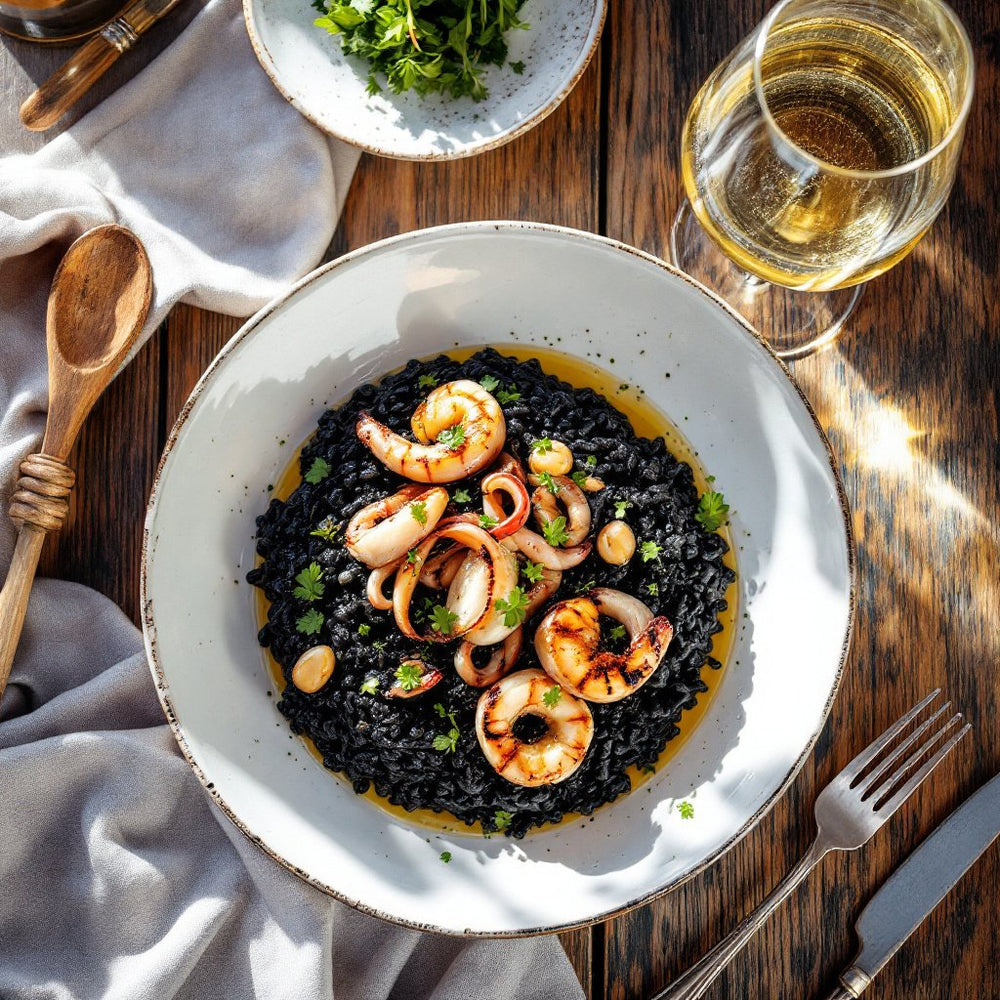
The Adriatic's most dramatic offering, crni rižot derives its midnight hue from cuttlefish ink, which lends a briny sweetness to Arborio rice slow-cooked in shellfish stock. Topped with tender calamari and prawns, this Dalmatian specialty reflects centuries of Venetian influence along Croatia's coast, where seafood reigns supreme in every seaside konoba.
Credits: THE PAINTED PASSPORT
Local cuisine study in Dubrovnik, Croatia

☕︎ Local Flavor

Restaurant Nautika

Rating: 5★ | Price: $$$$ | Coordinates: 42.6419° N, 18.1058° E

The definitive fine-dining address in Dubrovnik — a restaurant built into the limestone terrace directly below the Pile Gate and the Lovrijenac fortress, whose outdoor tables sit at the edge of the city walls with an unobstructed view of the Bokar tower, the open Adriatic, and the setting sun. The kitchen works with Adriatic seafood in the Dalmatian tradition: grilled Adriatic sea bass with olive oil and lemon, black risotto made with fresh cuttlefish ink, and local lobster from the Elafiti Islands prepared simply in the manner that lets the quality of the ingredient carry the dish. The terrace at sunset, with the Lovrijenac fortress turning gold above the limestone and the Adriatic fading to deep blue, is one of the finest settings for a meal anywhere on the Croatian coast.

View Entry Details

Konoba Kolona

Rating: 4★ | Price: $$ | Coordinates: 42.6416° N, 18.1099° E

The most honest and least theatrical Dalmatian kitchen inside the old city walls — a konoba on the quieter streets north of the Stradun whose menu is built around the same ingredients that Ragusan families have been eating for centuries: peka-roasted lamb and octopus cooked under the iron bell in the restaurant's courtyard, black risotto, grilled fresh fish priced by weight, and the local white wine from the Pelješac peninsula poured without ceremony in ceramic jugs. The interior is stone-vaulted and dark, the service unpretentious, and the food produced with the specific directness of a kitchen that has no interest in performing for tourists.

View Entry Details

Café Buža (Cliff Bar)

Rating: 5★ | Price: $ | Coordinates: 42.6401° N, 18.1098° E

A bar accessed through a hole cut in the south face of the old city wall — a gap in the medieval limestone that opens onto a series of wooden platforms bolted directly onto the cliff face above the Adriatic, where local beer and Dalmatian wine are served at plastic tables with a view of the open sea and the island of Lokrum that is available from no other seat in Dubrovnik. The bar has no kitchen, no pretension, and no air conditioning. What it has is the specific experience of sitting inside the city walls but outside the city, suspended between the medieval limestone above and the clear Adriatic below, in a position that would have been inconceivable to the Ragusan architects who built the wall 600 years ago.

View Entry Details

Proto Restaurant

Rating: 4★ | Price: $$$ | Coordinates: 42.6414° N, 18.1083° E

One of the oldest restaurants on the Stradun — a Dalmatian seafood institution occupying the first floor of a 15th-century merchant building with a terrace overlooking the main limestone thoroughfare of the old city. The kitchen has been serving grilled Adriatic fish, seafood risotto, and Dalmatian prstaci clams since 1886, and the longevity is explained by a consistency of execution rather than innovation: the oysters from the Ston bay 50 km north are the freshest available in the city, and the grilled dentex with blitva and olive oil is the dish that Proto has been producing better than anywhere else for four generations.

View Entry Details

🛌︎ Boutique Stays

Hotel Excelsior

Rating: 5★ | Price: $$$$ | Coordinates: 42.6384° N, 18.1123° E

The finest address in Dubrovnik — a clifftop hotel on the Frana Supila coastal road, 300 metres east of the Ploče Gate, whose sea-facing rooms look directly across the Adriatic to the island of Lokrum. The hotel was established in 1913 and occupies a stretch of limestone coastline with private beach access, an outdoor seawater pool, and a restaurant terrace positioned at water level where the clarity of the Adriatic is visible to a depth of several metres. The view of the old city walls from the hotel's terrace at dusk — the limestone ramparts turning gold against the deep blue of the open sea — is the best available from any accommodation in the city.

View Entry Details

Villa Dubrovnik

Rating: 5★ | Price: $$$$ | Coordinates: 42.6378° N, 18.1134° E

A clifftop boutique hotel carved into the limestone above the Adriatic, accessible only by private boat or the hotel's shuttle — an isolation that makes it the most genuinely removed accommodation in Dubrovnik despite being minutes from the old city walls. The 56 rooms are built into the cliff face in descending terraces, with floor-to-ceiling glass facing the open sea and the island of Lokrum. The hotel's beach is a private platform of limestone with ladder access to the clearest water available on the Dubrovnik shoreline, and the sense of being positioned between the cliff and the open Adriatic is the specific quality that distinguishes Villa Dubrovnik from every other property in the city.

View Entry Details

Stari Grad Hotel

Rating: 4★ | Price: $$$ | Coordinates: 42.6414° N, 18.1087° E

The only hotel actually inside the old city walls — an 8-room property on the Od Sigurate street in the heart of the medieval centre, a 2-minute walk from the Stradun. The building is a restored 15th-century Ragusan merchant house whose stone-vaulted interior, exposed limestone walls, and heavy timber beams preserve the specific architectural atmosphere of the Republic of Ragusa at its commercial peak. Sleeping inside the walls rather than in the hotel districts outside the Ploče Gate or Pile Gate is the most direct way to experience the old city in the hours before and after the day-tripper crowds, when the Stradun is empty and the limestone reflects the early morning light without interruption.

View Entry Details

Apartments Amoret

Rating: 4★ | Price: $$ | Coordinates: 42.6411° N, 18.1082° E

A small collection of self-contained apartments inside the old city walls — the most practical accommodation option for visitors staying more than two nights, offering the independence of a kitchen, a private terrace, and the rhythm of a local resident rather than a hotel guest. The apartments occupy restored 16th and 17th-century Ragusan buildings on the quieter streets north of the Stradun, away from the main pedestrian flow, where the old city's residential character — laundry lines, potted plants on stone window ledges, cats on warm limestone — is still legible beneath the tourist infrastructure.

View Entry Details

📍︎ Field Study

Dubrovnik City Walls Walk

Rating: 5★ | Price: $ | Coordinates: 42.6414° N, 18.1071° E

The 1,940-metre walk along the top of the medieval city walls — the most complete circuit of any surviving urban fortification in Europe — that provides a continuous elevated view of the old city's terracotta rooftops and church towers on one side and the open Adriatic on the other. The walls range from 4 to 6 metres thick, rise to 25 metres above the sea on the south face, and were built between the 12th and 17th centuries without ever being successfully breached by siege. The walk takes approximately 90 minutes and is best completed at opening time in summer before the heat and the crowds make it genuinely uncomfortable. The view from the southwest corner, looking back along the south wall toward the Lovrijenac fortress with the open sea below, is the defining image of Dubrovnik.

View Entry Details

Lovrijenac Fortress

Rating: 5★ | Price: $ | Coordinates: 42.6407° N, 18.1051° E

The free-standing fortress on the 37-metre limestone headland outside the Pile Gate — the most dramatic military structure on the Dalmatian coast and the building that defines the western approach to Dubrovnik from the sea. Lovrijenac was built in 1018 to prevent Venetian occupation of the headland and maintained by the Republic of Ragusa as both a military fortification and a statement of independence: the inscription above the gate reads Non bene pro toto libertas venditur auro — 'Liberty is not to be sold for all the gold in the world.' The fortress is included in the city walls ticket and the view from the upper battlements — looking east across the harbour entrance to the south face of the old city wall — is the viewpoint from which the Dubrovnik watercolor painting was made.

View Entry Details

Rector's Palace

Rating: 5★ | Price: $ | Coordinates: 42.6408° N, 18.1103° E

The Gothic-Renaissance palazzo on the Pred Dvorom that served as the seat of government of the Republic of Ragusa — a building of extraordinary architectural complexity where Gothic arched colonnades, Renaissance attic windows, and Baroque relief carvings accumulated across three centuries of construction and reconstruction following damage from the earthquake of 1667. The rector of Ragusa served one-month terms and was required to live in the palace for the duration — a constitutional constraint designed to prevent the concentration of power in any single individual that made the Republic of Ragusa one of the most sophisticated republican governments in medieval Europe. The building now houses the Cultural History Museum with original furnishings, portraits, and the coin collection of the Ragusan republic.

View Entry Details

Lokrum Island

Rating: 5★ | Price: $ | Coordinates: 42.6271° N, 18.1233° E

The forested island 600 metres off the Dubrovnik harbour — a 15-minute ferry from the old port — that has been a Benedictine monastery, an Austro-Hungarian botanical garden, and a Habsburg royal retreat, and is now a nature reserve whose interior pine and holm oak forests, saltwater lake, and cliff-edge swimming positions provide the most complete escape from the old city available without leaving the Dubrovnik area. The Dead Sea — a saltwater lake connected to the Adriatic by underground channels — is the best swimming in the area, naturally warmer than the open sea and surrounded by pine forest. The ferry runs every 30 minutes from the old harbour from April through November.

View Entry Details

Typography

Archival Note: A formal technical study of Dubrovnik, Croatia—archiving the coordinates, elevation, and environmental data that define the region. This data serves as a vital record for our ongoing global field study, allowing us to reconstruct the regional atmosphere with archival precision before our physical arrival.

Botanical and pigment specimen study for Dubrovnik, Croatia Colors of Dubrovnik, Croatia
Coordinates
42.6507° N, 18.0944° E — Southern Dalmatia, Adriatic coast, southern Croatia
Historical Epoch
Roman settlement 7th century. Republic of Ragusa founded 1358. Peak commercial power 15th–16th century. Great earthquake 1667. Napoleonic dissolution 1806. UNESCO World Heritage 1979. Population: 42,000 metro.
Elevation
0–412 m / 0–1,352 ft — sea-level old city on limestone karst; Srđ hill rising directly behind the city walls
Atmosphere
Mediterranean (Csa). Hot dry summers reaching 32°C with intense direct light, mild winters with occasional bora wind from the north. The shoulder seasons — April through June and September through October — offer the same quality of light with tolerable temperatures and a fraction of peak summer tourist density.
Observation Hour
18:30. The late afternoon sun strikes the south face of the city walls and Lovrijenac from the west, turning pale limestone to deep gold while the Adriatic darkens to cobalt. The window lasts about 40 minutes before the sun drops behind Srđ ridge and the terracotta rooftops fall into even shadow.
Primary Pigment
Ragusan Terracotta (#C4622D) and Adriatic Cobalt (#1B4F8A)
Best Time to Visit
May through June — the Adriatic is warm enough to swim, the summer heat has not yet arrived, and tourist density is a fraction of July and August. The light is at its most photogenic and the city walls walk is possible throughout the day without heat making it uncomfortable.
Avoid Visiting
July through August — peak tourist density, intense heat making the old city streets uncomfortable between 11 AM and 4 PM, and cruise ship arrivals adding several thousand visitors daily to the Stradun.

The Local Tongue

Language is the invisible architecture of Dubrovnik, Croatia. These entries document the regional vocabulary—capturing the "texture" of local speech that standard translations often miss. Hand-curated expressions reflecting the specific spirit and daily rhythm of the region.
Archival study of Croatian (Hrvatski) cultural texture

via / Zekai Zhu

Primary Language Croatian (Hrvatski)
Regional Dialect Dubrovnik Chakavian (Dubrovački čakavski)

Hvala

The Croatian word for thank you — pronunciation (HVAH-lah) immediately separates the visitor who has made a modest effort from the one who has not. In Dubrovnik it carries additional weight because the Republic of Ragusa placed an exceptional premium on the forms of courtesy, a diplomatic tradition whose legacy is still visible in the specific formality that characterises interactions between strangers in the old city streets.

Rakija

The fruit brandy that anchors Croatian social life — a clear distillate of grapes, plums, or figs served at room temperature in small ceramic cups as greeting, farewell, and punctuation between every significant event in a Dalmatian day. The Dubrovnik variety is typically grape-based from the Pelješac peninsula 50 km north, where the Plavac Mali grape that makes the region's finest red wine also produces a rakija of considerable intensity.

Peka

The Dalmatian cooking method in which meat or seafood goes under a cast-iron bell, covered with live embers, and cooks slowly for several hours — producing lamb, octopus, and veal of extraordinary tenderness that no oven replicates. Finding a konoba that still prepares it — with advance notice and genuine patience — is the most rewarding act of eating in the Dubrovnik region.

Wait! before you go...

Before you head over to Dubrovnik, Croatia, we’ve audited the essential data points for this corner of the world. These notes cover the logistics—from currency ratios to transit hubs—to help you navigate the landscape with clarity.
🚲 Getting Around The old city is entirely pedestrian. City bus connects Pile Gate with Lapad, airport, and ferry terminal. Taxis operate throughout. Lokrum Island and the Elafiti Islands are reached by ferry from the old harbour. A car is unnecessary for visitors staying in or near the old city.
⚖️ Cash or Card Aim for a 70/30 card-to-cash ratio. Major hotels and restaurants accept card, but smaller konobas, market vendors, and ferry operators may prefer cash. Croatia adopted the Euro in January 2023. ATMs are at the Pile Gate, old harbour, and along the Stradun.
☁️ Good to Know Dubrovnik receives over 1.5 million visitors annually into an old city of fewer than 1,500 residents. Crowds concentrate between 9 AM and 6 PM from June through September, with cruise ships adding thousands of visitors per day. The city walls and Lovrijenac are best at opening time or after the ships depart. The Prijeko neighbourhood north of the Stradun receives far less tourist flow and offers the most legible version of the old city.
🏧 ATMs ATMs are at the Pile Gate, the old harbour, and along the Stradun. Use Erste Bank or Splitska banka machines for the best rates and to avoid dynamic currency conversion. Avoid private exchange machines near the Pile Gate which charge higher transaction costs.
💳 Currency The local currency is the Euro (€), adopted in January 2023. Card and contactless payments are accepted in virtually all hotels, restaurants, and shops. A small amount of cash is useful for older konobas, market vendors, and ferry operators. ATMs are throughout the old city and at the ferry terminal.
🔌 Plugs Croatia uses Type C and Type F (Schuko) plugs with 230V and 50Hz. The Type F two-pin Schuko is standard and compatible with most European chargers. Travellers from the US, UK, and Australia need a plug adapter. Most hotels provide universal sockets.
🛡️ Safety Dubrovnik is among the safest cities in Croatia. Main practical considerations are the heat — carry water from June through September — and the uneven limestone paving, which becomes extremely slippery when wet. Pickpocketing is rare but possible in peak-season crowds along the Stradun.
✈️ Airports Dubrovnik Airport (DBV) is 20 km southeast; airport bus to Pile Gate in 30 minutes, taxi in 25 minutes. Split Airport (SPU) 230 km north is an alternative for budget carriers. Direct flights operate from most major European cities seasonally from April through October.

Behind The Scenes

Nathan

Note from the Founder

Hey, did you know this fun fact about Dubrovnik, Croatia? The walls of Dubrovnik were never breached by siege in 450 years of the Republic of Ragusa. They were shelled in 1991–92 when over 2,000 shells struck the old city during a seven-month siege. The restoration used stone from the same Brač island quarry as the original 14th-century walls, visible today as a colour difference between the older dark limestone and the newer pale replacement stone.
Thank you for exploring the Dubrovnik, Croatia series with us. We hope these notes have inspired you to add this incredible destination to your own passport—we are so glad you're here. — Nathan

Some of our Favorites