Shop the Collection

To help you build your own global archive, we've prepared this collection of watercolor studies from our research into Chengdu, China. These artifacts are designed to bring the stillness of this corner of the world into your home.

Original Series Decorative Magnet

A personal study of Chengdu, China, captured in high-fidelity watercolor and prepared for your collection.

Chengdu, China | Anshun Bridge River Glow | Original Series Decorative Magnet
Add to Collection / $18
Exclusive Series Artifact

Original Series Gallery Canvas

This high-fidelity canvas is a beautiful way to anchor a room and keep your memories of Chengdu, China fresh long after you've returned home.

Chengdu, China | Anshun Bridge River Glow | Original Series Gallery Canvas detail Chengdu, China | Anshun Bridge River Glow | Original Series Gallery Canvas detail Chengdu, China | Anshun Bridge River Glow | Original Series Gallery Canvas detail Chengdu, China | Anshun Bridge River Glow | Original Series Gallery Canvas detail
Add to Collection / $65

Original Series Hardboard Coaster

A personal study of Chengdu, China, captured in high-fidelity watercolor and prepared for your collection.

Chengdu, China | Anshun Bridge River Glow | Original Series Hardboard Coaster
Add to Collection / $18
Exclusive Series Artifact

The Spirit of the Land

Archival Note: A curated field study of Chengdu, China, prioritizing the specific atmospheric stillness of the region. These artifacts have been meticulously sourced from our global archival partners to represent the area's unique cultural frequency and environmental character. This selection serves as a formal observation for our ongoing global archive, vetted for its visual accuracy and archival merit.

Chengdu, China study No. 01
Chengdu, China / 01 VIA / Tetovált Kínai
The Anshun Bridge glows warmly against the deepening blue twilight, its ornate yellow roofs and arched stone passages reflected perfectly in the still water below. Modern high-rises frame this centuries-old landmark, creating a striking contrast between Chengdu's ancient cultural heritage and contemporary urban development. The soft golden lighting along the riverbanks and the mirror-like water surface capture the serene beauty of this moment between day and night.
Chengdu, China study No. 02
Chengdu, China / 02 VIA / dave chen
Golden afternoon light bathes this contemporary urban landscape, casting warm tones across the distinctive sculptural bridge that dominates the intersection below. The elevated perspective creates a sense of urban scale and sophistication, with the geometric architecture contrasting beautifully against pockets of green vegetation throughout the cityscape. Standing at this vantage point would offer a serene, almost detached view of the bustling city life below, with an appreciative sense of Chengdu's modern urban design.
Chengdu, China study No. 03
Chengdu, China / 03 VIA / Ramaz Bluashvili
Two giant pandas enjoy a meal of fresh bamboo in their verdant habitat at a Chengdu sanctuary. The image captures the intricate texture of scattered bamboo stalks on the ground, creating a natural mosaic that contrasts with the soft fur of the pandas. One easily overlooks the delicate detail of the moss-covered rocks in the background, which adds depth and authenticity to this serene scene of wildlife in its element.

Where to wander

Archival Note: A curated field study of Chengdu, China, prioritizing cultural relevance and archival merit. While we haven't touched down here yet, we've meticulously vetted these locations through our global network of contributors to ensure they represent the most authentic atmosphere for your own expedition.

Local Cuisine Spotlight
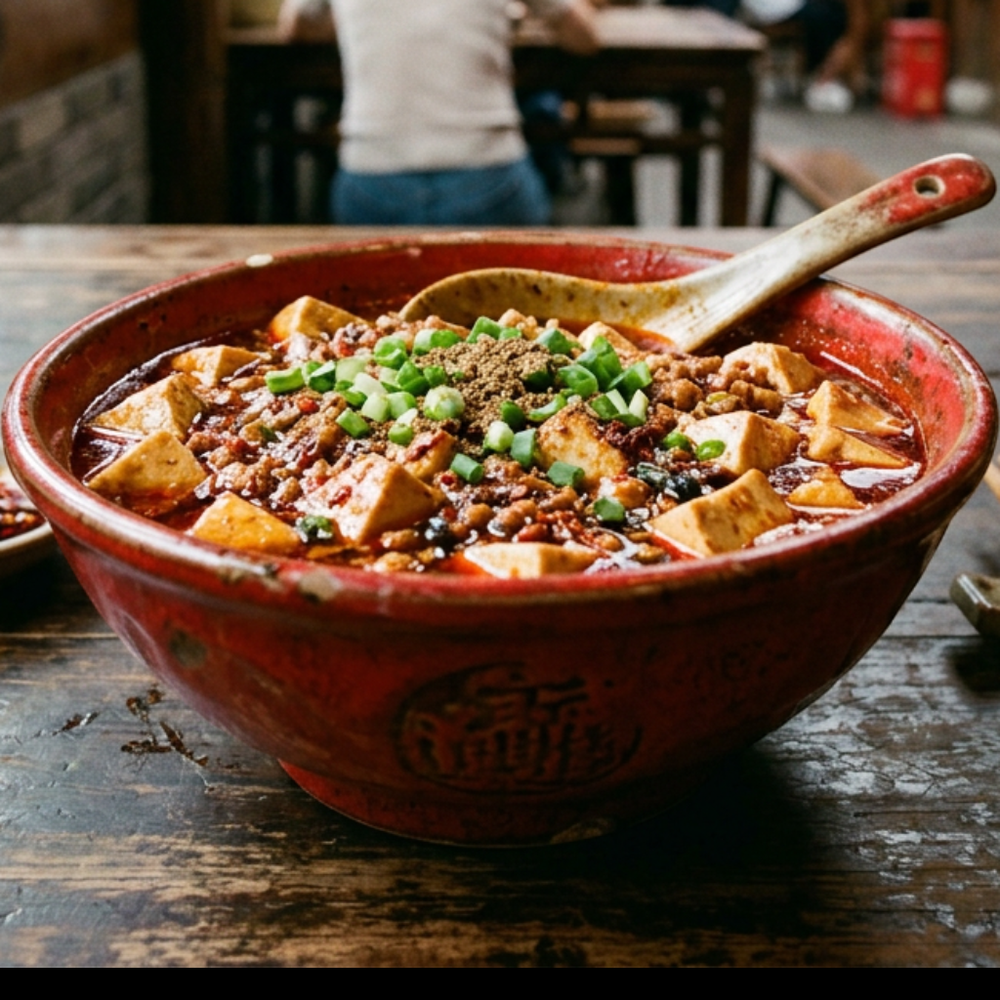
This iconic mapo tofu showcases Chengdu's mastery of bold, layered flavors, with silky tofu cubes swimming in a glossy chili oil infused with numbing Sichuan peppercorns. The aromatic ground meat topping and scattered scallions add textural contrast and herbaceous brightness. Each spoonful delivers the perfect balance of heat, numbing sensation, and savory depth that defines this timeless Sichuan classic.
Credits: THE PAINTED PASSPORT
Local cuisine study in Chengdu, China

☕︎ Local Flavor

Huangjia Maocai

Rating: 5* | Price: $ | Coordinates: 30.6598, 104.0712

Huangjia Maocai is a beloved local institution serving steaming bowls of Sichuan maocai, a personalized hot pot where you select your own ingredients from fresh daily offerings. The broth is rich, deeply spiced, and unmistakably authentic, delivering the numbing heat that Chengdu is famous for worldwide. Arrive early to beat the lunchtime crowds and watch the cheerful kitchen team ladle up bowls with practiced, joyful efficiency.

View Entry Details

Long Chao Shou Restaurant

Rating: 4* | Price: $ | Coordinates: 30.6602, 104.0648

Founded in 1941, Long Chao Shou is one of Chengdu's most iconic eateries, celebrated for its silky wonton dumplings bathed in chili oil and sesame sauce. The dining room buzzes with locals and curious visitors alike, all united by a shared love of honest, soul-satisfying Sichuan street food. Order the signature red oil wontons alongside a bowl of sweet rice dumplings for the ultimate classic Chengdu breakfast experience.

View Entry Details

Bafang Yunji Hot Pot

Rating: 5* | Price: $$$ | Coordinates: 30.6545, 104.0798

Bafang Yunji elevates the hot pot tradition with premium ingredients, elegant surroundings, and a bubbling communal broth that warms the soul from the very first sip. The menu features wagyu beef, hand-sliced lamb, and a remarkable variety of fresh Sichuan vegetables sourced directly from local farms each morning. Sharing a table here with friends over flowing tea and fiery broth is one of Chengdu's most joyful and memorable dining rituals.

View Entry Details

Yulin Chuanchuan Xiang

Rating: 4* | Price: $ | Coordinates: 30.6389, 104.0621

This lively skewer restaurant in the Yulin neighborhood captures the relaxed, convivial spirit that defines everyday life in Chengdu perfectly. Diners select bamboo skewers loaded with meat, tofu, and vegetables, then dip them into a fragrant communal pot of fiery Sichuan broth at the table. The outdoor seating spills onto tree-lined streets, making a long evening here feel like a warm and wonderful neighborhood celebration.

View Entry Details

🛌︎ Boutique Stays

Niccolo Chengdu

Rating: 5* | Price: $$$$ | Coordinates: 30.5728, 104.0668

Niccolo Chengdu rises above Sino-Ocean Taikoo Li with sleek Italian design and sweeping city views. Rooms are spacious and serene, featuring floor-to-ceiling windows that frame the glittering Chengdu skyline beautifully. The rooftop pool and attentive concierge team make every stay feel genuinely luxurious and effortlessly memorable.

View Entry Details

Chengdu Wangjiang Hotel

Rating: 4* | Price: $$ | Coordinates: 30.6234, 104.0891

Nestled beside the tranquil Wangjiang Park, this riverside hotel offers a peaceful retreat within easy reach of the city center. Rooms are comfortably furnished with warm tones and traditional touches that honor Sichuan culture and aesthetics. Waking up to bamboo groves and birdsong outside your window sets a wonderfully calm tone for the day ahead.

View Entry Details

The Temple House

Rating: 5* | Price: $$$$ | Coordinates: 30.6578, 104.0752

The Temple House is a boutique masterpiece seamlessly blending a restored Ming Dynasty courtyard with contemporary architecture and design. Each villa and suite wraps guests in quiet luxury, with private terraces overlooking serene water features and ancient stone pathways. Its central location near Taikoo Li means world-class dining and shopping are just steps from your door.

View Entry Details

Mandarin Oriental Chengdu

Rating: 5* | Price: $$$$ | Coordinates: 30.6612, 104.0635

The Mandarin Oriental delivers signature elegance in the heart of Chengdu, offering rooms decorated with refined Sichuan art and soft, calming palettes. The spa is extraordinary, drawing on traditional Chinese healing practices to create deeply restorative treatments for weary travelers. Impeccable service and a superb breakfast spread ensure guests leave each morning feeling genuinely refreshed and ready to explore.

View Entry Details

📍︎ Field Study

Chengdu Research Base of Giant Panda Breeding

Rating: 5* | Price: $$ | Coordinates: 30.7369, 104.1498

The Giant Panda Base is an unmissable experience, home to over 80 giant and red pandas living in beautifully landscaped naturalistic enclosures. Morning visits are especially rewarding, as pandas are most active and playful in the cooler hours right after the gates open at eight. Watching a giant panda contentedly munch bamboo just meters away is a genuinely heartwarming moment that stays with visitors long after they return home.

View Entry Details

Jinli Ancient Street

Rating: 4* | Price: Free | Coordinates: 30.6426, 104.0434

Jinli Ancient Street is a beautifully preserved pedestrian lane beside the Wuhou Shrine, lined with traditional architecture, lanterns, and the aromas of sizzling street food. Local artisans sell handcrafted shadow puppets, embroideries, and painted face masks that reflect the rich cultural heritage of the Sichuan region. Evening is the most enchanting time to visit, when red lanterns glow along the rooftops and folk music drifts through the narrow, bustling lanes.

View Entry Details

Wuhou Shrine

Rating: 5* | Price: $ | Coordinates: 30.6421, 104.0431

Wuhou Shrine is Chengdu's most celebrated historical site, dedicated to Zhuge Liang, the brilliant strategist of the Three Kingdoms period, and the Shu Han rulers who shaped the region's legacy. Ancient cypress trees shade the temple complex, creating a cool and contemplative atmosphere that invites slow, thoughtful wandering among the carved stone monuments and vivid murals. The adjoining museum displays remarkable artifacts and beautifully detailed dioramas that bring this fascinating chapter of Chinese history vividly to life.

View Entry Details

Kuanzhai Alley

Rating: 4* | Price: Free | Coordinates: 30.6712, 104.0523

Kuanzhai Alley, meaning Wide and Narrow Alley, is a charming complex of three parallel historic lanes that beautifully preserve Qing Dynasty courtyard architecture in the modern city. The streets are filled with teahouses, boutique shops, local snack vendors, and intimate galleries celebrating Sichuan art and culture at every turn. Settling into a traditional teahouse here with a pot of jasmine tea and a plate of sesame cakes is one of Chengdu's most quietly perfect afternoon pleasures.

View Entry Details

Typography

Archival Note: A formal technical study of Chengdu, China—archiving the coordinates, elevation, and environmental data that define the region. This data serves as a vital record for our ongoing global field study, allowing us to reconstruct the regional atmosphere with archival precision before our physical arrival.

Botanical and pigment specimen study for Chengdu, China Colors of Chengdu, China
Coordinates
30.5728° N, 104.0668° E — Chengdu city center, Sichuan Province, southwestern China
Historical Epoch
Chengdu has been continuously settled for over 2,300 years. It served as the capital of the Shu Han kingdom during the Three Kingdoms period and was a major center of Tang Dynasty poetry and commerce along the ancient Southern Silk Road.
Elevation
500 m / 1,640 ft - Chengdu sits on the flat Chengdu Plain at the western edge of the Sichuan Basin, with the Qinghai-Tibet Plateau rising dramatically to the west.
Atmosphere
Cfa - Humid Subtropical. Chengdu is mild and overcast for much of the year, with warm humid summers, cool misty winters, and relatively rare clear-sky days that locals celebrate with genuine enthusiasm.
Observation Hour
07:30 - Soft diffused morning light filters through Chengdu's characteristic haze, casting a pale gold glow over teahouse courtyards and canal reflections before the city fully wakes.
Primary Pigment
Sichuan Pepper Red (#C0392B) and Misty Jade (#7DA87B)
Best Time to Visit
April through May - Mild temperatures, blooming greenery, and fewer crowds make spring the most pleasant and photogenic season for exploring the city.
Avoid Visiting
July through August - Peak summer heat combines with high humidity and the largest tourist crowds, making outdoor sightseeing uncomfortable and accommodation rates elevated.

The Local Tongue

Language is the invisible architecture of Chengdu, China. These entries document the regional vocabulary—capturing the "texture" of local speech that standard translations often miss. Hand-curated expressions reflecting the specific spirit and daily rhythm of the region.
Archival study of Mandarin Chinese cultural texture

via / jacquemay dominique

Primary Language Mandarin Chinese
Regional Dialect Sichuan Mandarin (Sichuanhua)

Bashu (巴蜀)

Bashu refers to the ancient cultural and geographic identity of the Sichuan basin, encompassing the Ba and Shu kingdoms that predate unified China. Locals invoke it with quiet pride, a reminder that this civilization was forging bronze masks and writing its own mythology long before the rest of the world knew it existed.

Majiang (麻将)

Majiang is the tile game known elsewhere as mahjong, but in Chengdu it is less a game and more a civic institution. On any given afternoon, the clatter of tiles fills teahouse courtyards across the city, the sound so constant and communal that it has become the unofficial soundtrack of Chengdu leisure.

Xiuxi (休息)

Xiuxi means rest or to take a break, and in Chengdu the concept carries a philosophical weight that a simple translation cannot hold. The city's famous slow pace is built around xiuxi, from the hours spent in bamboo chairs with a pot of jasmine tea to the deliberate midday pause that locals treat as non-negotiable.

Wait! before you go...

Before you head over to Chengdu, China, we’ve audited the essential data points for this corner of the world. These notes cover the logistics—from currency ratios to transit hubs—to help you navigate the landscape with clarity.
🚲 Getting Around Chengdu's metro system is extensive, affordable, and the easiest way to move across the city, with signs and announcements available in English. Ride-hailing apps such as Didi are widely used for reaching destinations beyond metro range, though a VPN may be needed to access familiar apps from abroad.
⚖️ Cash or Card Chengdu is heavily cashless, with WeChat Pay and Alipay dominating transactions at markets, restaurants, and taxis to a degree that can surprise foreign visitors. International travelers should set up a linked payment method in advance or carry sufficient Chinese yuan, as card terminals are inconsistent outside major hotels and shopping malls.
☁️ Good to Know Teahouses in Chengdu are social spaces as much as they are places to drink tea, and sitting for two or three hours over a single pot is entirely normal and expected behavior. Mahjong is played loudly and joyfully in public, and the sound of tiles is not noise but culture, something worth pausing to appreciate rather than walking past.
🏧 ATMs ATMs accepting foreign cards are reliably found at Bank of China, ICBC, and China Construction Bank branches, as well as in most international hotel lobbies. It is worth withdrawing a modest amount of cash upon arrival as a backup, since the dominance of mobile payment platforms can occasionally leave foreign cards with limited acceptance at smaller vendors.
💳 Currency The currency is the Chinese Yuan Renminbi, abbreviated CNY and symbolized as the sign for yuan. Street food, teahouses, and local markets operate in a price range that makes Chengdu an exceptionally affordable destination, though luxury hotels and imported goods are priced at international rates.
🔌 Plugs China uses Type A and Type I outlets at 220V and 50Hz. Most hotels provide universal adapters at reception, but carrying a personal adapter is advisable.
🛡️ Safety Chengdu is a very safe city for travelers, with low rates of violent crime and a generally relaxed and welcoming atmosphere in tourist and residential areas alike. Standard urban awareness applies around busy transit hubs and night markets, and travelers should keep digital copies of their passport and visa documents readily accessible.
✈️ Airports Chengdu Tianfu International Airport opened in 2021 and now handles the majority of international and long-haul domestic flights, located approximately 51 kilometers southeast of the city center. The older Chengdu Shuangliu International Airport continues to serve select domestic and regional routes, and metro connections link both airports to the city.

Behind The Scenes

Nathan

Note from the Founder

Hey, did you know this fun fact about Chengdu, China? Chengdu is home to one of the world's most successful giant panda conservation programs. The Research Base of Giant Panda Breeding has helped raise the global captive panda population and draws over five million visitors each year.
Thank you for exploring the Chengdu, China series with us. We hope these notes have inspired you to add this incredible destination to your own passport—we are so glad you're here. — Nathan

Some of our Favorites