

The Real Cairo
More than a shop, each page is an immersive guide to the real Cairo: local tips and tricks, the language you'll hear, where to eat, stay, and explore, the lay of the land, and a fun fact to carry home — every canvas mapped to the very spot it was captured.
CAIRO, EGYPT | "أم الدنيا, Mother of the World"
Cairo is the largest city in Africa and the Arab world, a metropolis of 22 million people on the Nile Delta where five thousand years of continuous civilization have accumulated into the most historically dense urban environment on earth. The city was founded as Al-Qahira by the Fatimid dynasty in 969 CE on the site of earlier Roman, Byzantine, and Islamic settlements, but the civilization it sits upon extends to the Old Kingdom pyramids of Giza visible on the western horizon, the last remaining wonder of the ancient world, standing less than 20 kilometers from the modern city center. The Islamic Cairo district, a UNESCO World Heritage Site, contains over 600 monuments from the 7th to the 19th century including the medieval markets of Khan el-Khalili, the Mamluk mausoleum complex of the City of the Dead, and the mosque of Ibn Tulun, the oldest intact mosque in Africa, built in 876 CE on a plan derived from the mosque of the Prophet in Samarra.
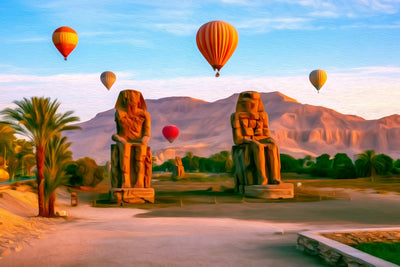
The colors of Cairo are the warm palette of a desert river city: the warm honey of the limestone pyramids at dawn before the heat haze builds, the deep ochre of the mudbrick buildings of Islamic Cairo, the brilliant turquoise of the Nile as seen from the Qasr el-Nil bridge at midday, and the extraordinary amber of the city at golden hour when the dust in the air catches the setting sun and the entire skyline turns the color of old brass.
We hope you love getting lost in Cairo through the art above — and that one of these canvases finds a home on your wall. Happy travels, from all of us at The Painted Passport.