Shop the Collection

To help you build your own global archive, we've prepared this collection of watercolor studies from our research into Bhutan Paro Valley. These artifacts are designed to bring the stillness of this corner of the world into your home.

Original Series Decorative Magnet

A personal study of Bhutan Paro Valley, captured in high-fidelity watercolor and prepared for your collection.

Bhutan Paro Valley | Tiger's Nest Cliff Monastery | Original Series Decorative Magnet
Add to Collection / $18
Exclusive Series Artifact

Original Series Gallery Canvas

This high-fidelity canvas is a beautiful way to anchor a room and keep your memories of Bhutan Paro Valley fresh long after you've returned home.

Bhutan Paro Valley | Tiger's Nest Cliff Monastery | Original Series Gallery Canvas detail Bhutan Paro Valley | Tiger's Nest Cliff Monastery | Original Series Gallery Canvas detail Bhutan Paro Valley | Tiger's Nest Cliff Monastery | Original Series Gallery Canvas detail
Add to Collection / $65

Original Series Hardboard Coaster

A personal study of Bhutan Paro Valley, captured in high-fidelity watercolor and prepared for your collection.

Bhutan Paro Valley | Tiger's Nest Cliff Monastery | Original Series Hardboard Coaster
Add to Collection / $18
Exclusive Series Artifact

The Spirit of the Land

Archival Note: A curated field study of Bhutan Paro Valley, prioritizing the specific atmospheric stillness of the region. These artifacts have been meticulously sourced from our global archival partners to represent the area's unique cultural frequency and environmental character. This selection serves as a formal observation for our ongoing global archive, vetted for its visual accuracy and archival merit.

Bhutan Paro Valley study No. 01
Bhutan Paro Valley / 01 VIA / Anil Sharma
Sunlight bathes the Paro Valley in brilliant clarity, illuminating the striking turquoise waters of the river as it winds past contemporary architecture and traditional Bhutanese structures with their distinctive green metal roofs. The valley floor reveals layers of human settlement—from the modern white hotel complex to scattered wooden pavilions—all framed by densely forested mountainsides that rise majestically on either side. The airstrip visible in the distance anchors this moment as a place where old and new worlds meet within Bhutan's carefully preserved landscape.
Bhutan Paro Valley study No. 02
Bhutan Paro Valley / 02 VIA / Harsh Suthar
The soft twilight bathes the scene in a serene, ethereal glow as the fortress monastery commands the landscape from its dramatic cliff-top perch. Standing here, one would feel the crisp mountain air and the meditative pull of the sacred site, enhanced by the gentle rush of the pristine turquoise river below. The interplay of warm architectural lighting and cool twilight sky creates a moment suspended between day and devotion.
Bhutan Paro Valley study No. 03
Bhutan Paro Valley / 03 VIA / Setu Chhaya
This photograph captures the architectural splendor of a traditional Bhutanese dzong, taken from within its central courtyard looking upward. The contrast between the pristine whitewashed walls and the intricate reddish-brown wooden details creates a striking visual harmony. What often goes unnoticed is the subtle texture of the stone walls, which reveals the craftsmanship and age of this cultural monument, grounding the ornate carved elements in centuries of mountain weathering.

Where to wander

Archival Note: A curated field study of Bhutan Paro Valley, prioritizing cultural relevance and archival merit. While we haven't touched down here yet, we've meticulously vetted these locations through our global network of contributors to ensure they represent the most authentic atmosphere for your own expedition.

Local Cuisine Spotlight
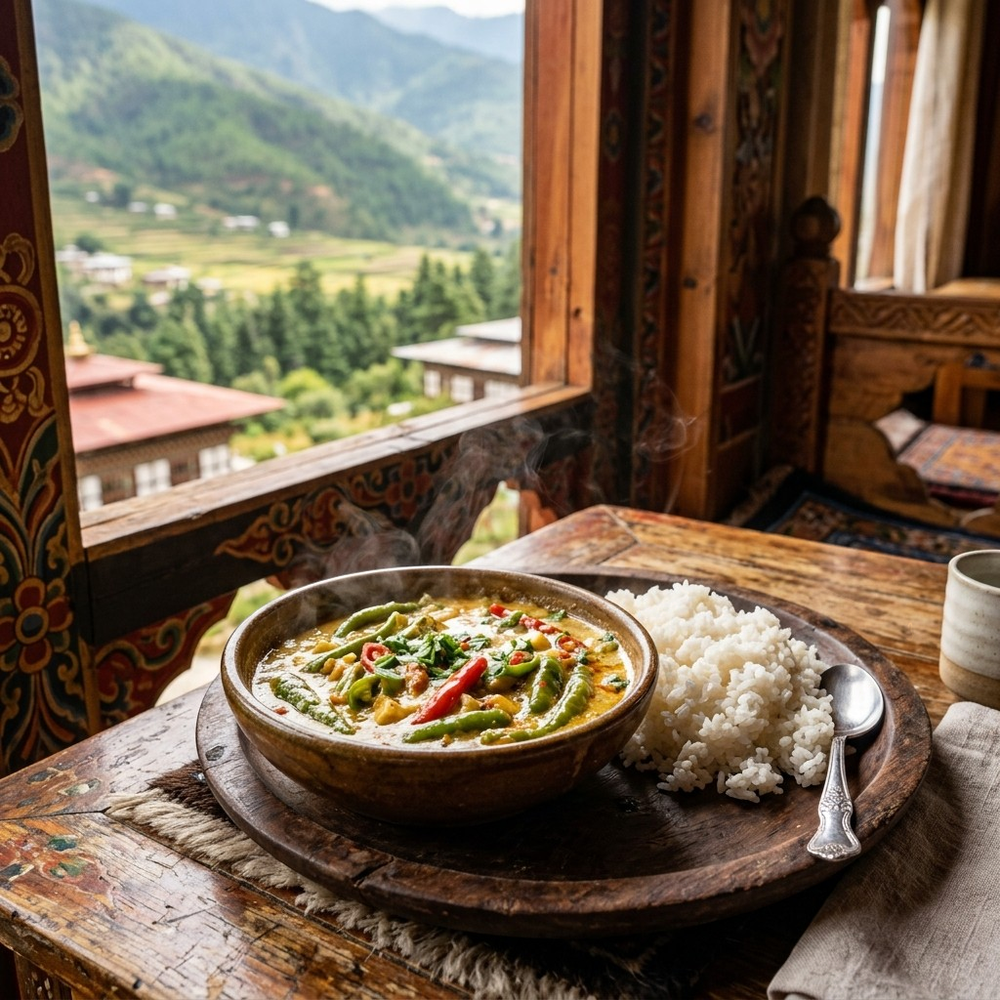
This creamy, fragrant curry features tender green peppers and bright red chilies swimming in a rich, coconut-kissed sauce that speaks to Bhutan's bold culinary traditions. Served alongside perfectly steamed white rice on weathered wood, each spoonful delivers warmth and complex spice, complemented beautifully by the peaceful mountain vistas visible through the window.
Credits: THE PAINTED PASSPORT
Local cuisine study in Bhutan Paro Valley

☕︎ Local Flavor

Soeriyan Restaurant

Rating: 5* | Price: $$ | Coordinates: 27.4301° N, 89.4121° E

Soeriyan is widely regarded as the best traditional Bhutanese dining experience in the Paro Valley by locals and travelers alike. The fiery ema datshi — chilies stewed in creamy yak cheese — here is perfectly balanced and utterly addictive. Low wooden tables, butter lamp centerpieces, and folk music on weekends make every meal a celebration.

View Entry Details

Paro Valley Kitchen

Rating: 4* | Price: $$ | Coordinates: 27.4289° N, 89.4133° E

A bright, welcoming spot where the menu bridges Bhutanese classics and light international dishes for travelers easing into local flavors. Their red rice bowl with mushroom curry and pickled vegetables is both nourishing and beautifully plated. The garden terrace overlooks the Paro Chhu river, making lunch here a genuinely peaceful affair.

View Entry Details

Bukhari Restaurant at Uma Paro

Rating: 5* | Price: $$$$ | Coordinates: 27.4322° N, 89.4098° E

The Bukhari at Uma Paro is a destination dining experience set inside a beautifully restored farmhouse with a central wood-burning stove. The menu showcases elevated Bhutanese cuisine using ingredients foraged from surrounding hills and valleys. Sipping single-malt Scotch beside the fire after dinner is a ritual worth planning your entire trip around.

View Entry Details

Tshering Café & Bakery

Rating: 4* | Price: $ | Coordinates: 27.4275° N, 89.4148° E

Beloved by trekkers and monastery-goers alike, this cheerful café serves strong butter tea, freshly baked buckwheat pancakes, and hearty soup from early morning. The owner, a retired monk, fills the walls with hand-drawn maps of local hikes and shares trail tips freely. It is the perfect place to fuel up before climbing toward Tiger's Nest.

View Entry Details

🛌︎ Boutique Stays

Amankora Paro

Rating: 5* | Price: $$$$ | Coordinates: 27.4316° N, 89.4137° E

Nestled among blue pine forests, Amankora Paro is the crown jewel of luxury lodges in the valley. Stone and timber suites feature private fireplaces and sweeping views of the sacred Paro Taktsang cliffs. Every morning begins with butter tea delivered to your door as monks chant in the distance.

View Entry Details

Zhiwaling Heritage Hotel

Rating: 4* | Price: $$$ | Coordinates: 27.4285° N, 89.4102° E

Zhiwaling blends traditional Bhutanese architecture with thoughtful modern comfort in a serene riverside setting. Hand-painted murals adorn every corridor, telling stories of Bhutan's royal history and Buddhist legends. The candlelit restaurant and rooftop terrace make evenings here genuinely magical.

View Entry Details

Naksel Boutique Hotel & Spa

Rating: 4* | Price: $$$ | Coordinates: 27.4350° N, 89.4180° E

Perched on a gentle hill overlooking terraced farmland, Naksel offers intimate boutique luxury with a deeply local soul. Traditional hot stone baths using river-heated rocks are the signature wellness ritual not to be missed. Warm staff greet you like family and the organic garden supplies the kitchen daily.

View Entry Details

Paro Guesthouse Tenzin

Rating: 3* | Price: $$ | Coordinates: 27.4268° N, 89.4155° E

This family-run guesthouse sits right in the heart of Paro town, offering cozy rooms decorated with woven textiles and brass butter lamps. Hosts Tenzin and his wife cook generous homemade breakfasts featuring local red rice, eggs, and fresh yak cheese. It is the most affordable and genuinely human way to experience valley life.

View Entry Details

📍︎ Field Study

Paro Taktsang (Tiger's Nest Monastery)

Rating: 5* | Price: $ | Coordinates: 27.4914° N, 89.3637° E

Clinging to a sheer 900-meter cliff face, Tiger's Nest is arguably the most breathtaking sacred site in all of Asia. The four-hour round-trip hike through pine and rhododendron forest builds to a reveal that will stop your breath entirely. Inside, flickering butter lamps illuminate ancient murals and the cave where Guru Rinpoche meditated for three years.

View Entry Details

Rinpung Dzong

Rating: 5* | Price: Free | Coordinates: 27.4326° N, 89.4162° E

This magnificent 17th-century fortress monastery watches over the valley from its rocky promontory above the Paro Chhu river with quiet authority. Inside its whitewashed courtyards, monks in crimson robes study and debate while elaborate thangka paintings cover every surface. Crossing the traditional wooden covered bridge to reach it is itself a meditative and memorable experience.

View Entry Details

National Museum of Bhutan

Rating: 4* | Price: $ | Coordinates: 27.4338° N, 89.4171° E

Housed in the ancient Ta Dzong watchtower above Rinpung Dzong, this museum is a lovingly curated window into Bhutan's layered artistic and spiritual heritage. Collections span ceremonial masks, ancient weaponry, royal costumes, and remarkably detailed thangka scrolls spanning five centuries. Guides here are passionate and knowledgeable, turning every exhibit into a living story.

View Entry Details

Kyichu Lhakhang Temple

Rating: 5* | Price: Free | Coordinates: 27.4198° N, 89.3985° E

One of Bhutan's oldest and most sacred temples, Kyichu Lhakhang was built in the 7th century by the Tibetan king Songtsen Gampo to pin down a demoness threatening the Himalayan realm. A centuries-old orange tree blooms perpetually in its inner courtyard, considered miraculous by pilgrims who travel far to see it. The atmosphere at dawn, with incense smoke rising and prayer wheels spinning, is profoundly moving.

View Entry Details

Typography

Archival Note: A formal technical study of Bhutan Paro Valley—archiving the coordinates, elevation, and environmental data that define the region. This data serves as a vital record for our ongoing global field study, allowing us to reconstruct the regional atmosphere with archival precision before our physical arrival.

Botanical and pigment specimen study for Bhutan Paro Valley Colors of Bhutan Paro Valley
Coordinates
27.4316° N, 89.4137° E — Paro Valley, western Bhutan, Himalayan foothills
Historical Epoch
Paro has been central to Bhutanese history since the seventh century, when Tibetan king Songtsen Gampo built Kyichu Lhakhang. The valley later became a key diplomatic and trade corridor linking Tibet to the Bhutanese heartland through its formidable dzong fortresses.
Elevation
2,200-2,500 m / 7,218-8,202 ft - Valley floor to lower ridgeline, with Tiger's Nest trail reaching approx 3,120 m
Atmosphere
Cwb - Oceanic Highland. Cool, temperate, and deeply seasonal with dry winters, lush monsoon summers, and the clearest skies of the year in October and November.
Observation Hour
07:00 - Golden hour arrives early in the valley, catching dzong walls and orchard blossoms in warm directional light before morning mist burns off the rice terraces around mid-morning.
Primary Pigment
Dzong Ochre (#C4943A) and Himalayan Mist Blue (#8BA7B8)
Best Time to Visit
March through May and October through November - Spring brings rhododendrons and the famous Paro Tshechu festival, while autumn offers crystal-clear skies and the best trekking conditions.
Avoid Visiting
July through August - Peak monsoon season brings heavy rainfall, leech-prone trails, frequent flight delays into Paro, and limited visibility of the mountain scenery.

The Local Tongue

Language is the invisible architecture of Bhutan Paro Valley. These entries document the regional vocabulary—capturing the "texture" of local speech that standard translations often miss. Hand-curated expressions reflecting the specific spirit and daily rhythm of the region.
Archival study of Dzongkha cultural texture

via / Pragyan Bezbaruah

Primary Language Dzongkha
Regional Dialect Parop dialect (local Paro Valley variant of Dzongkha)

Driglam Namzha (དྲིགས་ལམ་རྣམ་གཞག་)

Driglam Namzha translates loosely as the code of etiquette and discipline that governs Bhutanese conduct, dress, and civic life. Visitors feel its presence immediately when approaching Rinpung Dzong, where a traditional gho or kira must be worn as a mark of respect, and silence replaces casual chatter at the threshold.

Tshechu (ཚེས་བཅུ་)

Tshechu refers to a sacred festival held on the tenth day of a Bhutanese lunar month in honor of Guru Rinpoche, the saint who introduced Buddhism to the Himalayas. At Paro's annual Tshechu, monks perform cham dances in elaborate silk costumes and terrifying masks while the smell of butter lamps drifts across the dzong courtyard.

Lhakhang (ལྷ་ཁང་)

Lhakhang simply means a temple or sacred house, but in Bhutan the word carries centuries of devotional weight. At Kyichu Lhakhang, one of Bhutan's oldest temples said to date from the seventh century, the air inside is cool and dense with juniper incense, and the flickering of butter lamps casts trembling shadows across gilded statues worn smooth by generations of devoted hands.

Wait! before you go...

Before you head over to Bhutan Paro Valley, we’ve audited the essential data points for this corner of the world. These notes cover the logistics—from currency ratios to transit hubs—to help you navigate the landscape with clarity.
🚲 Getting Around The only international entry point is Paro International Airport, served by Druk Air and Bhutan Airlines with connections via Delhi, Kathmandu, and Bangkok. From the airport, taxis and tour vehicles reach the valley town in under fifteen minutes, and all internal travel requires a licensed Bhutanese tour operator.
⚖️ Cash or Card Cash remains essential in Paro, particularly for local restaurants, smaller guesthouses, market stalls, and temple entry fees. Cards are accepted at luxury properties like Amankora and Uma Paro, but a reliable supply of Bhutanese Ngultrum in small denominations makes daily life considerably easier.
☁️ Good to Know All visitors to Bhutan except Indian, Bangladeshi, and Maldivian nationals must book through a licensed tour operator and pay a Sustainable Development Fee, currently set at USD 100 per person per night. This fee covers accommodation, meals, and a guide, making independent wandering less relevant and guided discovery the genuine local rhythm.
🏧 ATMs There are a small number of ATMs in Paro town center, operated primarily by the Bank of Bhutan and Bhutan National Bank, and they accept Visa and MasterCard with reasonable reliability. It is wise to withdraw sufficient local currency early in the stay, as machines occasionally run low on notes during festival periods and long weekends.
💳 Currency The Bhutanese Ngultrum (BTN) is pegged at parity with the Indian Rupee, and Indian Rupees are widely accepted throughout Paro, though denominations above 100 INR are not. USD and other foreign currencies should be exchanged at the Bank of Bhutan or authorized hotels upon arrival.
🔌 Plugs Bhutan uses Type D, F, and G outlets at 230V 50Hz. A universal adapter is strongly recommended as socket types vary even within the same property.
🛡️ Safety Paro Valley is considered one of the safest destinations in Asia, with very low crime rates and a culture that treats guests with genuine warmth and hospitality. Altitude is the primary physical concern, and visitors arriving directly from sea level should allow a day of gentle acclimatization before attempting the Tiger's Nest trail.
✈️ Airports Paro International Airport (PBH) is the sole international airport in Bhutan and one of the most technically demanding approaches in commercial aviation, surrounded on all sides by steep Himalayan peaks. Flights operate only in daylight under visual flight rules, so weather delays are common and a buffer day on either end of an itinerary is a sensible practice.

Behind The Scenes

Nathan

Note from the Founder

Hey, did you know this fun fact about Bhutan Paro Valley? Bhutan was the last country in the world to introduce television, doing so only in 1999. The country also measures national success through Gross National Happiness, a development philosophy enshrined in its constitution since 2008.
Thank you for exploring the Bhutan Paro Valley series with us. We hope these notes have inspired you to add this incredible destination to your own passport—we are so glad you're here. — Nathan

Some of our Favorites