Shop the Collection

To help you bring a piece of your journey home, we've put together this collection of watercolor studies from our time in Amalfi Coast, Italy. These are our favorite ways to keep the spirit of the trip alive.

Original Series Decorative Magnet

A personal study of Amalfi Coast, Italy, captured in high-fidelity watercolor and prepared for your collection.

Amalfi Coast, Italy | Positano Hillside Village | Original Series Decorative Magnet
Add to Collection / $18
Exclusive Series Artifact

Original Series Gallery Canvas

This high-fidelity canvas is a beautiful way to anchor a room and keep your memories of Amalfi Coast, Italy fresh long after you've returned home.

Amalfi Coast, Italy | Positano Hillside Village | Original Series Gallery Canvas detail Amalfi Coast, Italy | Positano Hillside Village | Original Series Gallery Canvas detail Amalfi Coast, Italy | Positano Hillside Village | Original Series Gallery Canvas detail Amalfi Coast, Italy | Positano Hillside Village | Original Series Gallery Canvas detail
Add to Collection / $65

Original Series Hardboard Coaster

A personal study of Amalfi Coast, Italy, captured in high-fidelity watercolor and prepared for your collection.

Amalfi Coast, Italy | Positano Hillside Village | Original Series Hardboard Coaster
Add to Collection / $18
Exclusive Series Artifact

The Spirit of the Land

Archival Note: Documented personally during our time in Amalfi Coast, Italy. While we leverage a global network of contributors to provide these high-fidelity visual artifacts, each selection is curated to reflect the specific, quiet frequencies we experienced on the ground. These textures serve as a formal study of the unhurried light and environmental character that defined our journey.

Amalfi Coast, Italy study No. 01
Amalfi Coast, Italy / 01 VIA / Matteo Parisi
The late morning light falls soft and golden across the terraced hillsides, catching the terracotta rooftops of Amalfi town and turning the Tyrrhenian Sea a deep, almost impossible shade of cobalt blue. A speedboat cuts a wide white arc across the water below, its wake the most human thing in an otherwise ancient landscape of stone villages and lemon groves carved into the cliffs over centuries. There is something quietly overwhelming about seeing it all from above — the way the mountains press the town down toward the sea, and the sea simply holds it.
Amalfi Coast, Italy study No. 02
Amalfi Coast, Italy / 02 VIA / Gotta Be Worth It
The warm Mediterranean light cascades across the terraced hillside, illuminating the pastel facades in shades of cream, coral, and amber, as if the village itself were slowly blushing in the afternoon sun. Standing here, one would feel the peculiar sensation of time suspended — the vibrant magenta bougainvillea in the foreground pulling the eye downward while the stacked architecture draws it inexorably upward toward the rugged cliffs above. There is a gentle tension between the wild lushness of the vegetation and the centuries of human determination etched into every retaining wall and sun-bleached rooftop, leaving the observer with a quiet, almost reverential sense of wonder.
Amalfi Coast, Italy study No. 03
Amalfi Coast, Italy / 03 VIA / Magda Ehlers
The sun-drenched town of Amalfi cascades dramatically down the steep limestone cliffs toward the Tyrrhenian Sea, its terracotta rooftops and cream-colored facades creating a warm mosaic against the rugged gray rock face. What most visitors overlook is the solitary Italian stone pine standing sentinel in the foreground, its umbrella-shaped canopy a deliberate architectural echo of the domed cathedral below. The harbor's twin breakwaters stretch into the calm jade-green water like protective arms, their rough-hewn boulders slowly being reclaimed by the rhythmic patience of the sea.

Where to wander

Archival Note: These recommendations were curated personally during our time in Amalfi Coast, Italy to capture the textures that defined the quiet frequencies of the trip. Every entry here is a place we genuinely love; we hope these notes inspire you to wander off the main path and discover the same stillness we found on the ground.

Local Cuisine Spotlight
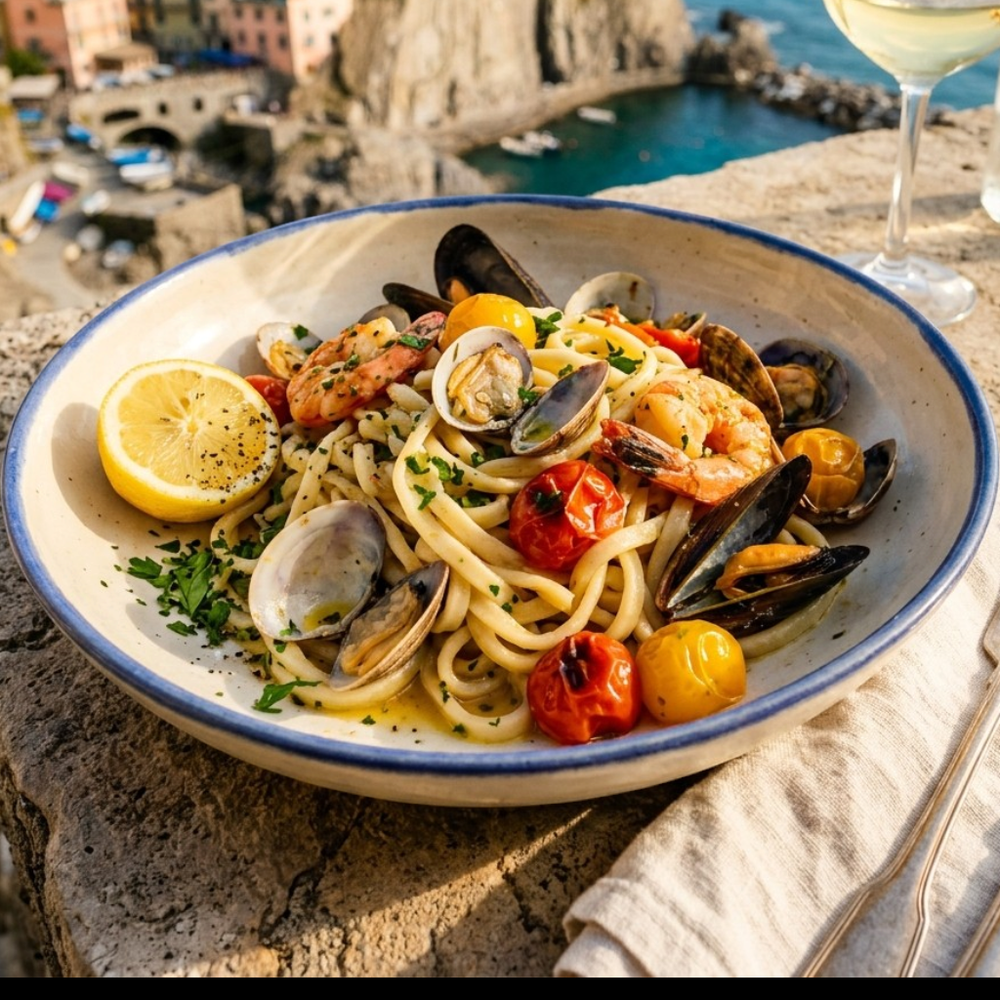
A sunlit bowl of spaghetti allo scoglio captures the soul of the Amalfi Coast — briny clams and mussels, plump shrimp, and blistered cherry tomatoes tangled in silky pasta. Finished with fresh parsley, cracked pepper, and a squeeze of lemon, every bite tastes of the sea breeze below.
Credits: THE PAINTED PASSPORT
Local cuisine study in Amalfi Coast, Italy

☕︎ Local Flavor

Ristorante Zaccaria

Rating: 5* | Price: $$$ | Coordinates: 40.6341° N, 14.6024° E

Tucked into Amalfi's old town, this beloved family-run trattoria has been feeding locals and fortunate visitors for generations with deeply honest Campanian cooking. Order the spaghetti alle vongole, made with clams pulled from the bay that very morning, and pair it with a crisp local Falanghina. The sun-dappled courtyard seating and grandmotherly warmth of the service make every meal feel like a cherished family occasion.

View Entry Details

Il Ritrovo

Rating: 5* | Price: $$ | Coordinates: 40.6271° N, 14.5734° E

High above Positano in the hillside village of Montepertuso, this rustic mountain gem is worth every hairpin bend of the winding journey up. Chef Salvatore Russo champions hyper-local mountain ingredients, serving earthy pastas, wood-fired meats, and handmade mozzarella that tastes impossibly fresh. The terrace rewards you with quiet valley views far removed from the coastal crowds, and the house limoncello flows generously at meal's end.

View Entry Details

Da Adolfo

Rating: 4* | Price: $$ | Coordinates: 40.6251° N, 14.5812° E

Accessible only by the restaurant's own little red boat from Positano's pier, this beach trattoria has a wonderfully earned cult following among those in the know. Tables are set beneath a trellis of vines on a tiny private cove, and the grilled pesce spada with mozzarella melted over lemon leaves is legendary for good reason. The whole experience, boat ride included, feels like discovering a delicious secret that the rest of the world somehow hasn't found yet.

View Entry Details

Salvatore Ristorante

Rating: 5* | Price: $$$ | Coordinates: 40.6492° N, 14.6131° E

Perched at the entrance to Ravello with a terrace that floats seemingly above the entire coastline, Salvatore has been a benchmark for refined southern Italian cuisine since 1950. Signature dishes like ravioli stuffed with local buffalo ricotta and drizzled with lemon butter demonstrate a kitchen that understands restraint and quality above all else. Watching the sun slide into the sea from your table here while sipping Aglianico is a memory you will actively work to recreate for years afterward.

View Entry Details

🛌︎ Boutique Stays

Hotel Santa Caterina

Rating: 5* | Price: $$$$ | Coordinates: 40.6347° N, 14.6027° E

Perched dramatically on the cliffside just outside Amalfi town, this legendary hotel has welcomed guests since 1880 with timeless elegance. Private elevator lifts descend to saltwater pools and sun terraces carved into the rock face above a sparkling sea. Expect impeccable service, lush citrus gardens, and rooms dressed in hand-painted Vietri ceramics.

View Entry Details

Le Sirenuse

Rating: 5* | Price: $$$$ | Coordinates: 40.6273° N, 14.5847° E

This iconic pink palazzo in Positano has defined romantic Italian luxury since 1951, offering sweeping panoramic views of the pastel-stacked village and shimmering bay below. Each of the 58 rooms is uniquely furnished with antiques, locally crafted tiles, and crisp linens that glow warm in the coastal light. The rooftop pool and acclaimed La Sponda restaurant make leaving feel genuinely impossible.

View Entry Details

Monastero Santa Rosa

Rating: 5* | Price: $$$$ | Coordinates: 40.6108° N, 14.6189° E

A 17th-century Dominican monastery in Conca dei Marini has been breathtakingly transformed into one of the coast's most serene luxury retreats. Terraced infinity pools cascade down toward the sea through manicured gardens bursting with bougainvillea and ancient olive trees. With only 20 rooms, the intimacy is extraordinary and the spa, set within original vaulted chambers, feels genuinely otherworldly.

View Entry Details

Hotel Villa Cimbrone

Rating: 5* | Price: $$$ | Coordinates: 40.6489° N, 14.6127° E

Tucked within the medieval gardens of Ravello high above the coast, this romantic villa offers a sense of peaceful seclusion that is extraordinarily rare on the Amalfi Coast. Greta Garbo once hid here, and the atmosphere of cultured quiet and jasmine-scented terraces still feels deliciously secret. Wake to fog rolling off the mountains, then stroll to the famous Terrace of Infinity for views that stretch endlessly over the Tyrrhenian Sea.

View Entry Details

📍︎ Field Study

Villa Rufolo Gardens

Rating: 5* | Price: $ | Coordinates: 40.6494° N, 14.6125° E

Richard Wagner was so moved by these extraordinary terraced gardens in Ravello in 1880 that he declared them the inspiration for Klingsor's magic garden in Parsifal. Moorish-influenced towers and crumbling medieval architecture frame riot-coloured flowerbeds that tumble toward an impossibly blue horizon. Visit in summer when the gardens host the famous Ravello Festival concerts, with music literally performed above the clouds and the sea.

View Entry Details

Grotta dello Smeraldo

Rating: 4* | Price: $ | Coordinates: 40.6172° N, 14.6289° E

Hidden at sea level near Conca dei Marini, this luminous sea cave earned its name from the ethereal emerald glow created when sunlight filters through an underwater opening and illuminates the grotto from below. Small boats row visitors slowly through the cathedral-like interior, past stalactites and the submerged ceramic nativity scene visible through the transparent green water. Morning visits offer the most dramatic and magical quality of light, making the colours appear almost impossibly vivid.

View Entry Details

Path of the Gods

Rating: 5* | Price: Free | Coordinates: 40.6317° N, 14.5623° E

The Sentiero degli Dei is arguably the most spectacular coastal hiking trail in all of Europe, threading along ancient mule paths between Bomerano and Nocelle high above the glittering Tyrrhenian Sea. The roughly six-kilometre route passes through wild thyme and fennel, limestone outcroppings, and abandoned terraces, with Positano appearing like a scattered mosaic of colour far below. Start early to catch morning mist filling the valleys and to earn that post-hike limoncello in Nocelle with a deeply satisfying sense of achievement.

View Entry Details

Duomo di Amalfi

Rating: 5* | Price: $ | Coordinates: 40.6344° N, 14.6022° E

The Cathedral of Saint Andrew dominates Amalfi's main piazza with its gloriously striped Arab-Norman façade and 62 wide steps that seem to rise theatrically from the bustling town below. Built in the 9th century and expanded over subsequent centuries, the interior blends Byzantine mosaics, bronze doors cast in Constantinople, and the crypt of Saint Andrew himself in a richly layered historical narrative. Climb in the golden late-afternoon light when the intricate geometric tilework on the campanile catches fire and the piazza below hums with the warm life of the town.

View Entry Details

Typography

Archival Note: We have personally documented these geographic specs for Amalfi Coast, Italy to ensure every watercolor study is anchored in real-world data. By cataloging the precise elevation, light cycles, and historical epochs, we provide a technical foundation that justifies the atmospheric stillness captured in our visual artifacts.

Botanical and pigment specimen study for Amalfi Coast, Italy Colors of Amalfi Coast, Italy
Coordinates
40.6333° N, 14.6029° E — Central Amalfi Coast, anchored at the town of Amalfi on the Gulf of Salerno, Campania, southern Italy
Historical Epoch
The Republic of Amalfi was among the first maritime republics of medieval Italy, a seafaring power from the 9th to 11th centuries that traded across the Mediterranean and left behind architecture, legal codes, and a cultural confidence still faintly visible in the towns today.
Elevation
0-1,443 m / 0-4,734 ft - Sea level at the waterfront villages rising steeply to the ridgeline of the Lattari Mountains directly behind the coast
Atmosphere
Csa - Hot-summer Mediterranean. Long, dry, intensely sunny summers with mild and occasionally rainy winters. The sea stays warm well into October, extending the usable season generously.
Observation Hour
17:30 - The late afternoon sun hits the cliffside villages at a low westerly angle, saturating terracottas and turning the sea from aquamarine to deep gold at the waterline. Shadows lengthen and the whole coast seems to exhale.
Primary Pigment
Tyrrhenian Cobalt (#1A5276) and Limoncello Gold (#F4C430)
Best Time to Visit
May through June - warm, uncrowded, flowers in bloom, and the sea already swimmable before the summer crowds and heat peak in July and August.
Avoid Visiting
August - peak crowds, highest prices, intense heat, and traffic on the coastal road at its most challenging. The coast remains beautiful but the experience is significantly more pressured.

The Local Tongue

Language is the invisible architecture of Amalfi Coast, Italy. These entries document the regional vocabulary—capturing the "texture" of local speech that standard translations often miss. Hand-curated expressions reflecting the specific spirit and daily rhythm of the region.
Archival study of Italian cultural texture

via / Isaac Garcia

Primary Language Italian
Regional Dialect Neapolitan Italian (napoletano)

Abbiocco

Abbiocco refers to the drowsy, heavy-lidded feeling that follows a long meal, particularly at midday. On the Amalfi Coast, it arrives almost on schedule after a lunch of pasta al pomodoro and a carafe of local white wine eaten in the shade of a lemon pergola, when the heat presses down and the sea shimmers below.

Magari

Magari is a wonderfully layered word that can mean hopefully, maybe, or if only, depending on the tone and the moment. Along the coast it surfaces in conversations about the weather, the ferry schedule, or the possibility of a table at a favorite trattoria, carrying with it a distinctly Italian shrug toward fate that somehow feels more optimistic than resigned.

Frescura

Frescura describes the particular coolness felt when stepping from bright sunlight into shadow, a sensation so specific and pleasurable that it earns its own word. On the Amalfi Coast it is found in the thick-walled interior of the Duomo di Amalfi or beneath the arched passageways of Ravello, where the temperature drops noticeably and the skin registers the relief before the mind does.

Wait! before you go...

Before you head over to Amalfi Coast, Italy, we wanted to share a few basic tips we picked up along the way. These notes cover the simple things—like how to get around or what to do about cash—so you can spend less time worrying and more time just enjoying the place.
🚲 Getting Around The SITA Sud bus service connects the coastal towns along the SS163 and is the most practical local option, though the roads are famously narrow and journeys can be slow. The ferry network linking Amalfi, Positano, Ravello, and Salerno is a far more scenic and often faster alternative.
⚖️ Cash or Card Card payments are widely accepted at hotels, larger restaurants, and shops, but cash remains important for smaller trattorias, market stalls, beach clubs, and ferry tickets purchased dockside. Carrying a reasonable amount of euros on hand avoids friction at the many family-run spots that still prefer it.
☁️ Good to Know Lunch is the main meal of the day here and closing times between roughly 13:00 and 16:00 are taken seriously, even during high season. Attempting to shop, visit churches, or arrange anything practical in that window will often result in a politely closed door and a better plan for next time.
🏧 ATMs ATMs are available in Amalfi town, Positano, and Sorrento, though they can have queues during busy summer days and occasionally run low on cash in peak season. Using a bank card with no foreign transaction fees and withdrawing a useful amount in one visit is the most efficient approach.
💳 Currency Italy uses the Euro (EUR), which is universally accepted across the coast and available at banks and ATMs in all the main towns. Larger denomination notes can occasionally cause friction at small vendors, so keeping a supply of smaller bills makes daily transactions considerably smoother.
🔌 Plugs Italy uses Type F and Type L outlets at 230V and 50Hz. A universal travel adapter is recommended, particularly for North American and British devices.
🛡️ Safety The Amalfi Coast is a very safe destination for travelers, with petty theft being the primary concern, particularly in crowded ferry terminals and busy piazzas during peak summer months. Road travel deserves genuine caution: the coastal road is narrow, winding, and shared by buses, scooters, and pedestrians, so attentiveness is non-negotiable.
✈️ Airports Naples International Airport (NAP), also known as Capodichino, is the primary gateway, sitting approximately 60-75 kilometres from the coast and reachable by taxi, private transfer, or the Curreri bus service directly to Sorrento. Rome Fiumicino (FCO) is a secondary option for those combining the coast with a Roman stay, with high-speed trains connecting to Naples in about 70 minutes.

Behind The Scenes

Nathan

Note from the Founder

Hey, did you know this fun fact about Amalfi Coast, Italy? The Amalfi Coast was designated a UNESCO World Heritage Site in 1997 for its outstanding cultural landscape. The sfusato amalfitano lemon, grown on terraced hillsides above the sea, is protected by an IGP designation and is the source of the region's celebrated limoncello.
Thank you for exploring the Amalfi Coast, Italy series with us. We hope these notes have inspired you to add this incredible destination to your own passport—we are so glad you're here. — Nathan

Some of our Favorites